



ABSTRACT:
OBJECTIVE: Psychomotor abnormalities are relevant symptoms in the clinical presentation of schizophrenia,
and assessing them could facilitate monitoring. New technologies can measure psychomotor
activity objectively and continuously, but evidence on the topic is scarce. Our aim
is to systematically review the existing evidence about eHealth tools for assessing
psychomotor activity in patients diagnosed with schizophrenia.
METHOD: We performed a systematic search of the PubMed and Embase databases and identified
15 relevant articles on eHealth tools for assessing psychomotor activity in schizophrenia.
RESULTS: eHealth devices accurately assessed psychomotor activity and were well accepted. Abnormalities
in psychomotor activity helped differentiate between different subtypes of schizophrenia.
Abnormal increases in psychomotor activity were correlated with acute presentations,
while lower activity was associated with relapses, deterioration, and negative symptoms.
CONCLUSION: Actigraphy is still the preferred eHealth device in research settings, but mobile
applications have great potential. Further studies are needed to explore the possibilities
of psychomotor monitoring and mobile health applications for preventing relapses in
schizophrenia. eHealth could be useful for monitoring psychomotor activity, which
might help prevent relapses.
Keywords: Actigraphy; eHealth; mobile applications; psychomotor activity; schizophrenia.
FIGURES
| Received: January 22 2020; Accepted: February 12 2020 |
INTRODUCTION
Schizophrenia affects more than 21 million people around the world and is associated with high rates of disability and reduced life expectancy.1 Aberrant motor function is a common feature of schizophrenia. Psychomotor abnormalities (e.g., catatonia, extrapyramidal symptoms, lower psychomotor activity, and motoric neurological soft signs) are associated with poor prognosis and can be an early indicator of decompensation.2,3 Thus, they could be exploited for secondary prevention, which is one of the most sought-after goals in schizophrenia management, since relapses have a great impact on disease progression.4
Motor symptoms can also be a side effect of antipsychotic medications. Although the introduction of second-generation antipsychotics has reduced the risks, they are still prevalent: drug-induced extrapyramidal symptoms reach 15% for dystonia, 16% for akathisia, and 29% for parkinsonism.5 Psychomotor activity can alert us to potentially serious side effects of antipsychotic medication. Patients may fail to identify the exact nature of their discomfort, which could delay diagnosis of extrapyramidal side effects. Switching to a different antipsychotic or minimizing the side effects with co-adjuvant strategies could prevent treatment discontinuation, a major issue in schizophrenia patients.6 Reduced psychomotor activity could also indicate a deterioration in other aspects of physical health, such as an increased risk of metabolic syndrome.7
Nursing professionals play a major role in monitoring the mental and physical status of patients, assessing the side effects of medication and encouraging good treatment adherence. Reliable tools for measuring psychomotor activity can be very helpful for these purposes, especially if they allow continuous symptom monitoring. However, the availability of tools to objectively assess psychomotor-related variables is very limited. Assessment usually involves psychometric scales and clinical observations, whose subjectivity is susceptible to bias.
Psychomotor assessment in schizophrenia can be facilitated through the use of new technologies. Applying digital devices to healthcare settings, which is called electronic health or eHealth, is opening new prospects in the management and prevention of mental disorders.8,9 The potential of eHealth has increased thanks to continuous improvements in sensor precision and the widespread availability of eHealth tools, such as smartphones, wearable devices, and virtual reality platforms.10
eHealth interventions show excellent rates of acceptability and usability. For instance, it is estimated that over 60% of patients who have suffered from a psychotic episode support the use of mobile applications for monitoring their condition, and the daily usage rate for those who have them is over 85%. The sensors of wearable technologies, smartphones and other devices can provide information on user mobility (location, frequency of movement and distance travelled) and psychomotor activity (movement and acceleration). By integrating this information with data from other sources, increasingly complex variables can be inferred. Moreover, through machine learning, mobile applications can infer the association between certain behavior patterns and clinical decompensation.11
In the past few years, there has been an increasing interest in these technologies in mental health settings, but the continuous development of new technologies is advancing much faster than empirical research on them.12 It is crucial to review the evidence about such tools to provide the best evidence-based knowledge for good use of this technology. This is the first review on this topic. Our aim is to systematically review the existing evidence about eHealth tools for assessing psychomotor activity in schizophrenia.
METHODS
This review complied with the applicable Preferred Reporting Items for Systematic reviews and Meta-Analyses (PRISMA) guidelines.13
Inclusion/exclusion criteria
The inclusion criteria were: 1) articles published in peer-reviewed journals; 2) articles that included adults diagnosed with schizophrenia in their sample; 3) articles that explored any kind of eHealth tool (mobile apps, wearable devices, computer software, virtual reality devices, actigraphs, video games) to evaluate psychomotor variables. Proofs of concept, protocols for original studies, n=1 case studies, and articles that did not provide measurable outcomes were excluded.
Search strategy
We conducted a systematic literature search in the PubMed and Embase databases whose final search date was January 21st, 2020. There were no restrictions regarding publication date, although only publications in English or Spanish were selected for review. For the search strategy, we used combinations of three groups of terms: one group to refer to eHealth, another for psychomotor variables, and a third focusing on schizophrenia diagnosis.
The following search terms were used (in any field): ((ehealth OR mhealth OR technology OR actigraph OR phone OR app OR virtual reality OR video game OR videogame OR wearables OR computer) AND (psychomotor OR movement OR motor OR mobility OR physical activity) AND (schizophrenia OR psychosis OR psychotic OR schizophrenic)). The references of included studies were also screened.
Study selection process
The publications were assessed independently by two researchers (APS and RM). Articles were selected according to their relevance and quality. We used critical appraisal checklists to assess study quality.14 Conflicts were resolved through a third author (EBG), who made the final decision. Agreement between reviewers, measured by intraclass correlation coefficient (ICC), was 0.80 (95% confidence interval [95%CI] 0.69-0.88).
Data extraction
Data were collected by two independent authors (APS and RM) using previously developed forms. Data on the following variables were collected: author, study design, year of study publication, device, psychometric tools, and main findings.
RESULTS
Results of the bibliographical search
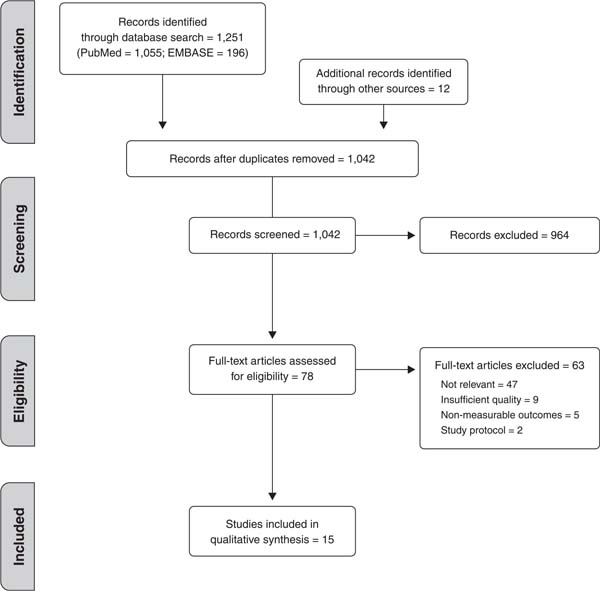
The initial search revealed 1,251 results. After content analysis, 15 articles were included in the review. Figure 1 shows the flow chart of the systematic search.
Study characteristics
The sample sizes ranged between 1115 and 148 participants.16 The main findings of the reviewed studies are shown in Table 1.15-29 Eleven of the studies included only psychotic patients in the case group, while four used mixed psychiatric samples with different diagnoses - including schizophrenia. Most studies recruited stable patients with no recent psychopathological decompensations, while a few included patients who were at high risk or who had been admitted to acute inpatient psychiatric units.23
| Study | Sample size | Study design | Device | Psychometric tools | Main findings |
|---|---|---|---|---|---|
| Berle, 201017 | 46 cases & 23 controls | Cohort | Wearable device (Actiwatch) | MADRS, BPRS | Reduced motor activity in cases compared to controls. Less complex motor activity was found in cases than controls. |
| Barnett, 201818 | 17 | Cohort | Smartphone app (Beiwe App) | 71% increase in mobility changes at relapse. | |
| Bracht, 201219 | 106 | Validation | Wearable device (Actiwatch) | BPS, GSM | Actigraphy-assessed motor activity was highly correlated with GSM scores and quantitative BPS scores, but not with qualitative BPS scores. |
| Bueno, 201820 | 82 | Validation | Wearable device (SenseWear Pro3) | 6-MWT, HRQoL | Digitally-measured BMI, CRF and vitality were associated with physical component scores of HRQoL. |
| Cella, 201721 | 30 cases & 25 controls | Cross-sectional | mHealth device | PANSS | Cases showed lower levels of HR variability, movement and functioning. Illness severity and positive symptoms were associated with parasympathetic dysregulation. |
| Chapman, 201722 | 99 | Cross-sectional | ActiGraph GT3X | MINI | There were significant differences in activity patterns between BD and schizophrenia cases. |
| Dean, 201823 | 54 cases & 62 controls | Case-control | Video analysis software | SIPS, SCID | Cases showed greater total body movement and speed than controls, but lower variation in body movement. |
| Dutschke, 201824 | 31 cases & 32 controls | Case-control | Videoanalysis software (MEA) | MINI, TULIA | Cases and controls differed significantly in quantitative gesture performance: cases required more movement and more time to complete the tasks. |
| Kluge, 201825 | 18 | Cross-sectional | Tri-axial-accelometer + Pro-Diary | PANSS | Motor activity was negatively correlated with apathy. EMA measures of daily activity were not associated with apathy. |
| Mentzel, 201615 | 6 cases & 5 controls | Case-control | Wearable device (accelerometer, gyroscope and magnetometer) | Seven tasks significantly discriminated cases from controls. The best combination for instrumental assessment of bradykinesia was gait + pronation/supination + leg agility and flexion + elbow extension. | |
| Naslund, 201626 | 34 | Intervention | Wearable device (Fitbit Zip) | 6-MWT | Higher daily average of steps was associated with a greater weight loss, but not better physical condition. |
| Osipov, 201527 | 16 cases & 19 controls | Validation | Waist-worn wearable | Cross-validation accuracy was 95.3% for differentiating between cases and controls through motor activity and heart rate. | |
| Walther, 201516 | 148 | Cross-sectional | Wearable device (Actiwatch) | First psychotic episodes were associated with higher actigraphic activity. Decreased motor activity was associated with n° of relapses. | |
| Walther, 200928 | 55 | Validation | Wearable device (Actiwatch) | PANSS | Negative symptoms were associated with low activity levels. PANSS scale psychomotor items imprecisely reflected actigraphy-measured motor activity. |
| Wichniak, 201129 | 73 cases & 36 controls | Case-control | Wearable device (Actiwatch) | AIS, ESS, PANSS, CDSS | Cases had lower 24-h and 10-h daytime activity, and longer time in bed than controls. Lower activity was associated with higher PANSS scores and negative symptoms. |
6-MWT = 6-Minute Walk Test; AIS = Athens Insomnia Scale; BD = bipolar disorder; BMI = body mass index; BPRS = Brief Psychiatric Rating Scale; BPS = Bern Psychopathology Scale; CDSS = Calgary Depression Scale for Schizophrenia; CRF = cardiorespiratory fitness ESS = Epworth Sleepiness Scale; EMA = Ecological Momentary Assessment; ESS = Epworth Sleepiness Scale; GSM = global severity of the motor behavior domain; HR = heart rate; HRQoL = Health-Related Quality of Life; MADRS = Montgomery-Åsberg Depression Rating Scale; MEA = Motion Energy Analysis Program; MINI = Mini International Neuropsychiatric Interview; PANSS = Positive and Negative Syndrome Scale; SCID = Structured Clinical Interview for Axis-I DSM-IV Disorders; SIPS = Structured Interview for Prodromal Syndromes; TULIA = Test of Upper Limb Apraxia.
Wearable devices
In 11 of the reviewed articles, movement was assessed through actigraphy. In most of them, the actigraph was integrated into a wearable device, typically worn on the wrist.
The Actiwatch®, a wrist-worn actigraphy-equipped device developed by Cambridge Neurotechnology, was the most common device used in these studies. Walther et al. measured psychomotor activity over 24 hours in 55 patients using the Actiwatch, and then compared the results with the patients' Positive and Negative Syndrome Scale (PANSS) scores, finding that high scores in PANSS-assessed negative symptoms correlated with low levels of actigraphy-measured motor activity. In contrast, specific motor-related items of the PANSS scale were not significantly associated with their corresponding actigraphic parameters.16 Also using the Actiwatch, Welther et al. found that differences in physical activity accurately discriminated between first psychotic episode and subsequent outbreaks in those diagnosed with schizophrenia, with lower activity indicating greater deterioration.
A different wearable device, the SenseWear Pro3 Armband was used to assess sedentary behavior in patients diagnosed with schizophrenia, and good correlation was found between this assessment tool and traditional tests, such as the 6-minute walk test, regarding the physical component of the Health-Related Quality of Life.20
Other eHealth tools
Three of the reviewed studies used mobile apps, either alone or in combination with actigraphy. Barnett et al. followed 17 adults diagnosed with schizophrenia for 3 months, using passively collected smartphone data on mobility and social activity to predict relapses. They found that behavioral abnormalities were 71% higher at the moment of relapse than during periods of stability.18 Kluge et al. used a combination of Ecological Momentary Assessment (EMA) and actigraphy to measure motor activity and explore its association with apathy. They found that objectively measured motor activity was a better correlate of apathy than daily activities subjectively assessed through EMA. They also found that alterations detected by actigraphy had different neurobiological correlates than those detected by EMA.25
Two studies used video recording and analysis software to objectively assess psychomotor activity. Dean et al. chose this approach to characterize young adults at high risk of psychosis, finding that motor activity accurately differentiated them from age-matched healthy controls.23 Dutschke et al. also used video recording with automatized analysis, finding differences in gesture performance between cases and controls.24
Feasibility
Actigraphy and inertial movement sensors yielded generally good results in terms of user acceptance and engagement, with few drop-outs over the follow-up periods. In some studies, patients received some kind of monetary compensation for participating.25 The most commonly reported causes for dropout were: failure to engage with the device/application for several days in a row,20,25,26 losing the portable device,26 and technical issues with the device/application.20
DISCUSSION
Summary of findings
We found few articles exploring new technologies for assessing psychomotor activity in schizophrenia. This is a neglected field of study that should receive further attention in future research.
Psychomotor abnormalities in schizophrenia
Psychomotor variables are highly correlated with relevant aspects of schizophrenia. Since psychomotor symptoms can help predict a first psychiatric episode and are predictors of high risk for psychosis, they might also be used as markers to predict changes in the clinical course of the disease. Early detection and treatment of the first psychotic episode and subsequent relapses greatly improves prognosis.
In our review, an abnormal increase in psychomotor activity was correlated with acute presentations, while lower activity was associated with deterioration. Abnormalities in psychomotor activity also helped differentiate between different subtypes of schizophrenia patients. These findings could be related to the different physiopathological mechanisms underlying schizophrenia and may shed some light on the neurobiological correlates of the disorder.
The differences in motor activity between depression and schizophrenia patients found in one of the studies suggest that these motor symptoms are more than a non-specific consequence of severe mental illness. In research settings, these symptoms may yield more clinically-relevant data than other transdiagnostic symptoms, such as sleep. Improved measures and the availability of more tools for objective mobility assessment, as well as the possibility of continuous monitoring, make psychomotor activity a valuable source of information that is underused in research.
Barriers to using eHealth
Despite good acceptability rates, there are still several barriers to using eHealth among psychiatric patients. One is that eHealth has not been integrated into public health systems, which can raise suspicions about its reliability and effectiveness and limit access to interventions.30 Although a few health systems, such as the UK's National Health System, are beginning to integrate eHealth as a therapeutic tool in health care coverage, this is the exception rather than the rule.31 Privacy concerns have also been associated with patient reluctance to use eHealth.32 In agreement with previous reviews, we found that eHealth interventions are generally well accepted by individuals diagnosed with schizophrenia.33 Most apps have had good rates of engagement, with few dropouts during follow-up. However, one potential bias is that the samples predominantly consisted of stable patients, since they are more likely to participate. Another potential bias involves the use of incentives, i.e. monetary or other rewards for participating in studies and engaging with the devices. Since patients will not be rewarded for using the device in real world settings, the application of these findings in clinical practice could be limited.
Implications for clinical practice
eHealth tools could be especially apt for detecting relapses through continuous monitoring of psychomotor-related symptoms. Mobile phone ownership among people with psychosis is estimated to be between 66 and 81% and is rapidly increasing.34,35 The increasing reliability of the devices' sensors further expands their potential. Movement could be a feasible and reliable digital biomarker of decompensation and could be used in relapse prevention. This also represents a step towards precision medicine.8 However, most of the reviewed studies recommended actigraphy for objective measurement of movement. More studies with larger sample sizes are required to confirm this hypothesis.
The role of nursing staff in the implementation of eHealth tools
Nursing professionals can be crucial in overcoming these barriers and facilitating eHealth use in psychiatric patients.36 Since psychiatric patients tend to create strong bonds with nursing professionals, whom they usually perceive as less threatening, they may trust their recommendations.36 Another way to spread eHealth in psychiatric settings is by encouraging patients and their families to participate in designing and implementing usage strategies.37
Limitations
Our findings must be considered in light of some limitations. Firstly, due to the composition of our research team, the search had to be language-restricted to Spanish or English. Secondly, the variety of terms for new technologies, which are becoming more numerous and varied, may have led us to overlook some tools that would fit within the eHealth umbrella. Finally, the exponential growth in available evidence will render any reviews in this field quickly outdated.
CONCLUSIONS
Although eHealth-based mobility assessment is still at an early stage of development, eHealth tools were found to be generally accurate assessment methods in the reviewed studies. One factor that can influence precision is the placement of the wearable device. Devices are usually attached to the non-dominant wrist, since measures from the dominant wrist might reflect low-energy demanding manual tasks rather than whole body movement. Placing devices on different parts of the body (e.g. the chest, hip, or waist) risks less sensitivity to activities performed while sitting. Technological advancements and optimizing these devices for use in clinical practice can improve precision in the next few years.
ACKNOWLEDGEMENTS
This study received grant support from the Instituto de Salud Carlos III (Grant/Award Number: ISCIII CM19/00026).
Disclosure
The authors report no conflicts of interest.
 PDF
 Print
 Send this article by email
 How to cite this article
 Submit a comment
 Mendeley
 Pocket
 Share on Facebook
 Share on Twitter



