



| Received: April 30 2021; Accepted: July 27 2021 |
In the past three decades, there has been increasing interest in the study of the ultra-high risk state for psychosis (UHR).1 Originally proposed as "at-risk mental state" by Yung et al.,2 this state represents wide and heterogeneous modifications of an individual's perception and/or behavior which can precede full-blown psychotic episodes, with some studies showing a transition rate of 18% after 6 months and 36% after 3 years.1
This prodrome can be separated into three major syndromes:2 attenuated positive symptoms syndrome, brief intermittent psychotic symptoms syndrome, and genetic risk and deterioration syndrome. Many instruments have been developed to assess these phenomena. One such instrument, the Structured Interview for Prodromal Syndromes (SIPS), has been used for more than 17 years, with good indicators of its reliability and validity.3
The SIPS is a structured interview that diagnoses and measure the severity of the UHR state.4 It consists of the Scale of Psychosis-Risk Symptoms (SOPS), a 19-item scale subdivided into four domains (positive, negative, disorganization, general); the Schizotypal Personality Disorder Criteria; the Global Assessment of Functioning Scale; a family history questionnaire; and two operational definitions - the Criteria of Prodromal Syndromes and Presence of Psychotic Syndrome - used for determining the three prodromal syndromes and a full-blown psychosis, respectively.
This letter provides a brief overview of the process of translation and cross-cultural validation of the SIPS for Brazilian Portuguese. Five bilingual researchers specialized in psychosis translated the original questionnaire from English to Portuguese. Then, two independent bilingual researchers proficient in English did the back-translation. The back-translated version was reviewed and given final approval by Prof. Scott W. Woods and Prof. Barbara Walsh, who first developed the original SIPS. The final Portuguese version of the scale was applied to 24 UHR subjects (recruited for the ongoing Subclinical Symptoms and Psychosis Prodrome Project5) and to 10 individuals with schizophrenia (inpatients from the Institute of Psychiatry, Universidade de São Paulo).
We then sought to verify if the Portuguese version of the SOPS would be able to differentiate between the UHR and schizophrenia groups with statistical significance. Analysis of variance (ANOVA) with Bonferroni post-hoc correction was conducted for SOPS items to assess the difference between scores in the UHR and the diagnosed schizophrenia group. Cronbach's alpha was calculated for SOPS items to check for the scale's internal consistency. To evaluate the instrument's validity in Portuguese, the SIPS questionnaire was applied to both groups and the total SOPS score was compared using a receiver operating characteristic (ROC) curve.
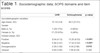
The analysis of SOPS scores between groups is shown in Table 1, as well as data regarding the sex and age of the individuals in each group. Cronbach's alpha coefficient was 0.875. This value remained stable after removal of any SOPS item. The comparative analysis of the total SOPS scores of both groups using the ROC curve showed a high area under the curve of 0.917.
| UHR | Schizophrenia | p-value | |
|---|---|---|---|
| Sociodemographic variables | |||
| Age (mean, SD) | 27.33 (3.9) | 48.5 (21.61) | |
| Gender | |||
| Male (n, %) | 7 (29.17%) | 6 (60%) | |
| Female (n, %) | 17 (70.83%) | 4 (40%) | |
| Domain (mean, SD) | |||
| Positive | 8.04 (4.13) | 15.20 (6.03) | < 0.001 |
| Negative | 6.46 (5.47) | 17.50 (5.62) | < 0.001 |
| Disorganization | 2.29 (1.60) | 4.30 (2.98) | 0.015 |
| General | 6.00 (3.90) | 7.90 (6.54) | 0.300 |
| Items score (mean, SD) | |||
| P1 - Unusual thought content | 2.17 (1.40) | 3.1 (2.18) | 0.145 |
| P2 - Suspiciousness | 2.67 (1.20) | 4 (2.4) | 0.038 |
| P3 - Grandiose Ideas | 0.29 (0.69) | 1.8 (2.57) | 0.011 |
| P4 - Perceptual Abnormalities | 2.42 (1.77) | 4.4 (1.95) | 0.007 |
| P5 - Disorganized Communication | 0.5 (0.88) | 1.9 (1.73) | 0.004 |
| N1 - Social Anhedonia | 1.54 (1.82) | 3.3 (1.7) | 0.013 |
| N2 - Avolition | 1.33 (1.63) | 2.2 (2.2) | 0.213 |
| N3 - Expression of Emotion | 0.54 (1.02) | 2.3 (2.21) | 0.003 |
| N4 - Experience of Emotions and Self | 0.92 (1.25) | 2.7 (2.31) | 0.006 |
| N5 - Ideational Richness | 1.29 (1.46) | 2.5 (2.32) | 0.075 |
| N6 - Occupational Functioning | 0.83 (1.24) | 4.5 (2.32) | < 0.001 |
| D1 - Odd Behavior or Appearance | 0.25 (0.61) | 0.3 (0.48) | 0.819 |
| D2 - Bizarre Thinking | 0.08 (0.28) | 1.6 (1.65) | 0.001 |
| D3 - Trouble with Focus and Attention | 1.96 (1.4) | 1.9 (2.23) | 0.927 |
| D4 - Impairment in Personal Hygiene | 0 (0) | 0.5 (1.08) | 0.027 |
| G1 - Sleep Disturbance | 1.71 (1.78) | 0.9 (1.73) | 0.233 |
| G2 - Dysphoric Mood | 2.25 (1.48) | 3.9 (2.42) | 0.020 |
| G3 - Motor Disturbances | 0.25 (0.44) | 1.3 (2) | 0.019 |
| G4 - Impaired Tolerance to Normal Stress | 1.79 (1.56) | 1.8 (1.75) | 0.989 |
Bold type denotes statistical significance. SD = standard deviation; SOPS = Scale of Prodromal Symptoms; UHR = ultra-high risk state for psychosis.
We have evidence that the Portuguese version of the SOPS can be used to assess the prodromal symptoms of psychotic disorders. With this instrument available in the Portuguese language, we expect that UHR research in Brazil can move further.
ACKNOWLEDGMENTS
This work was funded by the Fundação de Amparo à Pesquisa do Estado de São Paulo (FAPESP; grant 2018/02238-8 and 2016/09069-1).
Disclosure
The authors report no conflicts of interest.
 PDF
 Print
 Send this article by email
 How to cite this article
 Submit a comment
 Mendeley
 Pocket
 Share on Facebook
 Share on Twitter



