



FIGURES
| Received: August 25 2021; Accepted: August 25 2021 |
In 1907, Alois Alzheimer, a German psychiatrist and neuropathologist, described the case of Auguste Deter, a 51-year-old woman who was closely monitored for 5 years for symptoms of progressive presenile dementia. After her death, necropsy revealed several abnormalities in her brain, including cortical atrophy, arteriosclerotic changes in vascular tissues, and the abnormal deposition of "special substances" inside and outside of neurons, now identified as hyperphosphorylated tau tangles and amyloid-ß (Aß) plaques, respectively.1 Presently, Alzheimer's disease (AD) is considered the leading cause of dementia worldwide and is rapidly becoming one of the most costly, deadly, and burdensome diseases.2 Unfortunately, more than 100 years after its first description, we do not entirely understand how AD is initiated and what factors modulate its progression. At present, we know that sporadic AD (accounting for over 95% of all AD cases) can be linked with unmodifiable and modifiable risk factors. Aging is the most notorious risk factor for AD. Female sex and certain ethnicities have also been associated with a higher risk of developing this type of dementia. More recently, several pathological conditions such as type 2 diabetes, hypertension, and others have been linked with AD at physiological and molecular levels. Among them, an emerging risk factor for AD includes microbial infections.3 Basic and clinical data support the role of microbial infection in AD. Some of this evidence is discussed below.
One example found in the literature includes a multiscale analysis of three distinct patient cohorts demonstrating that human herpesvirus (HHV)-6A and HHV-7 disrupt molecular, genetic, and clinical networks more severely in AD patients than in non-demented individuals.4 Another study showed that individuals recently diagnosed with herpes simplex virus (HSV, n=8,362) had a risk ratio of 2.564 to develop dementia compared to non-HSV controls (n=25,086). Notably, this risk ratio decreased to 0.092 when the HSV-infected patients received anti-herpetic treatment,5 suggesting that the removal of pathogens results in an improved prognosis.
In the preclinical field, growing evidence suggests that infections might be associated with the accumulation of amyloid plaques in the brain, one of the hallmarks and perhaps the triggering event in AD. One example includes experiments involving transgenic Caenorhabditis elegans expressing the human Aß1-42 residue. These animals, developing Aß deposits over time, displayed reduced mortality compared to their non-transgenic counterparts when infected with Candida albicans.6 Additional support comes from experiments involving the intracerebral injection of Salmonella Typhimurium in transgenic 5XFAD mice, an animal model of accelerated amyloid pathology. Treated mice exhibited increased brain amyloid pathology compared to sham-treated mice. Moreover, Aß deposits in Salmonella-treated 5XFAD co-localized with the invading bacteria, suggesting a direct interaction between both pathogenic entities (amyloid plaques and bacteria). Interestingly, the mortality rate induced by Salmonella sp. administration was reduced in 5XFAD mice, consistent with previous in vitro and in vivo evidence suggesting an antimicrobial role for Aß aggregates.6 Corroborating the involvement of infection in AD pathogenesis, we have demonstrated that pneumococcal meningitis increased the expression of the receptor for advanced glycation endproducts (RAGE), a known contributor for Aß production by enhancing the activity of secretases and neuroinflammation. We found that infection with Streptococcus pneumoniae also enhanced the generation of Aß1-42, an Aß fragment associated with increased fibrillogenesis, microglial cell activation, and memory impairment.7
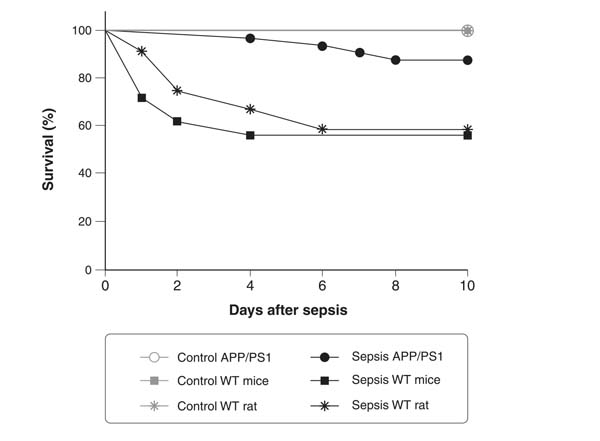
Similar results were observed in models of peripheral infection triggered by polymicrobial sepsis using cecal ligation and puncture (CLP) surgery, the gold-standard model of polymicrobial sepsis. These animals displayed an increase in Aß production and higher Ser-202-phosphorylated Tau (p-TauSer-202, another indicator of AD pathology) and RAGE followed by cognitive impairment.8 In another study, APP/PS1 double transgenic mice that express human amyloid-ß precursor protein (APP) and a mutant human presenilin (PS1) associated with early-onset AD, were subjected to CLP and their survival was measured over time. Usually, CLP triggers sepsis of moderate severity, with mortality rate in rodents of about 40%.8,9 Some crucial variables that influence the mortality rate of the animals include fluid resuscitation procedures, CLP conditions, the position of the ligation, the postoperative antibiotic regimen, and parenteral nutrition.9 Surprisingly, we found that APP/PS1 mice subjected to polymicrobial sepsis had a mortality rate of only 12.12%, while the mortality of CLP in wild-type mice was 44% (Figure 1). This was also observed in a rat model of sepsis, where wild-type Wistar rats had a mortality rate of 41.6% compared with the respective controls. In summary, our data show that wild-type C57BL/6 mice and Wistar rats had a threefold increase in mortality compared to APP/PS1 mice. Our results are in agreement with those found in the literature, demonstrating that Aß provides protection during infection.
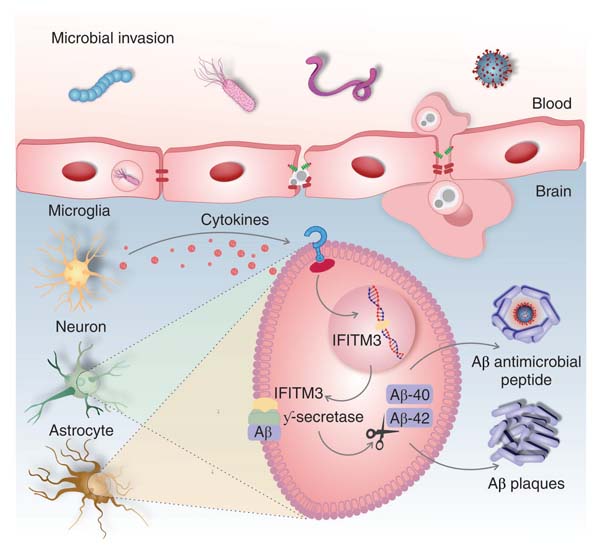
Neuroinflammation is a central component of AD pathogenesis; it contributes to disease development and neurodegeneration.2,3 Infection or inflammatory conditions derived from aging, as well as stroke, have been identified as AD risk factors,3 triggers of pro-inflammatory cytokine production in the brain, and drivers of neuroinflammation. Recently, an essential mechanism of cell signaling that associates neuroinflammation to Aß production was identified. In the brain, insults or infection lead to production of pro-inflammatory cytokines, which in turn promote the formation of interferon-induced transmembrane protein 3 (IFITM3) in neurons and astrocytes. IFITM3 binds to ?-secretase, increasing its activity, and upregulates Aß production.10 Figure 2 provides a summary of the molecular cascade associated with this pathway.
Overall, several mechanisms link microbial infections and AD, including but not limited to Aß misfolding and neuroinflammation. Additional research will help us clarify the specific molecular links between pathological events, explore the specificity of certain microbes with pathological variations in AD, and identify new preventive and therapeutic strategies to combat this fatal form of dementia.
ACKNOWLEDGEMENTS
This work was supported by The University of Texas Health Science Center at Houston. TB has received a grant from the Alzheimer's Association (AARGDNTF-19-619645). TB and RM have received grants from the National Institutes of Health/National Institute on Aging (NIH/NIA grant 1RF1AG072491).
Disclosure
The authors report no conflicts of interest.
 PDF
 Print
 Send this article by email
 How to cite this article
 Submit a comment
 Mendeley
 Pocket
 Share on Facebook
 Share on Twitter



