



| Received: November 8 2021; Accepted: November 10 2021 |
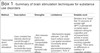
Current treatments for substance use disorders (SUDs) are far from ideal, with no U.S. Food and Drug Administration-approved pharmacotherapies to treat stimulant and other use disorders. New approaches are urgently needed to combat the increasing prevalence of SUDs and overdose deaths. It is widely accepted that addiction is a chronic disease of the brain involving changes in neural circuitry associated with cognitive and reward functioning. Brain stimulation techniques are novel methods that can modulate these circuits directly and thus hold considerable promise for treating SUDs. Below we briefly describe three of these neuromodulation techniques (see Box 1 for summary).
| Method | Description | Strengths | Limitations | Notable work |
|---|---|---|---|---|
| Transcranial direct current stimulation | Uses constant low intensity electrical current through 2 electrodes placed on the scalp to increase/decrease cortical excitability | - Non-invasive- Easy to administer- Transportable- Affordable- Minimal, transient side effects | - Mechanisms largely unknown- Can only reach surface areas- Low spatial resolution- Uncertainty about electrode placement/stimulation parameters- Risk of seizure | Mondino et al.1 found that 10 sessions of anodal right dlPFC/cathodal left occipital region reduced craving for cigarettes and increased brain activity in areas associated with resisting cigarette cravings. There were no differences in numbers of cigarettes smoked between sham and active tDCS. Future work should determine optimal parameters for decreasing both craving and use. |
| Repetitive transcranial magnetic stimulation | Uses an insulated coil placed over the scalp that delivers a brief magnetic pulse which causes depolarization or hyperpolarization in the brain area under the coil | - Non-invasive- Well-tolerated, transient side effects- Mechanisms better understood- More focal stimulation is possible | - Deeper stimulation is less focused- Risk of seizure- Mild/moderate discomfort- Treatment time burdensome to patients | Hanlon et al.2 found that 6 trains of inhibitory rTMS to the vmPFC reduced mesolimbic brain reactivity to drug/alcohol cues in cocaine and alcohol users. A multiday trial will confirm if these stimulation parameters can decrease craving or use. |
| Deep brain stimulation | Uses an internal pulse generator implanted under the skin that controls an electrode implanted in the brain to modulate abnormal brain activity | - Allows stimulation of deeper areas- More focal stimulation is possible- Easily alter stimulation parameters- Reduce number of patient visits | - Invasive- Risks and side effects associated with neurosurgery- Expensive- Requires a team of skilled experts | Chen et al.3 used DBS to stimulate the NAc and the anterior limb of the internal capsule in patients with opioid use disorder. They reported that 5/8 patients were abstinent after 3 years and concluded that DBS was safe with few side effects. DBS also increased brain metabolism in relevant areas after 6 months of treatment. A sham-controlled design will help rule out potential placebo effects. |
DBS = deep brain stimulation; dlPFC = dorsolateral prefrontal cortex; NAc = nucleus accumbens; rTMS = repetitive transcranial magnetic stimulation; tDCS = transcranial direct current stimulation; vmPFC = ventromedial PFC.
Transcranial direct current stimulation (tDCS) is a non-invasive technique that uses an anode and cathode to apply a low intensity (1-2 mA) constant current to a superficial area of the brain. Anodal tDCS increases and cathodal tDCS decreases cortical excitability, although there are individual differences. Despite the fact that the exact mechanisms of tDCS are unknown, its advantages include low cost, minimal risk, and easy application. The most common area targeted with tDCS is the dorsolateral prefrontal cortex (dlPFC), given its role in decision-making, working memory, and emotion and its position directly under the scalp. In a systematic review of 16 clinical trials investigating tDCS of the dlPFC,4 eight studies provided evidence of reduced drug craving after stimulation. A handful of studies also reported reductions in cue reactivity, risky decision-making, and substance use. The studies varied on anodal and cathodal electrode placement, leaving unanswered questions about optimal stimulation. Future studies that use multi-session, sham-controlled designs combining tDCS with neuroimaging and long-term follow-up assessment will be beneficial to understanding the mechanisms of tDCS.
Transcranial magnetic stimulation (TMS) is a non-invasive brain stimulation technique that uses an insulated coil to generate magnetic fields that pass through the scalp and skull unimpeded. These magnetic fields generate an electrical current that briefly modulates the neurons directly under the coil. When the pulses are repeated several times within a period of time (repetitive TMS [rTMS]), there can be a longer lasting response. rTMS likely works through long term potentiation/depression, with higher frequency stimulation generally having excitatory effects and low frequencies having inhibitory effects. TMS is well-tolerated and has a favorable safety profile. Considering the overlap in neural circuit disruptions, the majority of research has mimicked the depression literature, targeting the dlPFC as a treatment for SUD. In a review on sham-controlled rTMS studies for SUDs,5 excitatory rTMS to the dlPFC reduced craving and drug use in patients with cocaine and tobacco use disorders, but was less efficacious for alcohol. Notably, stimulation of the dlPFC did not consistently show reductions in both substance use and craving, suggesting the need to consider alternative target areas. Theoretically, increasing activity in areas involved in cognitive control and response inhibition, such as the dorsomedial PFC and the dorsal anterior cingulate cortex, and decreasing activity in areas associated with drug reward reactivity, such as the ventromedial PFC (vmPFC), could be beneficial for treating addiction.6 Secondary measures, such as cognitive functioning and neuroimaging, will be critical to our understanding of rTMS for SUD. While it is difficult to reach deeper areas, new coils are being developed. In fact, BrainsWay's "deep TMS" H4-coil, which targets the bilateral insula and PFC, received approval for smoking cessation in 2020.
Deep brain stimulation (DBS) involves implanting electrodes in the brain that send electrical pulses that modulate abnormal brain activity. Stimulation is controlled by a pacemaker-like device under the skin. DBS carries the risks associated with any neurosurgical procedure, but has important advantages over other non-invasive stimulation techniques, including the ability to easily alter stimulation parameters, stimulate deeper areas, and for the patient, reduce the burden associated with long-term care visits. The primary target for DBS treatment is the nucleus accumbens, given its involvement in drug-seeking behavior, craving, and withdrawal. A recent systematic review of 11 studies (33 patients) targeting the nucleus accumbens reported average remission rates of 61% at 6 months and 53% at 1 year,7 along with improvements in quality of life and drug craving. Although all of the studies in this review were case reports or series, ClinicalTrials.gov currently lists 15 active DBS trials at several international locations.
Despite its promise, the emerging field of neuromodulation treatments for SUD faces challenges. Defining the best "dose" is a critical question and a barrier to success. rTMS, for example, lacks clarity about ideal stimulation parameters, such as the number of pulses per session or sessions per day. Further, every substance has slightly different effects on neurotransmitter systems, suggesting that a more nuanced strategy may be needed for specific types of SUDs. Future research must also reconcile the effects of individual differences and state-dependent factors on treatment response. Brain stimulation could have increased efficacy when the brain is already in a particular state,8 and cognitive tasks/psychotherapy/pharmacotherapy could be employed to induce brain states during brain stimulation to improve treatment outcomes. One of the most critical challenges involves the ability to safely engage neural targets in deep brain regions. DBS has a higher risk/benefit ratio, and TMS is limited by the principle that the deeper the magnetic field penetrates, the less focused the stimulation will be. Transcranial focused ultrasound is a cutting-edge technique that passes sound waves through the skull to modulate any brain area with exceptional precision. While there is no clinical data on focused ultrasound and SUD, this is an extremely exciting field of research that might address some of the challenges we face with current brain stimulation techniques.
Disclosure
The authors report no conflicts of interest.
 PDF
 Print
 Send this article by email
 How to cite this article
 Submit a comment
 Mendeley
 Pocket
 Share on Facebook
 Share on Twitter



