


| Received: November 29 2021; Accepted: December 11 2021 |
Psychopathology is the source of objective signs for characterization of mental disorders.1 Despite extensive research into neuroimaging and biomarkers, we still use almost the same definitions of "pathological behavior" first described more than a century ago to assess mental disorders.2 Almost the same occurs with physical examination in general medicine, but their laboratory tests and image techniques thrived, improving clinical description in a way not yet developed by mental sciences.
Mental status examination (MSE) is the tool of choice for assessment of psychopathological signs.3 It was developed by psychopathologists of the past, essentially through direct and indirect interaction with patients.1 Except for the development of questionnaires to record the presence of observed signs, as it is with psychopathology, MSE has not changed significantly during the last century. However, we should be aware that technological evolution brings other ways of interaction and, consequently, new fields for behavior observation.
Telemedicine (including telepsychiatry) has expanded manifold during the COVID-19 outbreak, expanding clinical experience with MSE through digital media.4,5 Video medical appointments, text and audio messaging apps, and even social media expanded our patient observation horizons, but psychopathologists have not yet explored this new field. After years of telemedicine practice in care and research, the field that we are calling digital psychopathology has received almost no attention. In this letter, we present some observations carried out during the last months, discussed among peers like medical folk knowledge, which can seed some ideas for future research.
Psychopathological signs observed through digital interaction were classified by us into three categories: 1) classical signs of classical psychopathology; 2) new presentations of classical psychopathology; and 3) digital psychopathology. The first includes all classical psychopathological disturbances assessable by video consultation. The second is a group of previously described disturbances "dressed in new clothes" or viewed "through a new lens," due to telemedicine use or which would otherwise not be accessible at office or inpatient evaluation. Digital psychopathology, in turn, is an entirely new field, where behavior (and possibly new psychopathological signs) manifests in a way not yet described, since it only happens through digital interaction.
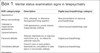
We have attached a box with some examples using MSE segments (Box 1.), clinically observed by us, as a guide. Since mental disorders still lack laboratory and image tests, psychopathologists should not close their eyes to new observable findings which could improve disease descriptions. We hope that our call to action will promote discussion among clinicians, and be answered by other researchers observing new psychopathological patterns, so the field can thrive with future research.
| MSE category/sign | Description | Digital psychopathology category |
|---|---|---|
| Appearance | ||
| Messy surroundings | Dirty, unkempt, or otherwise disorganized living quarters | New presentation of classical psychopathology |
| Unkempt or inappropriate appearance | Odd appearance, poorly shaven, inappropriate clothing | Classical psychopathology sign |
| General behavior | ||
| Paranoid attitude | Refuses telemedicine or imposes restrictions (e.g., no video) for unknown reasons | Digital psychopathology |
| Uninhibited attitude | Doesn't care or even prefers telemedicine consultation to take place in non-private settings | Digital psychopathology |
| Perception | ||
| Unprovoked giggling | Giggles, interact with empty space | Classical psychopathology sign |
| Earphone soliloquy | Subject speaks, discusses, or openly argues while wearing a headset, but is not on a call | New presentation of classical psychopathology; usually a patient with some insight, but unable to avoid answering hallucinations |
| Language | ||
| Pressured texting | Sends half-written messages or with incomplete meaning, resulting in dozens of messages for a single sentence | Digital psychopathology |
| Obsessive or super-inclusive texting | Writes huge, overcorrected, over-reflected, or otherwise non-spontaneously generated texts | Digital psychopathology |
| Thinking | ||
| Loud background sounds | Subject keeps loud sounds on in the background (e.g., music, TV) during a telemedicine appointment to avoid being heard by others | New presentation of classical psychopathology (delusion) |
| Bizarre texting | Subject replaces text spaces with periods, commas, or other symbols during psychotic states | Digital psychopathology |
| Intelligence | ||
| Inability to comprehend interaction through camera/screen | Subject interprets the clinician as a TV show | Digital psychopathology |
| Psychomotricity | ||
| Hyperactivity | Subject interrupts or constantly walks during the consultation due to difficulty staying still | New presentation of classical psychopathology |
| Self-disorder | ||
| Can't look at the camera/screen | Subject avoids looking at the camera or at the screen due to difficulties dealing with self-image or maintaining eye contact with examiner | New presentation of classical psychopathology |
| Television Fregoli phenomenon | Subject insists that a character in a TV show is a disguised family member or friend | New presentation of classical psychopathology |
MSE = mental status examination.
Disclosure
The authors report no conflicts of interest.
REFERENCES

 PDF
 Print
 Send this article by email
 How to cite this article
 Submit a comment
 Mendeley
 Pocket
 Share on Facebook
 Share on Twitter