



ABSTRACT:
OBJECTIVE: To compare the prevalence and subtypes of childhood maltreatment (CM) between individuals
with and without substance use disorder (SUD) and investigate the influence of different
traumas on the preferential use of substances and the severity of dependence.
METHODS: The sample consisted of 1,040 men with SUD (alcohol users [n=315], crack-cocaine users
[n=406], multiple-substance users [n=319]) and 201 controls. The Childhood Trauma
Questionnaire (CTQ) and the Addiction Severity Index-6 (ASI-6) were used to assess
CM and drug-use patterns.
RESULTS: Individuals with SUD had a higher prevalence of CM than controls (63.4 vs. 28.1%,
respectively). Exposure to physical trauma was associated with alcohol use disorder
and severity of alcohol use. In contrast, emotional trauma was associated with use
of multiple substances and severity of drug use in crack-cocaine users.
CONCLUSIONS: This study corroborates the association of CM with SUD susceptibility. Our results
suggest that the type of CM may influence preferential substance use and addiction
severity. In this sense, physical traumas are more associated with alcohol use, while
emotional and sexual traumas favor use of multiple drugs, especially crack cocaine.
These findings may help the development of tailored prevention and intervention strategies.
Keywords: Alcoholism; cocaine-related disorders; substance-related disorders; adverse childhood experiences; child abuse.
| Received: November 8 2021; Accepted: January 24 2022 |
INTRODUCTION
Substance use is a common behavior, with a worldwide prevalence of 43%1 for alcohol and 5.4%2 for other psychoactive drugs (considering use at least once a year). Similar estimates have been reported in Brazil, where the most widely used substance is alcohol (43.1%), followed by cannabis (2.5%), cocaine (0.9%), and crack cocaine (0.3%).3 Alcohol and crack-cocaine use disorders are a public health problem, and evidence suggests that early trauma is a risk factor for substance use disorder (SUD) susceptibility and influences its severity.4-6
The prevalence of trauma subtypes differs according to sex and country,7 and is also related to national policies and funding.8 However, many countries lack data on sexual abuse of male children.9 Different theories have been proposed to clarify the relationship between addiction and childhood maltreatment (CM). The self-medication hypothesis suggests that substances are used to attenuate the symptoms related to untreated or improperly treated trauma.10 The ecological-transactional model explains how CM can influence and could contribute to coping strategies, leading to maladaptation and psychopathologies.11 Emotional regulation and coping strategies are related to CM, and contribute to alcohol use and dependence.4
Although it is well established that CM has negative outcomes in adulthood and is related to vulnerability to and severity of mental disorders,12,13 few studies have investigated the influence of each subtype of CM on different and specific SUDs. We analyzed data from a large sample of men with SUD and healthy controls to: 1) compare the prevalence and subtypes of CM among individuals with and without SUD; 2) investigate whether one's preferred substance of use is associated with a specific type of trauma (i.e., emotional abuse or physical neglect); and 3) investigate the possible relationship between type of trauma and the severity of substance use.
METHODS
Sample
A total of 1,241 men were included in this study, separated into four groups: alcohol users (n=315), crack-cocaine users (n=406), users of multiple substances (alcohol and crack cocaine, n=319), and non-users (n=201). These groups were defined based on the substance of choice and motive for treatment (alcohol, crack cocaine, or both). Use of other substances (i.e., cannabis) could be present, but less frequently. Individuals with SUD were recruited by convenience at public drug detoxification facilities in Porto Alegre, Southern Brazil, from 2011 to 2019. Healthy controls without SUD were recruited from the community in the metropolitan region of Porto Alegre. The inclusion criteria for cases were: 1) age 18 years or older; 2) admitted to an addiction treatment facility; 3) having a diagnosis of alcohol or crack/cocaine dependence in accordance with the DSM-IV or DSM-5 criteria; and 4) absence of severe cognitive deficits that would limit capacity to understand the research protocol. In controls, the same criteria were applied, except for the diagnosis of SUD.
Measures
CM was assessed using the Childhood Trauma Questionnaire (CTQ),14 which comprises 28 items, scored on a five-point Likert-type scale. A higher score indicates greater severity. Five subtypes of trauma were assessed: physical abuse, physical neglect, emotional abuse, emotional neglect, and sexual abuse. In cases, the Addiction Severity Index-6 (ASI-6) was applied to investigate addiction severity and history of drug use.15
Statistical analyses
Categorical variables were analyzed using the chi-square test and described as absolute and relative frequency (numbers and percentages). Standardized adjusted residuals were used to detect categories with higher-than-expected frequencies. Continuous data were tested for normality of distribution by the Kolmogorov-Smirnov test and presented as the median and interquartile range (IQR). Age and total CTQ scores were compared using the Kruskal-Wallis test. The Dunn-Bonferroni post-hoc test was carried out for pairwise comparisons, and adjusted-significance p-values were applied.
Ethics statement
This study was approved by the Hospital de Clínicas de Porto Alegre research ethics committee (14-0249 and 10-0201) and all individuals provided written informed consent to participate.
RESULTS
Cases and controls differed in terms of skin color (p < 0.001) and age (p < 0.001). Controls were mostly non-white (87.1% in controls vs. 36.2% in alcohol users, 47.7% in crack-cocaine users, and 42% in users of multiple substances), with a median age of 28 years (IQR 23-33.5). The median age of alcohol users was 52 (IQR 45-57), while for crack-cocaine users it was 30 years (IQR 25-37), and for users of multiple substances, it was 37 (IQR 29-44). Considering the use of other psychoactive substances, cannabis was the most commonly used drug (by 4.8% of alcohol users, n=15; 19.2% of crack-cocaine users, n=78; and 13.5% of users of multiple substances, n=43).
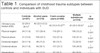
Individuals with SUD presented higher total CM scores compared to controls (p < 0.001, Table 1). The presence of moderate to severe CM was also assessed, and a lower prevalence of CM was observed in controls (p < 0.001) (Table 1). In our sample, 711 (57.7%) individuals had at least one type of trauma. The prevalence was higher in cases (n=655, 63.4%) compared to controls (n=56, 28.1%, p < 0.001). Similarly, exposure to more than one type of trauma was more prevalent in cases (n=412, 39.6%), especially in individuals who used multiple substances, compared to controls (n=26, 12.9%, p < 0.001). Exposure to physical neglect was associated with alcohol use disorder, while exposure to other CM subtypes was associated with the use of multiple substances. To analyze whether the preferred substance is associated with a specific type of subsequent trauma, analyses were performed only among individuals with SUD. Individuals with alcohol use presented a higher prevalence of physical neglect than crack-cocaine users (p = 0.032). Otherwise, users of multiple substances had a higher prevalence of emotional abuse compared to alcohol users (p = 0.017).
| Controls (n=201) | Alcohol users (n=315) | Crack-cocaine users (n=406) | Multiple substances (n=319) | p-value | |
|---|---|---|---|---|---|
| CM total score, median (IQR) | 32 (28.0-38.5)a | 40 (32.0-53.2)b | 42 (33.0-55.0)b,c | 45 (35.0-59.0)c | < 0.001 |
| Physical neglect | 24 (11.9)┼ | 121 (38.4)┼ | 118 (29.1) | 106 (33.2) | < 0.001 |
| Physical abuse | 31 (15.6)┼ | 109 (34.7) | 152 (37.4) | 132 (41.5)┼ | < 0.001 |
| Emotional neglect | 24 (11.9)┼ | 48 (15.2) | 80 (19.7) | 72 (22.6)┼ | 0.007 |
| Emotional abuse | 24 (11.9)┼ | 94 (30.1) | 137 (33.7) | 130 (40.8)┼ | < 0.001 |
| Sexual abuse | 7 (3.5)┼ | 42 (13.5) | 67 (16.7) | 60 (18.9)┼ | < 0.001 |
| More than one form of trauma | 26 (12.9)┼ | 114 (36.2) | 152 (37.4) | 146 (45.8)┼ | < 0.001 |
Data presented as n (%), unless otherwise specified.
CM = childhood maltreatment; IQR = interquartile range; SUD = substance use disorder.
┼ Adjusted residuals with a frequency higher than 1.96 or lower than -1.96.
Different lowercase superscript letters denote significant differences between the groups.
A higher severity of alcohol use (ASI-alcohol score) was associated with exposure to physical abuse in individuals with alcohol use disorder (median [IQR] 64 [58-70] vs. 66 [61-73], p = 0.047) and multiple substance use (58 [53.5-64] vs. 61 [56-66], p = 0.012). Physical neglect was associated with similar findings in users of multiple substances (58 [53-63] vs. 62 [56-67], p = 0.004). Severity of drug use (ASI-drugs score) was associated with exposure to emotional neglect (52 [49-57] vs. 54 [51-56.25], p = 0.015) in crack-cocaine users. Emotional abuse (53 [49-58] vs. 55 [50-59], p = 0.035) and sexual abuse (53 [49-58] vs. 55.5 [50.25-60], p = 0.022) were also associated with severity of drug use in individuals with multiple substance use.
DISCUSSION
To our knowledge, this is the largest and most comprehensive study conducted in Brazil analyzing the effect of CM on the use (and severity of use) of alcohol and crack cocaine. The present study provides relevant evidence, highlighting higher scores and prevalence of CM among individuals with SUD, corroborating previous research.12,13,16 Indeed, the prevalence of CM (especially of some specific CM subtypes) was two to four times higher in SUD individuals compared to non-users. In addition, the presence of more than one subtype of trauma was more prevalent in individuals who used both alcohol and crack cocaine (i.e., users of multiple substances). A systematic review indicated that childhood trauma exposure had a stronger association with addictive behaviors than adult trauma exposure.17
In our study, physical neglect was related to alcohol addiction, and both physical abuse and neglect were associated with severity of alcohol use. Studies with clinical and nonclinical samples support the association of alcohol use and severity with physical abuse5,6,12 and neglect,6 affected by its frequency.12 In this sense, alcohol use might be a coping strategy to deal with CM,4 especially in those who experienced physical trauma. Furthermore, emotional6,12 and sexual6 abuse have been associated with alcohol use. Although emotional abuse was not significantly associated with alcohol use disorder in our study, the presence of this type of trauma was three times greater in alcohol users than in controls.
Emotional abuse and neglect seem to be more related to crack-cocaine use and the use of multiple substances, and some previous studies conducted in Brazil and United States observed similar data among men.6,12,13 Moreover, sexual abuse was associated with the use of multiple substances, more specifically with the severity of crack-cocaine use, also echoing evidence from previous research.6,13,16 Nonetheless, most studies did not assess the association of neglect with crack-cocaine dependence,13 nor with drug dependence in general.16 It is also important to emphasize that the use of multiple substances makes it difficult to point out if there is any one specific substance associated with emotional trauma or if polyuse per se is a key component in this relationship.
The relationship between CM and addiction has been deeply explored. Beyond the self-medication hypothesis and the ecological-transactional model, the hypothalamic-pituitary-adrenal (HPA) axis has been implicated. CM influences HPA-axis functioning, modifying its ability to respond adequately to stressful experiences, leading to impulsive and risk-seeking behaviors and the development of SUD.18
This study has some limitations that should be mentioned. The cross-sectional design utilized retrospective and self-reported data. Thus, it is conditioned to recall bias and precludes any causal inferences. Also, our sample was composed only of men with severe dependence, and may not represent other populations of substance users. However, previous studies with men showed a CM prevalence similar to ours.6,12 On the other hand, women have a higher prevalence of sexual abuse and lower prevalence of physical abuse than men.13,16 Lastly, other studies have indicated that other factors, such as psychiatric disorders, might contribute to CM and addiction susceptibility.6,12,13,16 Also, considering the cross-sectional design of the study, it was difficult to reliably assess the temporality of the development of these comorbidities.
The present study confirmed the association of CM as a predictor of SUD and suggested a link of alcohol use with physical traumas and multiple substance use with emotional maltreatment. Public health policies should implement strategies to prevent maltreatment during childhood and help develop coping strategies in children exposed to CM, seeking to hinder excessive and harmful use of substances and thus decrease the prevalence and severity of SUD during adulthood. Although prevention is ideal, our findings are relevant for the development of tailored interventions to clinical population of patients with SUD. The inclusion of approaches that help evaluate and manage the implications of childhood traumas could also lead to better treatment outcomes.
ACKNOWLEDGEMENTS
This study was supported by the Conselho Nacional de Desenvolvimento Científico e Tecnológico (CNPq; grant 478492/2013-8), Secretaria Nacional de Políticas sobre Drogas (SENAD)/Ministério da Justiça e Segurança Pública (grant 08129.015636/2017-78), Fundo de Apoio à Pesquisa e Eventos, Hospital de Clínicas de Porto Alegre (FIPEHCPA; (grant 2014-0249), and Coordenação de Aperfeiçoamento de Pessoal de Nível Superior - Brazil (CAPES; finance code 001). The funders had no role in study design, data collection and analysis, decision to publish, or preparation of the manuscript.
Disclosure
The authors report no conflicts of interest.
 PDF
 Print
 Send this article by email
 How to cite this article
 Submit a comment
 Mendeley
 Pocket
 Share on Facebook
 Share on Twitter



