


| Received: May 01 2022; Accepted: June 18 2022 |
Although many studies have used online instruments to assess mental health,1 few have done so to assess suicide risk. We would like to share our experience with the 9-item Patient Health Questionnaire (PHQ-9), the standard measure of depression according to The Common Measures in Mental Health Science Governance Board,2 as a screening tool for suicide risk. The PHQ-9 contains the following item: "Over the last two weeks, how often have you been bothered by: thoughts that you would be better off dead or of hurting yourself in some way?" This sentence raises a question: are those bothered by thoughts of being better off dead or of hurting themselves at clinical risk of suicide?
We used data from TelePSI, a project providing tele-psychotherapy and tele-psychiatric support for essential workers dealing with the COVID-19 pandemic. Participants who answered this question with any other response than not at all were referred for a detailed psychiatric evaluation with a manualized protocol that addresses 44 risk/protective factors associated with suicidal behavior.3 We then classified the clinical risk of suicide as none, mild, moderate, or severe. Moderate and severe risk indicate the need for an in-person assessment and immediate inpatient admission, respectively. Data analysis was performed using logistic regression.
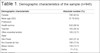
Among 945 adults that participated in the project (NCT04632082), 659 (69.7%) answered the item with not at all, 178 (18.8%) with several days, 55 (5.8%) with more than half of the days, and 53 (5.6%) with nearly every day. Of the 286 participants referred for psychiatric evaluation, 211 (73.8%) completed the assessment. After evaluation, it was concluded that 112 (53.1%) had no clinical risk, 84 (39.8%) had a mild risk, 14 (6.6%) had a moderate risk, and one (0.5%) had a severe risk. The responses more than half of the days or nearly every day for this item were associated with moderate/severe clinical risk compared to the response several days (odds ratio = 28.2, 95%CI = 3.63-219.2). Using more than half of the days or nearly every day as the cut-off for referral to a psychiatrist would have identified all 14 participants with moderate/severe risk except one (with moderate risk). The sample's demographic characteristics are shown in Table 1.
| Demographic characteristic | Absolute number (%) |
|---|---|
| Female | 790 (83.6) |
| Mean age (SD) | 37.79 (9.6) |
| Profession | |
| Health service | 632 (66.9) |
| Teacher | 193 (20.4) |
| Other essential worker | 120 (12.7) |
| State | |
| São Paulo | 202 (21.4) |
| Rio Grande do Sul | 166 (17.6) |
| Minas Gerais | 130 (13.7) |
| Bahia | 71 (7.5) |
| Rio de Janeiro | 66 (7.0) |
| Other | 310 (32.8) |
Contemporary models of suicide risk show that suicide etiology is heterogeneous, with an interaction between predisposing and precipitating factors.4 Consistent with previous research,5 our data support the notion that a positive response on the PHQ-9 suicidal thoughts item does not equate to clinical risk. It is not the "categorical" PHQ-9 item alone that matters, but its severity. Participants whose response to the PHQ-9 item on suicidal thoughts was more than half of the days or nearly every day might be at increased clinical risk of suicide and require assessment by a psychiatrist.
ACKNOWLEDGMENTS
The authors would like to thank Drs. Marcelo Pio de Almeida Fleck, Gisele Gus Manfro, Lívia Hartmann de Souza, and Christian Kristensen for their support of the TelePSI project and for earlier comments on this specific research question.
This study was funded by the Brazilian Ministry of Health (TED no.16/2020).
Disclosure
The authors report no conflicts of interest.
How to cite this article: Motta LS, Costa MA, Spanemberg L, Dreher CB, Salum GA. Is the 9-item Patient Health Questionnaire sufficiently sensitive to detect clinical risk of suicide in essential workers seeking emotional sup port during the COVID-19 pandemic? Braz J Psychiatry. 2022;00:000-000. http://doi.org/10.47626/1516-4446-2022-2666
 PDF
 Print
 Send this article by email
 How to cite this article
 Submit a comment
 Mendeley
 Pocket
 Share on Facebook
 Share on Twitter