


| Received: March 17 2022; Accepted: June 1 2022 |
Romantic jealousy could be understood as a continuum, from normal to morbid, where normal jealousy is reality-based, transient, and functional, while morbid jealousy is a more chronic form of jealousy with varying insight, intensity, and duration.1 Morbid jealousy has typically been described in the context of delusions in schizophrenia or alcohol-related psychoses,2 though it seems quite rare.3 A non-psychotic type may be more common4 and has clear phenomenological overlaps with obsessive-compulsive disorder.5 Furthermore, the DSM-5 included "Obsessional Jealousy" under the section "other specified obsessive-compulsive and related disorders."
Several rating scales have been developed to measure various aspects of jealousy. However, none of the existing instruments capture the distress and impairment associated with jealous thoughts and behaviors, which means that their clinical utility is questionable. We aimed to develop and evaluate a measure of jealousy severity that captures clinically important aspects, such as distress and impairment: the Obsessional Jealousy Severity Scale (OJSS).
The OJSS was modelled on the Yale Brown Obsessive Compulsive Scale and includes two symptom checklists and two severity scales that measure jealous thoughts and behaviors, respectively (checklist and severity scale items are presented in Tables S1-S3, available as online-only supplementary material). The severity scales are then summed to form a total severity score. A total of 1,087 adults completed an online survey published on the Karolinska Institutet website. An advertisement for the study was published on Facebook. We applied several methods to control for the validity of the responses, e.g., we excluded careless responders who gave inconsistent responses and outliers using the Mahalanobis distance statistic. The final sample included 1,038 participants (574 women, 441 men, and 23 others; median age 44 years [range 18-79]).
Exploratory factor analysis revealed a single factor as the underlying dimension of the OJSS, explaining 67% of the total variance. All items loaded strongly on this single factor (range 0.50-0.92). The internal consistency of scores was excellent (Cronbach's alpha = 0.89).
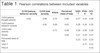
The OJSS was strongly correlated with functional impairment and perceived need of help. Weaker correlations were observed with worry, depression, and obsessive-compulsive symptoms (Table 1). Analysis of measurement invariance showed that the items functioned similarly between men and women and between heterosexual and other participants.
| OJSS jealous behavior severity | OJSS total severity | WSAS | Perceived need of help | GAD-7 | PHQ-9 | OCI-12 | |
|---|---|---|---|---|---|---|---|
| OJSS jealous thought severity | 0.82* | 0.96* | 0.70* | 0.66* | 0.27* | 0.25* | 0.26* |
| OJSS jealous behavior severity | 0.95* | 0.69* | 0.63* | 0.28* | 0.24* | 0.30* | |
| OJSS total severity | 0.73* | 0.68* | 0.29* | 0.26* | 0.29* | ||
| WSAS | 0.64* | 0.27* | 0.29* | 0.27* | |||
| Perceived need of help | 0.23* | 0.23* | 0.22* | ||||
| GAD-7 | 0.77* | 0.55* | |||||
| PHQ-9 | 0.52* |
OJSS = Obsessive Jealousy Severity Scale; WSAS = Work and Social Adjustment Scale, GAD-7 = Generalized Anxiety Disorder-7; PHQ-9 = Patient Health Questionnaire-9; OCI-12 = Obsessive-Compulsive Inventory-12.
* p < 0.001.
The OJSS is a promising instrument for assessing the severity of obsessional jealousy that could be particularly useful in clinical settings. The OJSS was strongly correlated with both functional impairment caused by jealousy and the perceived need of treatment for jealousy. This indicates that the scale captures clinical aspects of jealousy, as intended. Weaker correlations with other psychiatric symptoms suggest that specific therapeutic approaches may need to be developed for obsessional jealousy. Additional validation work is warranted, particularly in samples of individuals seeking treatment for morbid jealousy. This study focused on a self-administered version of the instrument, but it can easily be administered as a clinical interview, just like the Yale Brown Obsessive Compulsive Scale. For further details on the methods and results, see https://doi.org/10.17605/OSF.IO/93SJ7.
Disclosure
The authors report no conflicts of interest.
 PDF
 Print
 Send this article by email
 How to cite this article
 Submit a comment
 Mendeley
 Pocket
 Share on Facebook
 Share on Twitter