



ABSTRACT:
OBJECTIVE: Coronaviruses that cause respiratory infections in humans are known to be neuropathogenic.
The purpose of this study is to determine whether there is an association between
the severity of viral pneumonia and anxiety and depression levels in patients admitted
to an intensive care unit (ICU) with coronavirus disease 2019 (COVID-19).
METHODS: Prospective study of 165 patients, patients were divided into two groups (intubated
and non-intubated) according to whether they were intubated during follow-up.
RESULTS: Of 165 patients included, 70 were intubated after the first 7 days of follow-up. The
Generalized Anxiety Disorder-7 (GAD-7) score was 10.37±3.75 (p < 0.001) in these patients.
The length of ICU stay was 25±22.3 days (p < 0.001), and the length of overall hospital
stay was 28.28±23.37 days, significantly longer than in patients who were not intubated
(p < 0.001). The Acute Physiology and Chronic Health Evaluation II and Sequential
Organ Failure Assessment Score scores, as well as GAD-7 and Patient Health Questionnaire-9,
were positively associated with length of ICU stay and length of hospital stay (p
< 0.01).
CONCLUSION: The presence and exacerbation of anxiety and depression symptoms can provide information
about the aggravation and progression of the underlying disease.
Keywords: Viral pneumonia; anxiety; depression; intensive care unit; intensive care scores.
FIGURES
| Received: May 21 2022; Accepted: July 16 2022 |
INTRODUCTION
Survivors of respiratory viral infections experience both acute and long-term psychopathological consequences. Coronaviruses that cause respiratory infections in humans are also known to be neuropathogenic.1 According to a recent systematic review with meta-analysis by Rogers et al., coronaviruses induce serious psychiatric and neuropsychiatric repercussions both acutely and in the long term.2 In this review, the most common neuropsychiatric symptoms in patients admitted to hospitals due to severe acute respiratory syndrome (SARS) or Middle East respiratory syndrome (MERS) were insomnia (41.9%), anxiety (35.7%), memory impairment (34.1%), depressed mood (32.6%), and confusion (27.9%).2 Coronaviruses can have psychopathological effects on the central nervous system (CNS), either directly or indirectly through immune-mediated mechanisms.3 The immune response to coronaviral infections triggers a cytokine storm, which can increase neuroinflammation and lead to psychiatric symptoms.4 The purpose of this study is to determine whether there is an association between the severity of viral pneumonia and the anxiety and depression levels of patients admitted to an intensive care unit (ICU) who are being monitored for coronavirus disease 2019 (COVID-19)-related viral pneumonia.
METHODS
Between March 7, 2022, and June 1, 2022, 165 patients with viral pneumonia owing to COVID-19 were evaluated prospectively in our hospital's tertiary care unit.
After 7 days of follow-up, 70 of the 165 patients required intubation and invasive mechanical ventilation. When the patients were connected to the ventilator and when they were disconnected, the mechanical ventilation time was calculated.
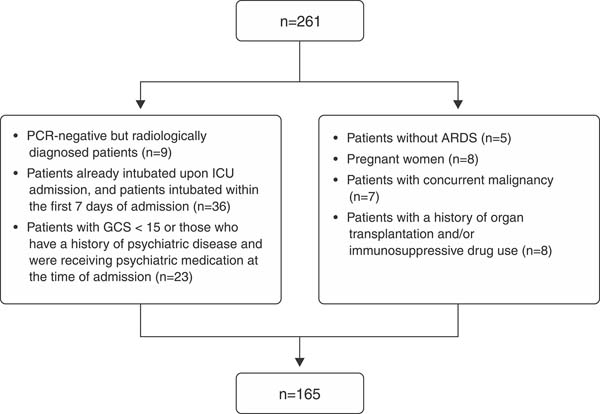
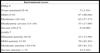
The inclusion criteria were: 1) COVID-19 diagnosis confirmed by real time-polymerase chain reaction (RT-PCR); 2) acute respiratory distress syndrome (ARDS) according to the Berlin criteria; 3) age 18 and over; and 4) Glasgow Coma Score (GCS) = 15 in patients who were not intubated during the first 7 days. The exclusion criteria were: 1) age less than 18 years; 2) no ARDS; 3) pregnancy; 4) concurrent malignancy; 5) history of organ transplantation and/or immunosuppressive drug use; 6) PCR test negative for COVID-19 (diagnosed radiologically); 7) patients admitted to the ICU as intubated, and patients intubated within the first 7 days of admission; 8) GCS < 15. Patients with a history of psychiatric disease who were receiving psychiatric medication at the time of admission were also not included in the study (Figure 1).
Study instruments
All patients were scored and given questionnaires within the first 24 hours of their admission to the ICU. In the ICU, the Acute Physiology and Chronic Health Evaluation II (APACHE II) and Sequential Organ Failure Assessment Score (SOFA) were used to score disease severity, the Patient Health Questionnaire-9 (PHQ-9) was used to screen for the presence and severity of depression, and the Generalized Anxiety Disorder-7 (GAD-7) was used to measure anxiety. In this investigation, the PHQ-9 was used.5 The PHQ-9 is based on the DSM-IV diagnostic criteria for depression. Each item represents one depressive symptom and is scored on a scale of 0 to 3 depending on how often the symptom bothered the patient during the recall period of the interview: zero if not at all, 1 if on several days, 2 if on more than half the days, and 3 if almost every day. The study employed a 2-week recall span. The overall score varied from 0 to 27, with a higher score indicating more self-reported depression. With a sensitivity of 80% and specificity of 92%, a total score of 10 indicated the possibility of serious depression.6,7 To assess the intensity of self-reported anxiety, the GAD-7 was utilized.8 As in the PHQ-9, zero equaled not at all, 1 equaled a few days, 2 equaled more than half the days, and 3 equaled almost every day. Again, the study employed a 2-week recall span. The overall score varied from 0 to 21, with a higher number indicating greater anxiety. A total score of 10 on the GAD-7 indicates potential anxiety, and is the optimal cutoff value for sensitivity (89%) and specificity (82%).9- 11
GCS, body temperature, mean arterial pressure, heart rate, respiratory rate, oxygenation, arterial pH, venous HCO3, sodium, potassium, serum creatinine, hematocrit, leukocytes, and age are all included in the APACHE II system. The entire APACHE II score is made up of three subsections: acute physiology score, age, and chronic health assessment; the highest possible score is 71. Mortality, which is 25% when the overall score is 25, rises to 80% when the total score is 35 or higher.12
The SOFA score was created in 1994 to quantify and objectively define the degree of organ dysfunction/failure in patients.13 The SOFA system assesses the respiratory, cardiovascular, hepatic, coagulation, renal, and neurological systems. Each system is graded on a scale of 0 to 4, with higher scores indicating increased organ dysfunction.13,14 Maximum SOFA score has been associated with death. Information on the patients was collected from the hospital's electronic medical record and patient files. Sociodemographic data included patient age, gender, body mass index (BMI), and comorbidity status. A complete blood count, kidney (urea, creatinine), and liver function tests (alanine aminotransferase [ALT], aspartate transaminase [AST]), as well as coagulation markers, were all obtained on the day of admission to the ICU. After ICU admission, C-reactive protein (CRP), procalcitonin (PRC), and ferritin levels as acute phase reactants, as well as glucose, d-dimer, and lactate dehydrogenase levels, were all monitored.
Oxygen therapy (conventional oxygen support, high flow nasal oxygen [HFNO], or noninvasive mechanical ventilation [NIV]) was started in all patients upon admission to the ICU.
Statistical analysis
The SPSS program was used to perform statistical analysis. To ascertain whether the continuous data fit the normal distribution, the one-sample Kolmogorov-Smirnov test was employed. Quantitative variables were expressed as mean and standard deviation (SD) or median (min-max) based on their distribution. Categorical variables were expressed as numbers and percentages. For continuous data that fit a normal distribution, the Student t-test was performed, and for those that do not, the Mann-Whitney U test was employed instead. The chi-square test was performed to compare categorical data between two groups. The Spearman method was used for correlation analysis.
Ethics statement
The ethics committee of Basaksehir Cam and Sakura City Hospital granted approval for the study (opinion number KAEK/2022.03.73).
RESULTS
The sample comprised 165 patients; 70 of them were intubated after 7 days, and the patients were separated into two groups based on their intubation status: intubated and non-intubated. Clinical and laboratory data for these two groups are shown in Table 1. Intubated patients had significantly higher white blood cell (WBC) (10.33±4.47, p < 0.001), hemoglobin (12.74±2.45, p = 0.006), neutrophil (9.10±4.435, p < 0.001), and immature granulocyte (0.30±0.62 [0.01-2.43], p < 0.001) counts than non-intubated patients.
| Total (n=165), SD (min-max) | Non-intubated (n=95), SD (min-max) | Intubated (n=70), SD (min-max) | p-value | |
|---|---|---|---|---|
| Age | 43.42±14.11 (23-65) | 44.68±13.19 (25-65) | 41.71±13.19 (23-65) | 0.11 |
| Sex (male) | 102 (61.81%) | 55 (33.33%) | 47 (28.48%) | 0.4 |
| Glucose (mg/dL) | 167.78±71.70 (83-391) | 163.73±64.65 (83-321) | 173.28±80.44 (96-391) | 0.62 |
| BUN (mg/dL) | 62.62±51.93 (10.4-269) | 73.9±63.57 (10-269) | 47.32±22.15 (10-105) | 0.01 |
| Creatinine (mg/dL) | 1.22±1.20 (0.49-6.03) | 1.4±1.52 (0.49-6.03) | 0.91±0.37 (0.54-2.04) | 0.45 |
| AST (U/L) | 47.27±28.01 (11-149) | 47.52±30.94 (11-149) | 46.92±24.18 (14-109) | 0.83 |
| ALT (U/L) | 43±35.68 (87-156) | 45.78±35.7 (7-135) | 39.21±34.54 (15-156) | 0.40 |
| Na | 137.36±5.65 (127-159) | 136.68±4.04 | 138.28±7.22 (127-159) | 0.20 |
| K | 4.29±0.57 (3.06-5.87) | 4.35±0.58 (3.5-0.58) | 4.21±0.55 (3.06-5.06) | 0.32 |
| Fibrinogen (mg/dL) | 601.12±180.78 (209-900) | 590.52±207.70 (209-900) | 615.5±136.20 (386-792) | 0.28 |
| Lactate | 1.9±0.91 (0.7-5.5) | 1.83±068 (0.8-3.2) | 1.99±1.14 (0.7-5.5) | 0.77 |
| D-dimer (µgFEU/mL) | 2.65±4.2 (0.20-21) | 2.86±4.98 (0.23-21) | 2.36±2.83 (0.20-9) | 0.38 |
| LDH (U/L) | 480±252.21(149-1436) | 494.26±299.03 (149-1436) | 460.85±169.49 (240-943) | 0.30 |
| Ferritin (ng/mL) | 1150.81±1417.34 (38-6098) | 13.44±1765.72 (38-6098) | 887.78±636.69 (275-2220) | 0.42 |
| WBC (10^9/L) | 9.7±4.26 (1.88-24.06) | 8.85±3.83 (4.9-18.6) | 10.33±4.47 (1.88-24) | 0.001 |
| HB (g/dL) | 12.08±2.4 (7.5-17) | 11.59±2.25 (7.5-15.39 | 12.74±2.45 (7.7-17) | 0.01 |
| Platelets | 230.75±87.95 (57-398) | 240.22±101.91 (57-372) | 240.22±62.71 (119-372) | 0.09 |
| RDW | 38.98±13.91 (12.9-78.6) | 38.57±15.14 (13-78.6) | 39.54±12.12 (12.9-57.9) | 0.65 |
| Lymphocytes (10^9/L) | 0.70±0.36 (0.06-1.54) | 0.70±0.37 (0.06-1.54) | 0.71±0.36 (0.26-1.42) | 0.93 |
| Neutrophils (10^9/L) | 8.41±4.10 (1.7-22.8) | 7.47±3.54 (4.12-15.34) | 9.10±4.35 (1.7-22.8) | 0.001 |
| Immature granulocytes | 0.28±0.45 (0.01-2.43) | 0.27±0.27 (0.04-0.82) | 0.30±0.62 (0.01-2.43) | 0.001 |
| NLR | 16.54±14.44 (4-63.33) | 19.46±17.34 (5.20-63.33) | 12.57±7.65 (4-34) | 0.07 |
| PLR | 496.79±658.06 (116.88-4000) | 587.63±840.48 (116.88-4000) | 373.50±200.30 (136.62-896.15) | 0.28 |
| CRP (mg/L) | 146.87±117.13 (29-683) | 134.42±71.84 (50-334) | 163.78±158.34 (29-683) | 0.86 |
| PCT (ng/mL) | 28.98±32.04 (0.08-138) | 24.44±22.75 (0.08-76) | 35.14±40.84 (2-138) | 0.41 |
ALT = alanine aminotransferase; AST = aspartate aminotransferase; BMI = body mass index; BUN = blood urea nitrogen; COPD = chronic obstructive pulmonary disease; CRP = C-reactive protein; HB = hemoglobin; LDH = lactate dehydrogenase; NLR = neutrophil-lymphocyte ratio; PCT = procalcitonin; PLR = platelet-lymphocyte ratio; WBC = white blood cell.
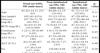
Table 2 summarizes the results of intensive care scores, depression and anxiety scales, and the length of stay (LOS) in ICU and in hospital overall. The GAD-7 score was 10.37±3.75 (p < 0.001) in patients who were intubated after the first 7 days, the LOS in ICU was 25±22.3/day (p < 0.001), and the LOS in the hospital was 28.28±23.37/day, which was longer than those who were not intubated (p < 0.001).
| Total (n=165) | Non-intubated (n=95) | Intubated (n=70) | p-value | |
|---|---|---|---|---|
| SOFA | 5.16±1.58 (3-9) | 4.98±1.68 (3-9) | 5.4±1.42 (3-8) | 0.11 |
| APACHE | 9.04±2.80 (4-16) | 8.01±2.87 (4-16) | 9.62±2.61 (5-14) | 0.01 |
| GAD-7 | 8.86±3.36 (3-16) | 7.75±3.08 (3-14) | 10.37±3.75 (4-16) | 0.001 |
| PHQ-9 | 7.21±3.38 (3-16) | 7.09±3.32 (3-16) | 7.38±3.48 (3-14) | 0.48 |
| ICU LOS | 17.57±16.84 (4-77) | 12.10±7.48 (3-34) | 25±22.30 (6-77) | 0.001 |
| Hospital LOS | 27.18±19.46 (5-86) | 26.36±10.07 (5-75) | 28.28±23.37 (8-86) | 0.001 |
APACHE = Acute Physiology and Chronic Health Evaluation; GAD-7 = Generalized Anxiety Disorder-7; ICU = intensive care unit; LOS: length of stay; PHQ-9: Patient Health Questionnaire-9; SOFA: Sequential Organ Failure Assessment Score.
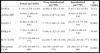
According to the PHQ-9, 3 (1.81%) of the patients exhibited minor depression, 87 (40.6%) mild depression, 62 (37.57%) moderate depression, and 33 (17%) moderately severe depression (Table 3). Minimal anxiety was seen in 23 (13.9%), mild anxiety in 70 (42.42%), moderate anxiety in 68 (41.21%), and severe anxiety in four (2.42%) patients, according to the GAD-7 (Table 3).
| Instrument/score | |
|---|---|
| PHQ-9 | |
| None-minimal (0-4) | 3 (1.81) |
| Mild (5-9) | 87 (40.60) |
| Moderate (10-14) | 62 (37.57) |
| Moderately severe (15-19) | 33 (17.00) |
| Severe (20-27) | 0 (0.00) |
| GAD-7 | |
| Minimal anxiety (0-4) | 23 (13.90) |
| Mild anxiety (5-9) | 70 (42.42) |
| Moderate anxiety (10-14) | 68 (41.21) |
| Severe anxiety = 15 | 4 (2.42) |
Data presented as n (%).
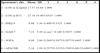
According to Spearman correlation analysis (Table 4), GAD-7, hospital LOS (p < 0.05), and PHQ-9 (p < 0.01) all correlated positively. PHQ-9, on the other hand, was found to have a positive correlation (p < 0.01) with ICU LOS and overall hospital LOS. Furthermore, APACHE and SOFA scores, as well as GAD-7 and PHQ-9, were found to be positively correlated to ICU LOS and overall hospital LOS (p < 0.01).
| Spearman's rho | Mean | SD | 1 | 2 | 3 | 4 | 5 | 6 |
|---|---|---|---|---|---|---|---|---|
| 1 - LOS in hospital | 17.57 | 16.84 | 1.000 | |||||
| 2 - LOS in ICU | 27.18 | 19.46 | 0.642┼ | 1.000 | ||||
| 3 - PHQ-9 | 8.86 | 3.36 | 0.408┼ | 0.332┼ | 1.000 | |||
| 4 - GAD-7 | 7.21 | 3.38 | 0.161╬ | 0.140 | 0.585┼ | 1.000 | ||
| 5 - SOFA | 9.04 | 2.80 | 0.260┼ | 0.307┼ | 0.587┼ | 0.448┼ | 1.000 | |
| 6 - APACHE | 5.16 | 1.58 | 0.257┼ | 0.333┼ | 0.550┼ | 0.401┼ | 0.690┼ | 1.000 |
APACHE = Acute Physiology and Chronic Health Evaluation; GAD-7 = Generalized Anxiety Disorder-711; ICU = intensive care unit; LOS = length of stay; PHQ-9 = Patient Health Questionnaire-95; SOFA = Sequential Organ Failure Assessment Score.
┼ p < 0.01, ╬ p < 0.05.
DISCUSSION
This is the first study to look into anxiety and depression in patients who were monitored in an ICU setting after contracting COVID-19 pneumonia and developing ARDS. All of the patients in the study had depression and anxiety to varying degrees. There was a positive correlation between APACHE and SOFA scores, which are critical illness severity measures, and the PHQ-9 and GAD-7 scores in these patients.
The immune response to SARS-CoV-2 infection - as well as psychological stressors such as social isolation, the psychological impact of a novel, serious, and potentially fatal disease, worry about infecting others, and stigma - may have psychological implications. The immune response to coronaviruses triggers production of cytokines, chemokines, and other inflammatory mediators both locally and systemically.15
Like in SARS and MERS patients, increased levels of interleukin (IL)-1ß, IL-6, interferon (IFN)-?, C-C motif chemokine ligand 2 (CCL2) and C-X-C motif chemokine 10 (CXCL10) can be observed in COVID-19 patients, suggesting activation of T-helper-1 cell function. Furthermore, in COVID-19, unlike in SARS and MERS, high levels of cytokines (such as IL-4 and IL-10) secreted by T-helper-2 cells have been found.16,17 Dysregulation of cytokines (particularly IL-1, IL-6, IL-10, IFN-?, TNF-a, and transforming growth factor -ß [TGF-ß]) has been linked to psychiatric problems in numerous studies.18- 23
During the follow-up period, the SOFA, APACHE, GAD-7, and PHQ-9 scores of the patients who were intubated were higher than among those who were not intubated. They also had longer ICU and hospital LOS. Unfortunately, 61 (36.96%) of the intubated patients died. In the intubated patient group with a more aggressive inflammatory response, the APACHE and SOFA scores were used in the ICU to predict mortality; PHQ-9 and GAD-7 scores used to assess depression and anxiety were also found to be higher in this population.
Neuroinflammation, disruption of the blood-brain barrier, peripheral immune cell invasion of the CNS, neurotransmission disorder, hypothalamic-pituitary-adrenal (HPA) axis dysfunction, microglia activation, and induction of indoleamine 2,3-dioxygenase (IDO) are all systems that contribute to psychiatric disorders. Furthermore, these systems represent psychopathological mechanisms and the immune system's interaction pathways.23- 26
One of the shortcomings of the study is that the questionnaires were only administered to the patients once. Unfortunately, no follow-up survey evaluation is available; no additional follow-up was done once the patients were discharged from the ICU to the ward and/or home. The lack of a control group without COVID-19 is another limitation of this study.
The psychological impacts of SARS-CoV-2 infection may be brought on by the fact that it is a brand-new, lethal disease that necessitates social seclusion. However, the onset and escalation of anxiety and depressive symptoms may also be a result of worsening and progression of the underlying disease (in this case, COVID-19).
 PDF
 Print
 Send this article by email
 How to cite this article
 Submit a comment
 Mendeley
 Pocket
 Share on Facebook
 Share on Twitter



