


FIGURES
| Received: April 12 2023; Accepted: April 12 2023 |
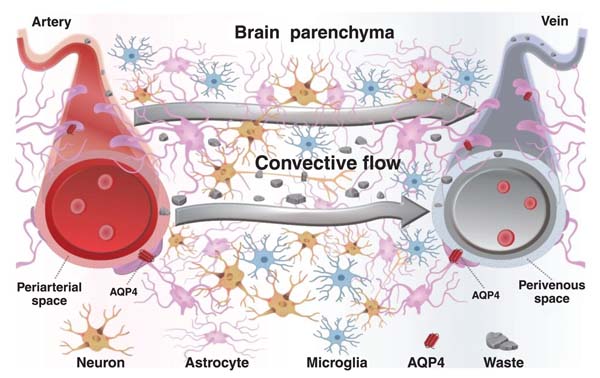
The clearance of extracellular material from the brain has been a topic of great interest in the scientific community. Illif et al. recently described the role of the glymphatic system in this clearence,1 which consists of a peri-arterial flow of cerebral spinal fluid (CSF) driven by the pulsatility of the arterial wall (Figure 1). The fluid exchange occurring in the glymphatic system ultimately helps maintain homeostasis in the central nervous system by removing toxic components and excessive proteins, such as amyloid-beta (Aß), a-synuclein, and tau.2 It has been shown that glymphatic fluid leaves the brain through peri-venous spaces and ultimately leaves the central nervous system into the deep cervical lymph node through lymphatic vessels surrounding the skull.3 It has been speculated that through the excretion of excessive proteins, the glymphatic system may prevent proteins from aggregating in the brain's interstitial spaces.
Alzheimer's disease (AD) is typically characterized by brain accumulation of Aß protein in the form of plaques and tau protein in the form of neurofibrillary tangles, which leads to brain degeneration and eventually cognitive decline.4,5 AD patients are known to have altered CSF flow, and impaired brain clearance is postulated as one cause of AD-related protein aggregation.6 In addition, Aß accumulation may occur in the vascular space, leading to cerebral amyloid angiopathy, which may reduce arterial pulsation, the driving force of the glymphatic system.1,2,7 Recent studies have identified that as the brain ages, the efficiency of perivascular fluid exchange within the glymphatic system significantly reduces, leading to a reduction in Aß clearance while production remains constant.6 Taken together, these observations suggest that glymphatic system waste management dysfunction has a role in the pathogenesis of AD. In preclinical observations of the glymphatic system, CSF intermixes with the interstitial, spinal fluid through a process that utilizes aquaporin-4 water channels (AQP4). AQP4 is a water channel protein found in the endfeet of astrocytes covering the cerebral vasculature and perivascular spaces of the brain that is believed to be driven by cerebral arterial pulsation. AQP4 channels contribute to brain homeostasis by acting as selectively permeable water channels that facilitate water transport across the plasma membrane and manage the exchange of brain-specific extracellular fluid, such as through the influx of CSF and the efflux of interstitial and spinal fluid.8 Human studies have shown reduced polarization and modified expression of AQP4 in AD patients.9 Reduced perivascular AQP4 levels were found in the frontal cortex of AD patients in a post-mortem study, while preserved AQP4 levels were found in those who remained cognitively intact.9 In addition, single nucleotide polymorphisms of the AQP4 gene have been associated with Aß production and cognitive decline.10 These results suggest AQP4 as a potential target to rectify glymphatic system impairment in AD patients.
To conclude, the link between the glymphatic system and protein aggregation in AD still has many unresolved issues, including the need for a better understanding of fluid dynamics and artifacts when analyzing histological data. Currently, the waste clearance role that the glymphatic system plays via AQP4 seems associated with central nervous system homeostasis and balanced protein accumulation, including Aß, a hallmark of AD. Targeting the brain's waste removal system is an attractive option because it has the potential to decrease aggregation of different proteins in bulk without the need for specific transporters. If successful, this could alleviate the brain burden of multiple proteinopathies. This approach aligns with the notion that AD is a multifactorial condition in which multiple brain processes play a role in dementia symptoms.11
Disclosure
The authors report no conflicts of interest.
 PDF
 Print
 Send this article by email
 How to cite this article
 Submit a comment
 Mendeley
 Pocket
 Share on Facebook
 Share on Twitter