



ABSTRACT:
OBJECTIVE: To evaluate the effect of narrative therapy on post-traumatic stress disorder (PTSD)
symptoms, perceived stress, anxiety, and depression in nurses.
METHODS: A total of 92 clinical nurses with positive PTSD symptom screening results were randomly
assigned (1:1) to the intervention or control group. The intervention group received
narrative therapy and a psychological stress leaflet, while the control group received
only a psychological stress leaflet. PTSD, perceived stress, anxiety, and depression
were measured before and after the intervention to assess the effect of narrative
therapy.
RESULTS: After the intervention, the intervention group showed significantly lower PTSD symptom
levels (p = 0.025), perceived stress (p = 0.033), anxiety (p = 0.004), and depression
(p = 0.015) than the control group. Regarding the dichotomous PTSD, anxiety, and depression
outcomes, there was a statistically significant decrease in the number of positive
cases of PTSD (p = 0.030) and anxiety (p = 0.002), but no significant change in the
number of positive cases of depression (p = 0.060).
CONCLUSION: Narrative therapy is expected to alleviate PTSD symptoms, stress, anxiety, and depression
among frontline clinical nurses, and healthcare managers should consider narrative
therapy interventions to improve the mental health of their nursing staff.
CLINICAL TRIAL REGISTRATION: ChiCTR2200058472. Registration date: April 09, 2022. Date of first recruitment: June
1, 2022.
Keywords: Narrative therapy; clinical nurse; post-traumatic stress disorder; perceived stress; anxiety; depression.
FIGURES
| Note: How to cite this article: Xue M, Yu P, Gu Z, Sun Y. Online narrative therapy intervention improves post-traumatic stress disorder symptoms, perceived stress, anxiety, and depression in nurses: a randomized controlled trial. Braz J Psychiatry. 2025;47:e20243740. http://doi.org/10.47626/1516-4446-2024-3740 |
| Received: May 22 2024; Accepted: August 30 2024 |
INTRODUCTION
Nurses, the largest occupational group in the healthcare industry, often face severe physical and psychological stress,1 which not only affects their productivity and well-being, but may lead to mental illness (e.g., post-traumatic stress disorder [PTSD], anxiety, and depression).2 In China, the problem seems even more pronounced. With the rapid development of healthcare in China, the increasing workload and stress have threatened the mental health of nurses. One study found that the mental health of Chinese nurses steadily declined between 1998 and 2016.3 Evidence suggests that nurses' mental health problems can affect their job performance and satisfaction and increase burnout, leading to either the desire to quit or to quitting.2,4,5 Mental health issues among nurses are closely related to care quality and patient safety issues.6,7 Therefore, maintaining nurses' mental health is critical to their physical and mental health, as well as to patient safety and employee retention.
PTSD is a long-term psychosomatic disorder that develops in individuals after experiencing a threat or traumatic event. According to the DSM-5, clinical symptoms include the repeated recurrence of traumatic experiences, continued avoidance of stimuli associated with traumatic events, negative changes in cognition and mood, and continued increased alertness.8 A previous study found that 14.7% of nurses had PTSD symptoms.9 A recent integrative review found that 6.7%-95.7% of nurses had at least one PTSD symptom, and 8.5%-20.8% met the criteria for PTSD,10 which is much higher than its prevalence in the general population or among people who have been exposed to trauma.11 This is due to the particular nature of nursing, which involves long-term exposure to stressors and significant mental stress, making them a high-risk population for PTSD. Traumatic events are significant factors that affect nursing staff, such as deaths from car accidents, violent injuries, or severe burns.12 Nurses are often exposed, directly or indirectly, to traumatic situations at work. Van der Ploeg et al.13 found that more than 85% of medical staff have experienced a traumatic event in the last 5 years. In addition, medical staff serve on the front lines during major public health events, such as the coronavirus disease 2019 pandemic, and their greater pressure and workload often result in anxiety, depression, and other psychological stress reactions. Such psychological stress can be transformed into PTSD.14 Workplace violence, bullying, and other incidents may also cause PTSD symptoms in nurses, seriously affecting their physical and mental health, work, and life.15 PTSD, a type of mental illness caused by fear or helplessness due to traumatic events or extreme pressure, not only diminishes nurses' enthusiasm for work but causes secondary anxiety and depression, leading to reduced quality of life, empathy fatigue, job burnout and turnover, and even suicide.16-19 Although negative emotions have a significant impact on nurses' physical and mental health, there are few effective strategies to reduce the occurrence of these problems, especially the occurrence of PTSD symptoms.
Evidence suggests that traumatic experiences or chronic stressors can impair the stress response system or autonomic nervous system, leading to negative emotions of stress, anxiety, and depression.20-22 The influence of objective events is determined to some extent by an individual's perception of the stress resulting from the event.23 Perceiving one's environment to be stressful has a greater influence on one's response than objectively measured stressors.24 Lazarus & Folkman25 define perceived stress as a response to an environment perceived as a threat to one's ability and health. Health professionals show higher levels of psychosocial stress than other population samples.26 Nurses have high responsibilities, risks, and workloads and are often faced with patient suffering and death. Heavy stress puts nurses at high risk for anxiety and depression,27 which can have a serious negative impact on their quality of life.28 Interestingly, Hatch et al.29 found that symptoms of anxiety, depression, and PTSD have a 65% chance of co-occurring. Therefore, improving stress, anxiety, and depression symptoms among nurses has become an urgent task for hospital administrators.
Narrative psychotherapy, also known as narrative therapy (NT), encourages individuals to share their stories through language and narrative description, enabling individuals to externalize their problems into social, cultural, or political contexts, view their problems from these contexts, and induce therapeutic change.30 The theory was developed in the 1980s by Australian clinical psychologist Michael White and New Zealander social worker and therapist David Epston. It is an emerging psychotherapeutic orientation derived from family therapy and has become one of the most valued psychological interventions in recent years for its therapeutic effectiveness and ease of practice.31 The theory consists of five main processes: problem externalization, deconstruction, reframing, external witnessing, and treatment documentation.32 Problem externalization includes four stages: naming the problem, asking about the impact, assessing the impact, and arguing for assessment. The main purpose is to separate clients from their problems and make them aware that the person is not the problem, thus reducing guilt. Deconstruction invites clients to explore the source of the problem, ideas, and feelings and to reflect on the background culture's influence on the story and its construction. Reconstruction occurs through the counselor's guidance around positive events, and the process develops alternative stories that weaken the negative impact of the problem story. External witnesses may include the visitor's family, friends, or dolls. Therapeutic documents include letters, awards, etc.33
There is growing evidence that NT is effective against negative emotions, such as PTSD symptoms, anxiety, and depression.34-36 A study of veterans diagnosed with PTSD found a significant reduction in PTSD symptoms after applying an NT intervention; the participants had high levels of satisfaction with the treatment process, and the findings suggested the need for further research into NT as a potential alternative to existing PTSD treatments.36 Meanwhile, NT can help reduce depression and anxiety symptoms in depressed patients by focusing on positive experiences and creating positive stories. This intervention strategy is effective in improving mental health problems.34,37 NT provides a way to improve negative emotions among clinical nurses.38 In the treatment process, narrative therapists can listen to their negative stories, use externalization and deconstruction to ensure that they fully vent their emotions, and help them find "exceptional events" with positive significance, guiding them to construct positive stories, which stimulate the development of internal strength and lead to meaningful individual change. This study focused on registered nurses on the front lines of clinical practice who have experienced major public health events and stressful or traumatic events that have negatively impacted them in order to meet their urgent need for improved mental health.
Therefore, the aim of this study was to examine the effectiveness of an NT-based online treatment program for clinical nurses with perceived stress, PTSD symptoms, anxiety, and depression in an effort to maintain or improve their physical and mental health.
METHODS
Study design and participants
This study, a group of randomized controlled trials, was conducted in two tertiary hospitals in Jiangsu Province from June 2022 to August 2022, using a cluster randomization method according to institution. The intervention and control groups were randomly grouped by lottery, which was done to prevent sample contamination and improve participant adherence. The number of study participants was accurately calculated using G*Power 3.1.9.7 and a t-test statistical model was selected, using a priori analysis with a two-sided test, a = 0.05, 1-ß = 0.9, d = 0.7 (d indicates the effect size). The sample size ratio of the observation group to the control group was set at 1:1, and based on the pre-experimental results, the size of each group was calculated as 44, totaling 88 participants. The study population consisted of registered nurses at least 18 years of age who work in a clinical setting. Participants were screened for PTSD symptoms and had a PTSD checklist score = 33. Exclusion criteria were participation in other interventional studies, having been treated with psycho-sedative medications, a history of alcohol or drug abuse, having been diagnosed with a severe mental disorder, and lack of Internet access. Ultimately, we recruited 92 registered nurses from two hospitals (intervention group = 46, control group = 46). This study was registered in the Chinese Clinical Trial Registry on April 9, 2022 (registration number: ChiCTR2200058472). All participants provided written and verbal informed consent.
Procedure
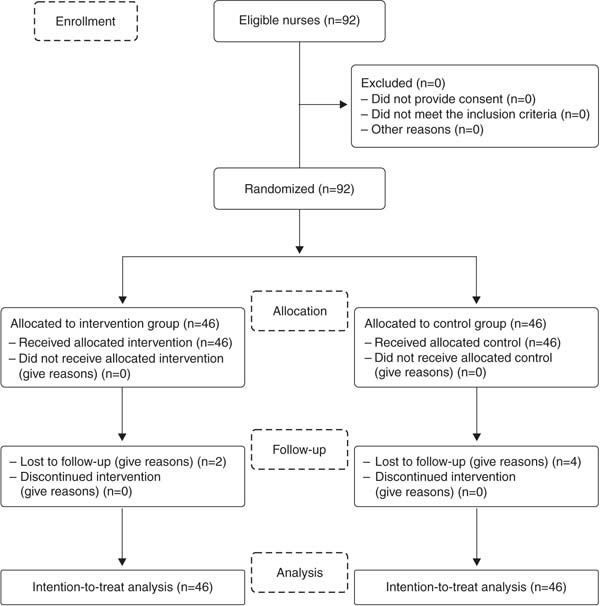
We used demographic questionnaires, a traumatic event questionnaire for nurses, the PTSD checklist,39 the Perceived Stress Scale,40 the Generalized Anxiety Disorder Scale,41 and the Patient Health Questionnaire Depression Scale42 to examine baseline levels in both groups. Two groups of nurses received psychological stress leaflets, on the basis of which the intervention group underwent a one-to-one online NT intervention program, while the control group did not. After 8 weeks, the test results for the measured variables were compared between groups. We then analyzed changes in the number of cases of PTSD, anxiety, and depression after the intervention in each group. Although we recruited and assessed 92 registered nurses, two members of the intervention group discontinued the intervention due to work-related reasons. Four nurses in the control group were unable to complete the final assessment, as shown in Figure 1.
Interventions
Psychological stress manual
The manual consists of three main parts: processes and outcomes of psychological stress development, coping with traumatic events, and negative emotions and stress management. The first section is related to the stress process, which consists of four components: input, mediator, response, and outcome. The second section is on coping with traumatic events, such as exercising, maintaining positive social relationships, and seeking professional help. The third section deals with negative emotions and stress management, such as quick ways to regulate emotions, self-regulation methods, and techniques for maintaining mental health. Participants were asked to read these frequently, especially when they underwent trauma or felt anxious and stressed.
Online treatment program based on narrative therapy
Team formation and training for NT. To ensure that the NT intervention protocol was correct, effective, and complete, members of the study team attended study sessions and training skills on NT to ensure that they were qualified to participate in the intervention process. The entire intervention was supervised and guided by a licensed psychotherapist and nursing specialist. One of the investigators conducted a one-on-one video chat with the participants, with the participant's consent, and the interview was recorded. Two other investigators were responsible for contacting participants to set appointment times and collect data.
Development and implementation of a narrative treatment plan. The NT intervention program was divided into three stages. First, based on prior research, the program was developed by drawing on techniques related to narrative psychotherapy theory and the appropriate application of problem externalization, deconstruction, reframing, external witnessing, and treatment documentation to effectively guide clinical nurses in narrating their stories. Second, the program was revised through group discussions and two rounds of correspondence with 15 experts. Finally, the intervention protocol was tested and optimized during the pre-experimental period to finalize its format, timing, frequency, themes, goals, content, and questions.
Our study took the form of a 45-60 minute one-to-one video call once a week for 8 weeks. The specific intervention protocol is shown in Supplementary Box S1.
Measures
Demographic questionnaire
The questionnaire included age, sex, marital status, years employed as nurse, education, and professional title.
Traumatic event questionnaire for nurses
Based on an extensive literature review,43-45 we designed a questionnaire on traumatic events specifically for nurses, which was mainly used to observe the frequency of traumatic events. This questionnaire included 23 traumatic events that could lead to PTSD in nurses. Four response options (none, occasionally, often, and always) were allowed for each type. The Cronbach's alpha was 0.905.
The Posttraumatic Stress Disorder Checklist for DSM-5
PTSD screening was based on DSM-5 diagnostic criteria.39 The questionnaire included 20 items, including intrusive symptoms (criterion B, avoidance symptoms [criterion C], negative changes in cognition and mood symptoms [criterion D], and hyperarousal [criterion E]). Responses were on a 5-point Likert scale ranging from 0 (not at all) to 4 (extreme). Total scores ranged from 0-80 points, with higher scores indicating more severe PTSD symptoms. The judgment standards were: 1) post-traumatic stress disorder checklist for DSM-5 scores = 33 indicate the presence of PTSD symptoms14; 2) according to the DSM-5, for PTSD to be considered positive, an individual must have at least one symptom of criterion B, one symptom of criterion C, two symptoms of criterion D, and two symptoms of criterion E, each with a symptom score = 2.39 In a study on psychiatric nurses, Yoon et al.14 found that the Posttraumatic Stress Disorder Checklist for DSM-5 had strong internal consistency.
The Chinese Version of the Perceived Stress Scale
The Perceived Stress Scale, compiled by Cohen et al.,46 was translated into Chinese and revised by Yang et al. in 2003.40 The scale includes two dimensions, tension and control, each including 14 items on a 5-point Likert scale ranging from 0 (never) to 4 (very common). The scale is used to measure the respondent's self-perceived stress level, with total scores ranging from 0-56 points. Higher scores indicate greater stress. The Chinese version of the scale has good reliability and validity.40,47
Generalized Anxiety Disorder Scale
The Generalized Anxiety Disorder Scale41 was used to assess the severity of seven anxiety symptoms in the last 2 weeks. The scale uses a 4-point Likert scale from 0 (not at all) to 3 (nearly every day), with overall scores ranging from 0-21 points. Higher scores indicate more severe anxiety symptoms.
The Patient Health Questionnaire-9
The Patient Health Questionnaire-9 Depression Scale was used to assess the severity of depressive symptoms over the past 2 weeks.42 The scale consists of nine items, using a 4-point Likert scale from 0 (not at all) to 3 (nearly every day), with total scores ranging from 0-27 points. Higher scores indicate more severe depressive symptoms.
Data analyses
Intention-to-treat analysis was used to process missing data.48 The categorical variables were described using frequency and percentage, while continuous variables were described using mean (SD). Pearson's chi-square test was used to analyze the differences in categorical variables. For normally distributed variables, differences between groups of continuous variables were tested using an independent sample t-test; otherwise, the Mann-Whitney U nonparametric test was used. All data were analyzed using IBM SPSS Statistics 26.0, with p < 0.05 considered statistically significant (two-tailed).
Ethics statement
All participants provided written informed consent before involvement in any research activity. All methods were performed in accordance with relevant guidelines and regulations.
RESULTS
Enrollment and baseline characteristics of the participants
Ninety-two clinical nurses were recruited and randomly assigned as a cluster to either the intervention (n = 46) or control (n = 46) group. There were no statistically significant differences regarding age, sex, marital status, or other demographic characteristics between the groups (p > 0.05). There were also no significant differences between the groups regarding PTSD, perceived stress, anxiety, and depression scores (p > 0.05), as shown in Table 1.
| All (n=92) | Control group (n=46) | Intervention group (n=46) | F/Z | p-value | |
|---|---|---|---|---|---|
| Age | 31.63±6.30 | 30.72±5.81 | 32.54±6.69 | -1.405╬ | 0.160╬ |
| Sex | 0.345┼ | 0.557 | |||
| Male | 3 (3.3) | 1 (1.1) | 2 (2.2) | ||
| Female | 89 (96.7) | 45 (48.9) | 46 (47.8) | ||
| Marital status | 1.042┼ | 0.594 | |||
| Unmarried | 23 (25.0) | 12 (13.0) | 11 (12.0) | ||
| Married | 68 (73.9) | 34 (37.0) | 34 (37.0) | ||
| Divorced or widowed | 1 (1.1) | 0 (0.0) | 1 (1.1) | ||
| Years employed as nurse | 9.55±6.65 | 8.35±5.90 | 10.75±7.20 | -1.678╬ | 0.093╬ |
| Education | 0.155┼ | 0.694 | |||
| < Bachelor's degree | 7 (7.6) | 3 (3.3) | 4 (4.3) | ||
| = Bachelor's degree | 85 (92.4) | 43 (46.7) | 42 (45.7) | ||
| Professional title | 5.943┼ | 0.114 | |||
| Nurse | 9 (9.8) | 3 (3.3) | 6 (6.5) | ||
| Senior nurse | 49 (53.3) | 29 (31.5) | 20 (21.7) | ||
| Nurse-in-charge | 31 (33.7) | 14 (15.2) | 17 (18.5) | ||
| Deputy chief nurse or higher | 3 (3.3) | 0 (0.0) | 3 (3.3) | ||
| PTSD | 43.53±10.94 | 42.20±9.99 | 44.87±11.77 | -1.420╬ | 0.156 |
| Criterion B | 11.23±3.67 | 10.41±3.38 | 12.04±3.79 | -1.797╬ | 0.072 |
| Criterion C | 4.53±1.38 | 4.39±1.18 | 4.67±1.55 | -0.361╬ | 0.718 |
| Criterion D | 15.24±3.91 | 15.02±3.74 | 15.46±4.10 | -0.349╬ | 0.727 |
| Criterion E | 12.53±3.71 | 12.37±3.56 | 12.70±3.89 | -0.028╬ | 0.978 |
| Perceived stress | 29.61±3.84 | 29.57±4.30 | 29.65±3.37 | -0.293╬ | 0.770 |
| Anxiety | 10.58±4.54 | 10.22±4.52 | 10.93±4.59 | -0.790╬ | 0.429 |
| Depression | 13.64±5.36 | 14.00±5.00 | 13.28±5.74 | -0.742╬ | 0.458 |
| Anxiety | 1.392┼ | 0.238 | |||
| No | 7 (7.6) | 5 (10.9) | 2 (4.3) | ||
| Yes | 85 (92.4) | 41 (89.1) | 44 (95.7) | ||
| Depression | 1.903┼ | 0.168 | |||
| No | 5 (5.4) | 1 (2.2) | 4 (8.7) | ||
| Yes | 87 (94.6) | 45 (97.8) | 42 (91.3) |
Traumatic events in nurses
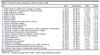
We investigated the frequency of traumatic events in the groups (Table 2); data were missing from two respondents in each group.
| Item | None | Occasionally | Often | Always |
|---|---|---|---|---|
| 1. Sudden death of a patient due to change in condition | 11 (12.5) | 56 (63.6) | 17 (19.3) | 4 (4.5) |
| 2. Patient death due to nontreatment for financial reasons | 14 (15.9) | 49 (55.7) | 24 (27.3) | 1 (1.1) |
| 3. Sudden suicide of a patient | 59 (67.0) | 24 (27.3) | 4 (4.5) | 1 (1.1) |
| 4. Sudden death of young adults | 38 (43.2) | 41 (46.6) | 8 (9.1) | 1 (1.1) |
| 5. Death of a child | 53 (60.2) | 28 (31.8) | 7 (8.0) | 0 (0.0) |
| 6. Palliative nursing | 30 (34.1) | 47 (53.4) | 11 (12.5) | 0 (0.0) |
| 7. Recovery failure | 16 (18.2) | 54 (61.4) | 17 (19.3) | 1 (1.1) |
| 8. Caring for patients with severe burns or trauma | 35 (39.8) | 39 (44.3) | 13 (14.8) | 1 (1.1) |
| 9. Caring for psychiatric patients | 27 (30.7) | 49 (55.7) | 10 (11.3) | 2 (2.3) |
| 10. Caring for patients with delirium | 14 (15.9) | 42 (47.7) | 30 (34.1) | 2 (2.3) |
| 11. Rescuing suicidal patients | 36 (40.9) | 37 (42.0) | 14 (15.9) | 1 (1.1) |
| 12. Rescuing comatose patients who have no money, companions, or legal status | 19 (21.6) | 50 (56.8) | 19 (21.6) | 0 (0.0) |
| 13. Caring for a relative or close friend whose life is in danger | 37 (42.0) | 33 (37.5) | 14 (15.9) | 4 (4.5) |
| 14. Verbal abuse from patients or family members | 13 (14.8) | 53 (60.2) | 22 (25.0) | 0 (0.0) |
| 15. Verbal or physical threats from patients or family members | 25 (28.4) | 51 (58.0) | 12 (13.6) | 0 (0.0) |
| 16. Physical assault by a patient or family member | 44 (50.0) | 35 (39.8) | 9 (10.2) | 0 (0.0) |
| 17. Sexual harassment | 81 (92.0) | 6 (6.8) | 1 (1.1) | 0 (0.0) |
| 18. Occupational exposure | 27 (30.7) | 53 (60.2) | 8 (9.1) | 0 (0.0) |
| 19. Verbal abuse by a physician | 64 (72.7) | 20 (22.7) | 4 (4.6) | 0 (0.0) |
| 20. Bullying by a colleague | 63 (71.6) | 23 (26.1) | 2 (2.3) | 0 (0.0) |
| 21. Exposure to life-threatening epidemics (e.g., SARS, COVID-19) | 29 (33.0) | 47 (53.4) | 11 (12.5) | 1 (1.1) |
| 22. Treating large numbers of patients with food poisoning | 69 (78.4) | 16 (18.2) | 3 (3.4) | 0 (0.0) |
| 23. Treating a large number of patients after traumatic accidents | 61 (69.3) | 21 (23.9) | 6 (6.8) | 0 (0.0) |
Data presented as n (%).
COVID-19 = coronavirus disease 2019; SARS = severe acute respiratory syndrome.
Primary outcome
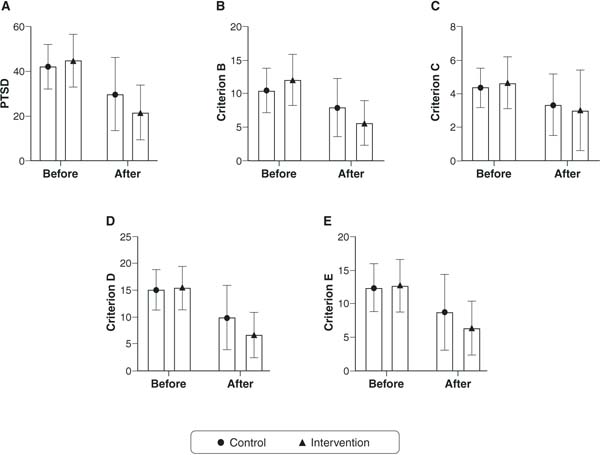
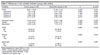
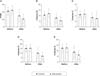
After the intervention, PTSD symptoms (criteria B, D, and E scores) were significantly lower in the intervention group than the control group (p < 0.05). However, there was no significant difference in criterion C scores between the groups (p > 0.05), as shown in Table 3. Figure 2 compares PTSD symptoms (criteria B, C, D, and E scores) between the groups before and after the intervention. The number of PTSD cases in the intervention group was significantly lower than in the control group (p < 0.05).
| Variables | Control group (n=46) | Intervention group (n=46) | Z | p-value |
|---|---|---|---|---|
| PTSD | 29.91±16.46 | 21.59±12.19 | -2.235┼ | 0.025 |
| Criterion B | 7.91±4.36 | 5.57±3.32 | -3.054┼ | 0.002 |
| Criterion C | 3.37±1.82 | 3.02±2.39 | -1.185┼ | 0.236 |
| Criterion D | 9.89±5.96 | 6.65±4.22 | -2.747┼ | 0.006 |
| Criterion E | 8.74±5.63 | 6.35±3.96 | -2.013┼ | 0.044 |
| Perceived stress | 27.59±6.18 | 24.41±7.80 | -2.130┼ | 0.033 |
| Anxiety | 7.54±4.34 | 5.50±3.79 | -2.850┼ | 0.004 |
| Depression | 10.59±5.60 | 7.74±4.73 | -2.434┼ | 0.015 |
| PTSD | 4.696╬ | 0.030 | ||
| No | 30 (65.2) | 39 (84.8) | ||
| Yes | 16 (34.8) | 7 (15.2) | ||
| Anxiety | 9.282╬ | 0.002 | ||
| No | 6 (13.0) | 19 (41.3) | ||
| Yes | 40 (87.0) | 27 (58.7) | ||
| Depression | 3.536╬ | 0.060 | ||
| No | 5 (10.9) | 12 (26.1) | ||
| Yes | 41(89.1) | 34 (73.9) |
Secondary outcomes
After the intervention, perceived stress, anxiety, and depression were significantly lower in the intervention group than the control group (p < 0.05), as shown in Table 3. Among the dichotomous outcome variables, the number of anxiety cases was significantly lower in the intervention group than the control group (p < 0.01), but there was no difference in the number of depression cases (p > 0.05).
DISCUSSION
The five most frequent traumatic events in both groups were "sudden death of patient due to change in condition," "verbal abuse by patients or family members," "patient death due to nontreatment for financial reasons," "caring for a patient with delirium," and "recovery failure." Researchers believe that the death or near death of special patients has a great psychological impact on nurses.44 Nurses have an innate sense of responsibility to protect vulnerable patients from pain and suffering. However, since nurses are often in contact with patients and families who are experiencing traumatic events, they are at an increased risk of developing PTSD.10 Studies have shown that workplace violence (e.g., assault, verbal abuse, and bullying) is also a risk factor for PTSD in healthcare workers. Cumulative exposure to traumatic events, including workplace violence, can have adverse effects on the physical and mental health of victims, such as PTSD, burnout, etc.49
To our knowledge, this is the first study to investigate the effectiveness of an NT-based online treatment program for PTSD symptoms, perceived stress, anxiety, and depression among frontline clinical nurses. After 8 weeks of intervention, with the exception of criterion C, the intervention group showed lower criteria B, D, and E PTSD symptoms than the control group. Research suggests that avoidance (criterion C) may be a significant barrier to PTSD treatment.50 People who have experienced trauma and have PTSD symptoms may avoid disclosing their experiences and avoid reminders of the trauma. NT helps clients examine their problem objectively and explore the causes and effects of negative emotions. Rewriting techniques help clients identify exceptional events and escape the dominant role of negative emotions, which leads to cognitive and emotional changes and a positive outlook on the future.51 Through the process of confiding, clients gradually discover the positive forces hidden within them, and these forces build up their courage and confidence to face difficulties, resulting in a positive self-identity,52 thus reducing the occurrence of intrusive symptoms and hyperarousal. Frontline clinical nurses often face stressful work conditions and traumatic events that seriously affect their physical and mental health. Evidence-based treatment plans developed using the NT theory of mind emphasize a client-centered approach. The theory is that narrative therapists and clients are in a collaborative relationship that can help clients tell the story of their experience and reconstruct it through deconstruction, externalization, and rewriting processes. As Frank53 argues, stories themselves can heal people by affirming what is valuable and by sharing personal pain and suffering with others. Most participants tend to talk, and their discourse is full of loss, pain, anxiety, and other emotions. By listening to clients, narrative therapists meet their needs, and through dialogue, understanding, and responding to their story, they provide psychological therapy and support, which can reduce PTSD symptoms.
According to our results, the intervention group had lower perceived stress, anxiety, and depression than the control group. Research suggests that PTSD symptoms may lead to additional psychological disorders, such as anxiety and depression, and these combined symptoms may decrease as PTSD symptoms improve.54 There is also a growing body of evidence that NT can reduce anxiety and depression levels.34,37 NT theory requires distinguishing the problem from the person, and practitioners help clients separate themselves from the problem by naming the problem, asking about its impact, etc. Together, they tap into the clients' potential strengths and help them rebuild their cognitive structure, fostering hope and positive emotions, enabling them to face stress and difficulties in a positive way.
There is an urgent need to address mental health problems among frontline clinical nurses. Affected individuals need psychotherapy and psychological support as soon as possible. NT-based online treatment programs, as standardized and procedural interventions with broad applicability, may have a favorable impact on frontline clinical nurses who experience stressful situations or traumatic events, improving their psychological stress responses and helping them adapt to their complex work environments.
The evidence generated in this study has important practical implications for online psychological support interventions for clinical nurses. However, our study has several limitations. First, we used the self-reported Posttraumatic Stress Disorder Checklist for DSM-5 to assess PTSD symptoms and, although this questionnaire has good reliability, a clinical structured interview could be used for diagnosis in future studies. Second, the large percentage of women (96.7%) in our sample may have led to some bias. Third, our study used a quantitative design instead of mixed data collection, although qualitative research designs can better explain the advantages and disadvantages of NT for psychological problems. Fourth, although our study implemented an NT intervention with nurses who had experienced trauma, we did not determine the time elapsed since the traumatic experience, which may have led to some bias. Finally, because we did not assess the long-term impact of the online NT-based treatment program, these effects should be determined in future studies.
This study demonstrated that an online NT-based treatment intervention reduced PTSD symptoms, perceived stress, anxiety, and depression in clinical nurses. Nurses who experience major public health events, stressful situations, and traumatic events are highly susceptible to PTSD, anxiety, and depression symptoms, and these conditions can negatively affect their physical and mental health, as well as the quality of care they provide. As a standardized and procedural intervention, online NT-based treatment is an effective intervention for psychological stress responses with broad applicability. Hospital administrators and healthcare providers should consider its widespread use to prevent and treat mental health problems among clinical nurses.
Relevance for clinical practice
Clinical nurses are frequently exposed, either directly or indirectly, to trauma and work stressors, and mental health problems, such as PTSD, anxiety, and depression, seriously affect their physical and mental health. Online NT-based treatment programs can improve perceived stress and PTSD, anxiety, and depression levels among nurses. The intervention used in this study is easy to implement and replicate and can reduce mental health problems among nurses.
ACKNOWLEDGEMENTS
This study was supported by the Jiangsu Graduate Research and Innovation Program (KYCX21_3298); Science and Technology Innovation Project of Jinling Hospital, Affiliated Hospital of Medical School, Nanjing University (2023YYHLZX199).
The authors would like to thank all of the nurses who participated in the study.
 PDF
 Print
 Send this article by email
 How to cite this article
 Submit a comment
 Mendeley
 Pocket
 Share on Facebook
 Share on Twitter



