



ABSTRACT:
OBJECTIVE: This study analyzed the role of vaccination in preventing COVID-19-related mortality
in patients with schizophrenia.
METHODS: This retrospective cohort study analyzed data from the Influenza Epidemiological Surveillance
Information System (Sistema de Informação da Vigilância Epidemiológica da Gripe [SIVEP-Gripe])
database, focusing on patients aged = 18 years with laboratory-confirmed COVID-19
between February 2020 and February 2023. The primary exposure was schizophrenia. The
primary outcome of interest was the role of vaccines in preventing COVID-19-associated
mortality. Statistical analysis included multiple binary logistic regressions to determine
the impact of schizophrenia on mortality and to compare vaccine protection between
cohorts.
RESULTS: The cohort included 2,131,089 patients, 3,516 (0.2%) of whom had schizophrenia. After
adjusting for potential confounders, patients with schizophrenia presented a significantly
higher risk of severe disease (OR = 1.59, 95%CI 1.39-1.81) and mortality (OR = 1.65,
95%CI 1.45-1.87). After the booster dose, protection against mortality was estimated
at 67.7% (95%CI 66.5-68.7) in the non-schizophrenia cohort and 62.4% (95%CI 44.1-74.6)
in the schizophrenia cohort. Mortality rate differences of approximately 20% and 10%
were observed between boosted and non-vaccinated individuals among the schizophrenia
and non-schizophrenia cohorts, respectively. Consequently, five patients (95%CI 4-8)
with schizophrenia and 10 patients (95%CI 9-11) in the general population would need
to receive a booster dose to prevent one fatality.
CONCLUSIONS: Our results suggest that vaccination provided similar protection against COVID-19-related
mortality in individuals with and without schizophrenia. However, the magnitude of
the intervention effect was double for individuals with schizophrenia due to their
higher baseline risk.
Keywords: COVID-19; schizophrenia; vaccine effectiveness; mental disorders; vaccination.
FIGURES
| Note: How to cite this article: Oliveira FES, Martelli-Júnior H, Colosimo EA, Silva ACS, Dias CS, Diniz LO, et al. Vaccine protection against COVID-19-related mortality in patients with schizophrenia: a retrospective cohort study. Braz J Psychiatry. 2025;47:e20244024. http://doi.org/10.47626/1516-4446-2024-4024 |
| Received: November 13 2024; Accepted: March 21 2025 |
INTRODUCTION
Coronavirus disease 2019 (COVID-19) is associated with a higher likelihood of severe symptoms and increased mortality in older adults and individuals with comorbidities.1 Severe psychiatric disorders, such as schizophrenia, have also been correlated with poorer COVID-19 outcomes.2-4 While limited research has explored vaccine response in patients with schizophrenia, existing studies have produced conflicting results regarding vaccine protection in this population. Some studies5-7 have indicated that vaccine protection is lower in this population, whereas others8,9 have suggested that it is effective.
Recently, we reported that patients with schizophrenia had a 68% higher COVID-19 mortality risk than the general Brazilian population.10 In this study, we expanded the analysis to address the knowledge gap regarding the role of vaccines in preventing COVID-19-related deaths in patients with schizophrenia using a large nationwide Brazilian cohort.
METHODS
Data source and study design
This retrospective cohort study was based on data from hospitalized patients recorded in the Influenza Epidemiological Surveillance Information System (Sistema de Informação da Vigilância Epidemiológica da Gripe [SIVEP-Gripe]). SIVEP-Gripe is a national Brazilian database that tracks severe acute respiratory infection cases.11 Information about SIVEP-Gripe is available at https://opendatasus.saude.gov.br/dataset.
Participants
The inclusion criteria were COVID-19 patients aged = 18 years who were registered in the database between February 2020 and February 2023. All patients had positive results for severe acute respiratory syndrome coronavirus 2 (SARS-CoV-2), confirmed by either quantitative reverse transcription polymerase chain reaction or antigen tests.
Exposure of interest
The exposure of interest was schizophrenia. Patients with this condition were identified in the SIVEP-Gripe database by extracting information from a specific text field on preexisting medical conditions.
Vaccination status
Vaccination status was categorized at the time of symptom onset as unvaccinated, partially vaccinated (one dose), fully vaccinated (two doses), or boosted (three doses).
Covariates
This study included demographic and clinical covariates to address potential confounders. Demographic data included age, sex, race (classified according to the Instituto Brasileiro de Geografia e Estatística system, https://www.ibge.gov.br/), educational level, and geographical macroregion. Clinical covariates included symptom onset and hospital admission dates, nosocomial infections, and pre-existing comorbidities, categorized as groups: none, 1, 2, or = 3. COVID-19 severity was assessed by intensive care unit admissions and use of ventilatory support, classified as none, noninvasive, or invasive. Severe COVID-19 was defined as the need for intensive care unit admission, mechanical ventilation, or COVID-related death. The dataset also included information on the virus strain and the number of vaccine doses the patient received.
Outcomes
The primary outcomes of interest were COVID-19 mortality in patients with schizophrenia and the role of vaccines in preventing COVID-19-related mortality in this population.
Statistical analysis
Descriptive statistics are presented as mean and standard deviation, median and interquartile range, or count and proportion, as appropriate. For comparisons between groups, Student's t-test and Pearson's chi-square test were used when applicable. To address the primary outcomes of the study, the analysis was conducted in two stages.
Coronavirus disease 2019-related deaths
To assess the effect of schizophrenia on the mortality of patients with COVID-19, we conducted a multiple binary logistic regression analysis, considering schizophrenia as the primary exposure of interest and COVID-19 mortality as the outcome. Therefore, in-hospital mortality was included as a dependent variable and schizophrenia was included as an independent variable. The model was adjusted for age, sex, race, region, education level, comorbidities, and viral strain.
Vaccine protection against coronavirus disease 2019-related mortality
We analyzed vaccine protection against mortality through two models based on the multiple binary logistic regression method (for the schizophrenia and non-schizophrenia cohorts), considering vaccination status as the primary exposure. In-hospital mortality was included as a dependent variable and vaccination status (stratified according to the number of doses) was included as an independent variable. The models were also adjusted by age, sex, race, region, education level, comorbidities, and virus strain. The results are expressed as vaccine protection (%) using the formula 100 × (1 - adjusted odds ratio [OR]) and 95%CI.12
Finally, because the risk of death differed at baseline, we evaluated the magnitude of the intervention effect by calculating the absolute risk reduction and the number needed to treat for each group.
Ethics statement
We used de-identified, publicly available data from SIVEP-Gripe. The study was approved by the institutional review board of the Universidade Federal de Minas Gerais (CEP 6.127.414) and followed the Strengthening the Reporting of Observational Studies in Epidemiology guidelines for observational cohort studies.13
RESULTS
Baseline demographic and clinical characteristics
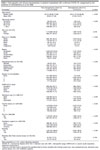
The cohort included a total of 2,131,089 patients, of whom 3,516 had been diagnosed with schizophrenia. The mean age of both groups was similar and the patients with schizophrenia were predominantly male. Compared with the non-schizophrenia cohort, patients with schizophrenia had, in general, a lower educational level and a greater prevalence of comorbidities. The proportion of vaccinated individuals was slightly higher in the schizophrenia group than the non-schizophrenia group (Table 1).
| Covariates┼ | Non-schizophrenia cohort (%)2,127,573 (99.8) | Schizophrenia cohort (%)3,516 (0.2) | p-value |
|---|---|---|---|
| Age (years) | |||
| Median (IQR) | 60.16 (46.66-73.08) | 58.41 (47.50-68.66) | < 0.001 |
| Mean (SD) | 59.84 (17.44) | 57.94 (15.57) | |
| Age group (years) | |||
| 18.0-29.9 | 94,018 (4.4) | 154 (4.4) | < 0.001 |
| 30.0-59.9 | 962,500 (45.2) | 1,757 (50.0) | |
| 60.0-79.9 | 771,152 (36.2) | 1,313 (37.3) | |
| > 80.0 | 299,903 (14.1) | 292 (8.3) | |
| Sex (n=2,131,073) | |||
| Male | 1,170,800 (55.0) | 1,967 (55.9) | 0.276 |
| Female | 956,757 (45.0) | 1,549 (44.1) | |
| Race (n=1,739,886) | < 0.001 | ||
| White | 906,755 (52.2) | 1,616 (54.9) | |
| Mixed | 714,476 (41.1) | 1,111 (37.8) | |
| Black | 90,761 (5.2) | 178 (6.1) | |
| Asian | 21,139 (1.2) | 35 (1.2) | |
| Indigenous | 3,813 (0.2) | 2 (0.1) | |
| Region | < 0.001 | ||
| Southeast | 1,050,479 (49.4) | 1,741 (49.5) | |
| South | 362,456 (17.0) | 708 (20.1) | |
| Central-West | 215,500 (10.1) | 359 (10.2) | |
| Northeast | 358,627 (16.9) | 631 (17.9) | |
| North | 140,511 (6.6) | 77 (2.2) | |
| Educational level (n=754,185) | < 0.001 | ||
| Illiterate | 49,975 (6.6) | 144 (12.3) | |
| Elementary | 204,197 (27.1) | 411 (35.2) | |
| Middle School | 140,179 (18.6) | 257 (22.0) | |
| High School | 244,781 (32.5) | 299 (25.6) | |
| College | 113,885 (15.1) | 57 (4.9) | |
| Number of comorbidities | |||
| None | 911,098 (42.8) | 172 (4.9) | < 0.001 |
| 1 | 625,409 (29.4) | 2,262 (64.3) | |
| 2 | 413,934 (19.5) | 708 (20.1) | |
| 3 | 177,132 (8.3) | 374 (10.6) | |
| SARS-CoV-2 strain | |||
| Ancestral | 695,280 (32.7) | 983 (28.0) | < 0.001 |
| Gamma | 1,078,150 (50.7) | 1,633 (46.4) | |
| Delta | 114,783 (5.4) | 252 (7.2) | |
| Omicron | 239,360 (11.3) | 648 (18.4) | |
| Admission year (n=1,648,412) | |||
| 2020 | 518,053 (31.5) | 717 (27.0) | < 0.001 |
| 2021 | 956,022 (58.1) | 1,437 (54.0) | |
| 2022/2023 | 171,677 (10.4) | 506 (19.0) | |
| Vaccine doses (n=1,887,890) | < 0.001 | ||
| None | 1,476,804 (78.4) | 2,270 (73.2) | |
| 1 | 103,509 (5.5) | 225 (7.3) | |
| 2 | 199,140 (10.6) | 386 (12.4) | |
| 3 | 105,294 (5.6) | 222 (7.2) | |
| ICU (n=1,836,099) | |||
| No | 1,145,027 (62.5) | 1,692 (52.9) | < 0.001 |
| Yes | 687,874 (37.5) | 1,506 (47.1) | |
| Ventilatory support (n=1,809,738) | |||
| None | 386,361 (21.4) | 564 (17.8) | < 0.001 |
| Non-invasive | 1,051,346 (58.2) | 1,656 (52.2) | |
| Invasive | 368,858 (20.4) | 953 (30.0) | |
| Mortality | |||
| No | 1,447,347 (68.0) | 2,061 (58.6) | < 0.001 |
| Yes | 680,226 (32.0) | 1,455 (41.4) | |
| Mortality after three vaccine doses (n=105,516) | |||
| No | 81,557 (77.5) | 170 (76.6) | 0.754 |
| Yes | 23,737 (25.5) | 52 (23.4) |
Data presented as n (%), unless otherwise specified.
COVID-19 = coronavirus disease 2019; ICU = intensive care unit; IQR = interquartile range; SARS-CoV-2 = severe acute respiratory syndrome coronavirus 2.
┼ Data (n) in the first column represent the available data for those variables with missing values (sex, race, educational level, admission year, vaccine doses, ICU, and ventilatory support).
Outcomes
COVID-19 infection was more severe in the schizophrenia cohort than the non-schizophrenia cohort, as can be observed by the higher prevalence of intensive care unit admission (47.1 vs. 37.5%), invasive ventilatory support (30 vs. 20.4%), and mortality rates (41.4 vs. 32%) (Table 1). After adjusting for potential clinical and epidemiological confounders, the schizophrenia cohort had a significantly higher risk of severe disease (OR = 1.59, 95%CI 1.39-1.81) and mortality (OR = 1.65, 95%CI 1.45-1.87).
Vaccine protection
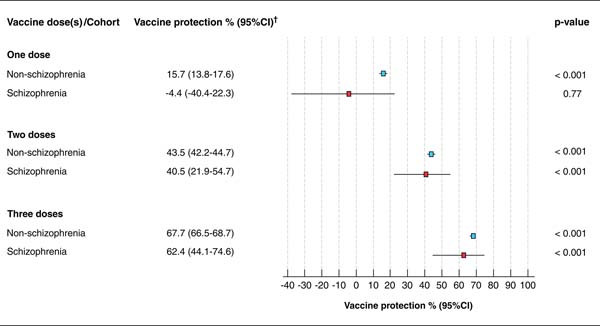
Mortality protection, stratified according to schizophrenia and vaccination status, is shown in Figure 1. All models were adjusted for age, sex, race, region of the country, and comorbidities. Protection was consistently lower in patients with schizophrenia across all vaccination schedules. For instance, at two doses, protection was estimated at 43.5% (95%CI 42.2-44.7) 40.5% (95%CI 21.9-54.7) in the non-schizophrenia and schizophrenia cohorts, respectively. After the booster dose, protection was estimated at 67.7% (95%CI 66.5-68.7) and 62.4% (95%CI 44.1-74.6) in the non-schizophrenia and schizophrenia cohorts, respectively. However, overlapping confidence intervals were observed in both cases.
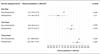
Because the risk of mortality differed at baseline, following the booster dose the intervention effect was estimated to double in the schizophrenia group. For instance, after the third vaccine dose, the absolute risk reduction in mortality was approximately 20% and 10% between boosted and non-vaccinated individuals in the schizophrenia and non-schizophrenia cohorts, respectively. Consequently, the number needed to treat (receiving the booster dose) to prevent one fatality was estimated in five patients with schizophrenia (95%CI 4-8) and 10 patients (95%CI 9-11) in the general population.
DISCUSSION
This retrospective cohort study found that, after controlling for confounders, the odds of severe COVID-19 and mortality were 59% and 65% higher, respectively, for individuals with schizophrenia than the general population. Nevertheless, COVID-19 vaccination significantly mitigated mortality risk in this group, reducing the mortality rate by 20% among those who received the booster dose. Although protection against mortality was similar between the schizophrenia group and the general population, the overall impact was greater due to the higher baseline mortality risk in the schizophrenia group.
These findings align with previous studies that also reported higher COVID-19-related mortality in patients with schizophrenia.3,4,10 Several explanations have been proposed for the higher COVID-19 mortality risk among patients with pre-existing schizophrenia, including delayed treatment seeking, immune system dysregulation, and coagulation pathway dysregulation.4
Although some studies have reported that patients with schizophrenia tend to have lower vaccination rates and self-care levels,5 our study found that the proportion of vaccinated patients with schizophrenia was slightly higher than that of those without schizophrenia. Recent studies have highlighted a lower immune response to vaccination among individuals with schizophrenia and other mental disorders compared to control groups.6,7 A systematic review of immune response to vaccination in individuals with schizophrenia found mixed results, with some studies reporting similar response to healthy controls, while others observed weaker responses.14 Nevertheless, clinical research has consistently shown that vaccination effectively reduces the risk of severe COVID-19 outcomes in patients with schizophrenia. However, these patients continue to experience a slightly higher risk of infection and a significantly higher risk of hospitalization than controls, even after vaccination.8 This suggests that while vaccination is indeed beneficial, it does not fully offset the heightened risks faced by this population. Notably, our findings, drawn from a substantial population sample, revealed that COVID-19 vaccination provided significantly greater protection against mortality in patients with schizophrenia than individuals in the general population. Importantly, owing to the substantially higher baseline risk of death in patients with schizophrenia, we estimated that the beneficial effect of vaccination was approximately doubled for this vulnerable group.
It is important to recognize that, due to baseline differences in potential confounders, observational studies have limitations in evaluating intervention efficacy.15 Although we used regression models to adjust estimation of vaccine effectiveness, precise quantification of the intervention's effect magnitude remains challenging, potentially leading to overestimation of the effect in observational studies. Furthermore, because the cohort study included only hospitalized patients, we could not determine the extent to which vaccination prevented hospitalization. However, the strength of observational studies with large sample sizes is their ability to assess vaccine effectiveness (e.g., against severe disease and mortality) and examine outcomes within subgroups.
In conclusion, this study demonstrated that vaccination provided comparable protection against COVID-19-associated mortality in individuals with and without schizophrenia. Furthermore, the magnitude of the intervention effect was more pronounced in patients with schizophrenia because of the elevated baseline mortality risk. These findings underscore the importance of prioritizing vaccination for individuals with schizophrenia, as well as the need for continued research to develop strategies for optimizing vaccine adherence and efficacy in this population.
ACKNOWLEDGEMENTS
We are profoundly grateful to all frontline health care workers for their impressive efforts to address the coronavirus disease 2019 pandemic in Brazil. All data from the Influenza Epidemiological Surveillance Information System (Sistema de Informação da Vigilância Epidemiológica da Gripe) were systematically collected in challenging circumstances by these frontline health care workers.
This study was supported by the Conselho Nacional de Desenvolvimento Científico e Tecnológico (grant number 405731/2023-0) and the Fundação de Amparo à Pesquisa do Estado de Minas Gerais (grant numbers APQ-03205-24 and APQ-04839-24).
 PDF
 Print
 Send this article by email
 How to cite this article
 Submit a comment
 Mendeley
 Pocket
 Share on Facebook
 Share on Twitter



