



FIGURES
| Note: How to cite this article: Arruda FS, Studart I. Carol Sonenreich and depression psychopathology. Braz J Psychiatry. 2025;47:e20254156. http://doi.org/10.47626/1516-4446-2025-4156 |
| Received: February 02 2025; Accepted: April 11 2025 |
In the last decade, the field of mental health has faced growing calls for significant paradigm shifts. One key factor driving the exhaustion of the current model is the impoverishment of psychopathological knowledge, which has led to stagnation in both clinical practice and biological and neurobiological research.1
Depression, one of the most prevalent mental disorders, is deeply affected by this crisis. The contemporary concept of depression as a psychopathology was profoundly shaped by the operational-criteriological shift of the 1970s, which introduced previously unrecognized symptom clusters.2 This shift ultimately resulted in today's diagnostic framework, which accommodates up to 10,377 symptom variations for depression.3 Such an expansive and fragmented model not only weakens the validity of research findings but also leaves clinicians ill-equipped for effective diagnosis and treatment in daily practice.
Rather than serving as gatekeepers (i.e., offering a minimal common definition), diagnostic criteria have been increasingly mistaken for psychiatric diagnoses themselves. As Kendler2 aptly noted, "the thing has been confused with its index." In light of these challenges, revisiting the work of psychiatrist and psychopathologist Carol Sonenreich can offer valuable insights, as his contributions resonate with contemporary discussions on depression.
Born in Romania on January 1, 1923, Carol Sonenreich graduated from the Faculty of Medicine in Bucharest and began practicing psychiatry in 1941. In December 1963, he joined the Hospital do Servidor Público do Estado de São Paulo, where he directed its Department of Psychiatry from 1968 to 2008.4 His work remains a significant reference in the study of depression and psychopathology, providing a crucial perspective in an era that increasingly demands reassessment of psychiatric diagnostic frameworks.
Sonenreich conceptualized mental illness as loss of the ability to make choices and live in accordance with them, to experience one's existence as the product of one's history, circumstances, and decisions. He defined the purpose of psychiatric treatment as the restoration of historicity - the ability for patients to reinterpret themselves, reinvent their experiences, create new conditions for living, and ultimately reclaim their capacity for choice and responsibility.5
Unlike traditional models that frame emotions and mood as functions, Sonenreich sees them as qualities of lived experience. His evaluation of psychiatric patients was based on the experiential field, particularly in relation to the speed of psychic processes. Rather than treating these parameters as mere symptoms, he considered them structural factors that must be assessed in relation to the individual rather than against a predefined statistical "average." Sonenreich considered the key diagnostic criterion for depression to be a slowing of psychic processes within a narrowed experiential field.6
From a psychopathological perspective, slowing and acceleration are fundamental in Sonenreich's framework, as they correspond to weight and lightness, rather than simply reflecting a quantitative scale (i.e., tachy-/brady-psychia rather than hypo-/hyper-function). He draws a parallel with physical phenomena: acceleration reduces weight, and it is precisely this sense of weight that is associated with depression.7
His concept of the experiential field refers to the subjective state associated with one's psychological relationship with the social environment. It encompasses the totality of an individual's lived activity, integrating internal and external perceptions, as well as interpersonal relationships. To assess the dimensions of the experiential field, Sonenreich proposed a schematic representation of four concentric circles, shown in Figure 1.
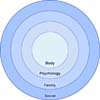
The diagnostic value of this model does not lie solely in the spatial extent of the experiential field but rather in its relation to the velocity of psychic processes. Depression, therefore, is understood within a global clinical picture where a narrowed experiential field coupled with slowed psychic activity becomes a core diagnostic marker.8 Sonenreich's model offers a structural and dynamic perspective on depression, moving beyond lists of symptoms to a holistic understanding of subjective experience and its alterations in mental illness.
His conceptualization of affective disorders aligns closely with contemporary models in cognitive science known as the "4E" approach. These models propose that mental states are: 1) embodied, i.e. there is no strict separation between mind and body; mental states are deeply intertwined with bodily processes; 2) extended, i.e., mental states are not confined to the individual but are shaped through interactions with the world and others, who co-create these experiences; 3) embedded, i.e., mental states arise within a specific context, where subjects actively shape their own experience through interactions; and 4) enacted, i.e., mental states are not passively received but are dynamically constructed through engagement with the environment.9
From this perspective, depression can be understood as the loss of affective resonance with the surrounding world, leading to a pervasive sense of detachment and separation. This reaches its extreme form in Cotard's syndrome, a condition in which individuals experience nihilistic delusions and profound estrangement from reality.9
Shifting the focus toward the contextual and embodied aspects of depression opens new pathways for clinical intervention and neurobiological research. Recognizing the centrality of lived experience in mental disorders allows for personalized treatment approaches, addressing the unique ways in which each patient's history, body, and environment interact in shaping their condition.10
Understanding "disease" as a construct justified by medical practice, whose purpose is to make sense of the patient's experience, calls for continuous refinement of diagnostic tools and the validity of the constructs we use. By shifting the clinician's focus from the disease to the patient, we move toward an individualized approach - one that seeks to restore patients' life history, values, and ability to reinterpret themselves, reclaim agency, and take responsibility for their choices.
This patient-centered paradigm aligns with Sonenreich's vision, reinforcing the idea that psychiatric treatment should not merely address symptoms but should aim to restore the individual's capacity for engagement, meaning-making, and active participation in their own lived experience.
 PDF
 Print
 Send this article by email
 How to cite this article
 Submit a comment
 Mendeley
 Pocket
 Share on Facebook
 Share on Twitter



