


ABSTRACT:
OBJECTIVE: Media representation of mental illness has the potential to reinforce stigma through
perpetuating stereotypes, associating mental disorders with violent conduct, or using
a disorder as a metaphor, often as an adjective. This study examined how Brazilian
newspapers have used schizophrenia (and derivatives involving the root schiz*) over
time, whether metaphorically or not.
METHODS: A database of news articles was compiled from 2001 to 2022. A multilayer neural network
model was trained to categorize the use of schizophrenia and its derivatives as either
metaphorical or non-metaphorical with 95% accuracy. The analysis was based on three
nationally distributed newspapers.
RESULTS: A total of 7,272 texts published between January 2001 and August 2022 were extracted.
Of these, 30.8% (2,243) were identified as using schizophrenia or derivative terms
in metaphorical language.
CONCLUSION: There is no evidence of a significant increase or decrease in metaphorical use over
the years, indicating that schizophrenia has persistently been represented in media
discourse over time.
Keywords: Schizophrenia; social stigma; media.
FIGURES
| Note: How to cite this article: Rabitzsch D, da Silva ROM, Gadelha A, Pedroso LG, Massuda R. Two decades of metaphorical use of schizophrenia in Brazilian newspapers: a machine learning approach. Braz J Psychiatry. 2026;48:e20254536. Epub 2026 Jan 20. http://doi.org/10.47626/1516-4446-2025-4536 |
| Received: August 29 2025; Accepted: December 26 2025 |
INTRODUCTION
Stigma is a social phenomenon characterized by labeling and negative stereotyping of a disadvantaged group. It reflects power asymmetry and is often associated with specific characteristics of an individual or group, such as race, gender, migrant status, sexual orientation, religion, or other characteristics.1,2 Several health conditions are stigmatized, including infectious diseases, cancer, obesity, dementia, and mental disorders.3,4 The impact of stigma on health conditions is often underestimated and can lead to discrimination, physical and verbal abuse, and barriers to treatment.4 The association of stigma with mental disorders is a complex phenomenon that occurs in various countries at different levels, from individual to structural discrimination.5
Schizophrenia is one of the most stigmatized health conditions.3,6-8 This includes self-stigma, which is associated with decreased self-esteem and confidence, reduced help-seeking and treatment adherence, unemployment, and low functioning.9,10 Furthermore, schizophrenia is linked to public stigma and structural discrimination, leading to negative societal reactions, including stereotypes, prejudiced attitudes, and discriminatory practices.2,9 Stigma, which could be considered a secondary illness, can trigger the desire for social distance and avoidance, negatively affect quality of life, and reduce empowerment.3,11
The media's influence on public opinion is important and can play a positive role in combating stigma, although it can also reinforce negative attitudes and perpetuate all types of mental health stigma.12 This can occur in a variety of forms, such as negatively referring to individuals diagnosed with a mental disorder, associating them with violence and danger, or using the disorder as a metaphor or adjective.13,14 Media representations can also shape behavior through mechanisms described in labeling theory, in which the assignment of a diagnostic label activates stereotypes, expectations, and social responses restricts social opportunities and influences interpersonal interactions.
Despite recent anti-stigma interventions and guidelines for improved reporting on mental disorders, schizophrenia continues to be associated with violence in the media and is often used metaphorically in a negative light in journalistic texts. The metaphorical use of schizophrenia or schizophrenic most often conveys notions of unpredictability, incoherence, contradiction, chaos, or absurdity. Such usage reflects a stereotypical misunderstanding of the illness and perpetuates the stigma surrounding schizophrenia.15-18 While media portrayals of mental illness and schizophrenia have been explored in the international literature, no large-scale, data-driven analyses concerning metaphorical language have been conducted in Brazil. Current studies are typically constrained by small samples, manual coding, or qualitative methods, which hinder the capacity to monitor evolving linguistic patterns over time.16,19
To address this limitation, we developed a neural network model capable of automatically distinguishing metaphorical from non-metaphorical uses of schizophrenia and derivative terms in a large database spanning 20 years of Brazilian journalistic texts. This approach not only enabled a more rigorous assessment but also provided a methodological tool that can be applied to other conditions, datasets, and media environments.
METHODS
To determine the most impactful national newspapers, we initially selected those listed as the largest publications in the country by Instituto Verificador de Comunicação, a Brazilian media monitoring agency. We considered the 10 largest newspapers in Brazil each year from 2001 to 2020, obtaining 20 lists. We then selected all of those newspapers that ranked in the top 10 for at least 10 years20 and determined whether they provided an online platform with a search engine to access the full texts in web pages from each year. Only newspapers that met these criteria were included in this study.
Three newspapers, Folha de São Paulo, O Estado de São Paulo, and Correio do Povo, which the Instituto Verificador de Comunicação ranked among the top 10 in circulation every year from 2001 and 2022, had online news portals that allowed the extraction of links containing words with the root "esquiz*" (i.e., "schiz*" in English). The former two newspapers provided access to news items throughout the observation period, whereas Correio do Povo only made articles published since 2009 available. Hyperlinks to articles containing words containing the root "esquiz*" (i.e., analogous to schizophrenia, schizophrenic, schizoid, etc.) were extracted. A single reviewer (DR) read > 15% of the texts, manually classifying their usage of the term as metaphorical or non-metaphorical.
Whenever the word root was detected, the entire paragraph was considered as context. Every paragraph containing "esquiz" at least once was considered for the vectorization process. They were vectorized using the Word2Vec technique with a 600-dimensional continuous bag-of-words model developed by the Núcleo Interinstitucional de Linguística Computacional, which has been trained on more than one billion Portuguese words.21 Stopwords (words that do not add meaning to a text), such as conjunctions and definite or indefinite articles, were removed from the excerpts using the spaCy language processing library before applying Word2Vec vectorization.22 The text was then classified using a multilayer neural network. Neural networks are mathematical structures composed of smaller units, known as neurons, which aim to mimic the structure of the human brain to organize and develop calculations for classification or regression tasks.23 For this study, we used four hidden layers of architecture, designed to learn representations of the vectorized data. Each hidden layer processes input information through mathematical operations that allow for progressively more complex and sophisticated extraction of features from schizophrenia-related texts.24,25 A neural network was chosen because distinguishing metaphorical from non-metaphorical language requires capturing subtle semantic and contextual nuances that are beyond the scope of traditional linear models, and neural architectures consistently outperform other models regarding semantic ambiguity and contextual interpretation.26 The network architecture, which was originally designed for basic classification tasks such as sentiment analysis, was adapted to distinguish between metaphorical and non-metaphorical language instead of the usual positive and negative sentiment examples. The code used to perform our analysis is available at https://github.com/RogerioOMDS/estigma_esquizofrenia.27
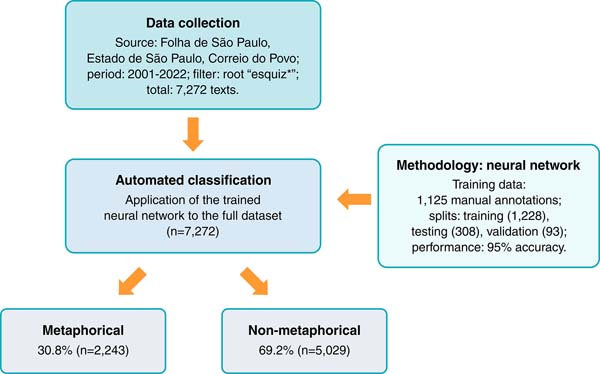
The initial search resulted in 7,272 texts. More than 15% (1,125 items) were read by a reviewer, who manually classified their use of schizophrenia-related words as either metaphorical or non-metaphorical. The data were then split, using 1,228 paragraphs for training, 308 for testing, and 93 for validation. In each of these subsets, approximately 30% included the metaphorical label. The neural network was trained by adjusting the model parameters and employing regularization techniques. As a result, the model achieved 95% accuracy on the test set, demonstrating its effectiveness in accurately categorizing complex mental health-related texts (Figure 1).
To determine whether the use of schizophrenia as a metaphor has changed over time, we fitted a linear regression model in which the dependent variable was the annual proportion of metaphorical uses of the term, and the independent variable was the calendar year (treated as a continuous variable from 2001 to 2021). This approach allowed us to test for significant upward or downward temporal trends in metaphorical usage. Statistical significance was set at p < 0.05. All analyses were performed using Jamovi 2.6.2628.28
RESULTS
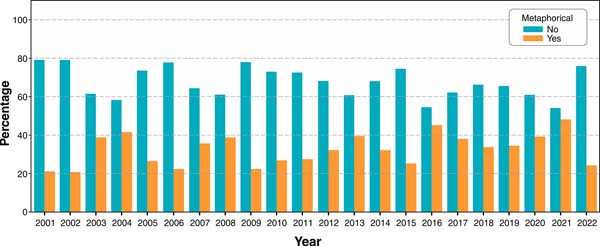
Of the 7,272 extracted texts involving schizophrenia, the usage was considered metaphorical in 30.8% (Figure 1), ranging from 20% to 40% over the years (Figure 2). The most frequently occurring words associated with schizophrenia/schizophrenic as a metaphor were governo (government), política (politics), país (country), Brasil (Brazil), mundo (world), public (public), and Lula (i.e., president Luiz Inácio Lula da Silva). In the non-metaphorical context, the most frequent terms were doença (disease), pacientes (patients), tratamento (treatment), mental (mental), depressão (depression), sintomas (symptoms), and transtorno (disorder). Word clouds of the findings from 2017 to 2022 are provided in Supplementary Figure S1 and S2.
Examples of metaphorical use are shown in Supplementary Box S1. Sentences like "Formula 1, like most forms of extreme capitalist enterprise, has moments that are completely schizophrenic" or "The schizophrenia of a government that simultaneously sought to control inflation through higher interest rates while stimulating the economy through credit expansion was followed, in recent months, by a reorganization of its economic policy guidelines" illustrate the metaphorical use of schizophrenia and schizophrenic.
Metaphorical use of the root "esquiz*" in Brazilian newspaper articles did not change significantly between 2001 and 2022 (p = 0.093, beta = 0.0045). The p and the beta values suggest a negligible positive increase in usage, meaning any apparent increase was slight and could reasonably be attributed to random variation rather than a true systemic change over time.
DISCUSSION
To the best of our knowledge, this is the first study to use a machine learning methodology to classify metaphorical and non-metaphorical uses of schizophrenia-related terminology in the media. Furthermore, it is the most extensive analysis of this subject conducted in Brazil, and one of the largest to have been conducted globally. In a total of 7,272 texts, the percentage of metaphorical uses between 2001 and 2022 was 30.8%, ranging between 20 and 40%, with no evidence of significant change over these two decades.
Few studies have been published about schizophrenia stigma in the Brazilian media, and these studies were published more than 10 years ago. Guarniero et al.16 analyzed newspapers articles mentioning schizophrenia in 2008 and 2011, classifying 34% as metaphorical, with 27% of all usage being associated with crime or violence. As a metaphor, schizophrenia was used to connote "absurd," "incoherent," and "contradictory." No positive use of schizophrenia in the metaphorical context was found.16 Dubugras et al.19 analyzed a single newspaper from 2007 to 2008, finding that 34% of the references to schizophrenia were metaphorical and 66% were not used in a medical context.19 Our results in a machine learning approach showed a percentage similar to Guarniero et al.16 and Dubugras et al.,19 suggesting that there has been no significant change over the years in the way schizophrenia is treated by the media in Brazil.
The metaphorical use of schizophrenia is prevalent in many countries and languages. We found a lower percentage of metaphorical uses than studies conducted in Italy (74%)29 or Spain (48%).29,30 Aragonès et al.30 also investigated mental illnesses beyond schizophrenia, showing that nearly half (49.2%) of the non-metaphorical texts associated mental illness with danger. Similarly, 40% of the appearances of schizophrenia in a Portuguese newspaper were found to be metaphorical.31 The percentage found in our study aligns closely with that of Greece (34%),32 but it was lower than in Turkey (44%),33 and France (40%).34 Metaphorical usage was lower in the United States (28%) and the United Kingdom (11%).15,35 Differences in percentages between countries may be related to greater or lesser stigma, but they could also be due to the newspaper selection process.
The media can be used to intensify or reduce mental health stigma.36 The Time to Change England program involved three strategic phases for increasing awareness of mental health and reducing social stigma.37 During the program, newspapers increased anti-stigmatizing elements in their coverage. However, years after the program, texts referring to schizophrenia were 6.37 times more likely to be stigmatizing than those referring to other disorders.17,36
More recently, Holmberg38 extended this line of research by examining schizophrenia-related content not only in print media but also across digital and audiovisual platforms, demonstrating that stigmatizing portrayals persist across formats. Analyzing a time span similar to that of our study, Holmberg likewise found no significant change over time in the frequency of stigmatizing representations in Swedish media, a result that closely mirrors our findings. Importantly, Holmberg also evaluated the impact of an intervention designed to flag potentially stigmatizing terms and provide structured feedback to media professionals, an anti-stigma campaign called StigmaWatch, illustrating that targeted actions can improve reporting practices even when long-term trends remain stable.38
The language used to describe individuals with mental illness influences the way their conditions are perceived. A cornerstone of stigma reduction programs lies in the effort to transform linguistic conventions surrounding mental health.12,39,40 This principle is particularly pertinent for schizophrenia, where the choice of words directly influences public understanding and attitudes towards the disorder. Modifying the way that schizophrenia is used in media may help reduce stigma and weaken its common association with violence and other negative stereotypes.12 Several proposals have been advanced to address the stigma surrounding schizophrenia, ranging from renaming the disorder41 to adopting person-centered language, such as "person with schizophrenia."12 Therefore, the media can become a crucial ally in efforts to change how schizophrenia is depicted. Our study shows that metaphorical use of schizophrenia has not significantly changed in Brazilian newspapers over the past two decades.36,42
Machine learning techniques have already been used to identify stigmatizing references to schizophrenia in social media.43 However, as far as we know, such approaches have not yet been used to identify stigma in print journalism. Machine learning techniques can help detect potentially stigmatizing content and broaden our understanding of stigma in media.43 Identification is a first step toward awareness and change, and the automatic detection of stigmatizing references to schizophrenia may help media outlets modify the way they depict the disorder.
One limitation of this study is that it focused exclusively on traditional media outlets, which may have resulted in a low frequency of metaphorical references to schizophrenia. Although our analysis focused on the digital platforms of prominent newspapers in Brazil, it is essential to acknowledge the significant impact of other contemporary media outlets, including television and social media platforms such as X, Instagram, and TikTok. Furthermore, we did not determine whether the metaphorical uses were positive or negative. Another limitation of this study is that it included only newspapers from the southern and southeastern regions of Brazil; different patterns might have been found in media outlets from other parts of the country, yielding alternative results. However, our study significantly contributes to the use of machine learning techniques for detecting metaphorical usage of schizophrenia. This approach allowed us to analyze extensive data across three distinct mass media publications, specifically measuring the prevalence of stigma over two decades. The same methodology could be easily applied to any number of newspapers that have searchable digital archives. We have also made our algorithm publicly available for wider use.27 Another strength of our study is its ability to help newspaper editors monitor the adjectival use of schizophrenia, which could prompt reflection on the appropriateness of using disease-related words in metaphorical language.
Future research could incorporate additional analytical frameworks, including semantic and structural analysis, to more deeply examine the discourse and stigma surrounding schizophrenia. Further work is also needed to evaluate interventions to reduce stigma in both traditional and social media. Despite the promising perspectives, our findings underscore the high prevalence of stigmatizing language in the media. It is thus advisable that editorial policies, both in traditional and digital outlets, explicitly discourage and/or prevent such usage. The present study has offered empirical and methodological support for such a position.
 PDF
 Print
 Send this article by email
 How to cite this article
 Submit a comment
 Mendeley
 Pocket
 Share on Facebook
 Share on Twitter