


FIGURES
| Note: How to cite this article: da Mota Gomes M, Nardi AE. Antônio Antônio Austregésilo at 150: a legacy of science and humanism. Braz J Psychiatry. 2026;48:e20254759. Epub 2026 Jan 23. http://doi.org/10.47626/1516-4446-2025-4759 |
| Received: December 12 2025; Accepted: December 29 2025 |
As modern psychiatry and neurology face the challenge of integrating humanistic values into evidence-based practice, the 150th anniversary of Antônio Austregésilo Rodrigues de Lima's birth offers a timely opportunity to reflect on his enduring contributions. His work, spanning neurology, psychiatry, literature, and public health, provides a model for addressing today's fragmentation in mental health care and medical education.
Born in Recife on April 21, 1876, Austregésilo faced early adversity, including socioeconomic challenges and stuttering. Yet, his determination propelled him forward. Aged just 16, he entered the Faculdade de Medicina do Rio de Janeiro, graduating in 1899 with a thesis, "Estudo clínico do delírio," that revealed his deep fascination with the human mind and nervous system.1-4 This early work set the foundation for a career that would bridge neurology and psychiatry, reshaping both disciplines in Brazil and earning him international acclaim.
Austregésilo began his academic career in 1902 at the Santa Casa de Misericórdia, where he swiftly distinguished himself as both an exceptional clinician and a passionate educator. Just two years later, he took charge of the men's ward at the National Hospice for the Insane (Hospício Nacional de Alienados, HNA), overseeing the Pinel Section and leading innovative research at the Observation Pavilion. There, he developed pioneering treatments for epilepsy and neurosyphilis, diseases that posed significant challenges at the time.4-7 This institution later became the Institute of Psychiatry at UFRJ.
In 1903, Austregésilo was elected to the National Academy of Medicine, where he would later serve as president for three terms (1935-1937, 1945-1947, and 1949-1951).1 His leadership of this prestigious institution was marked by a commitment to fostering scientific excellence and promoting the integration of medicine with broader intellectual and cultural movements.
Austregésilo's career reached a historic milestone in 1912 when he became Brazil's first full professor of Neurology, a chair position officially recognized by Decree No. 11,530 in 1915. This appointment was not only a personal achievement but also a turning point for Brazilian medicine, as it formalized neurology as a distinct and essential field. At Santa Casa de Misericórdia, he founded the Neurological Clinic in the 20th ward of the General Hospital, restructuring clinical services to emphasize both clinical medicine and neurology. Alongside colleagues such as Adauto Botelho, Pernambuco Filho, and Ulysses Viana, he co-founded the Sanatório Botafogo, an institution that became synonymous with excellence in patient care and medical education.4-7
His vision culminated in 1926 with the creation of the Neurological Pavilions within the HNA, a landmark institution for neurological training, research, and patient care in Brazil.3-7 This institution, later expanded by Deolindo Couto into the country's first Institute of Neurology, became a hub for innovation and collaboration, attracting scholars and clinicians from across the globe.
Within this new neurological hub, Austregésilo's contributions to neurosurgery were equally transformative. After visiting the United States in 1928 and meeting such pioneers as Harvey Cushing and Charles Frazier, he assembled a team that included Augusto Brandão Filho, Alfredo Alberto Pereira Monteiro, and José Ribeiro Portugal, laying the groundwork for what would become the Brazilian School of Neurosurgery. His research on movement disorders, including dystonia, chorea, tics, and Parkinson's syndrome, led to the adoption of innovative treatments in Brazil, such as scopolamine and Roemer's atropine sulfate formula.8 His 1912 collaboration with Faustino Esposel on the Babinski sign remains a cornerstone of neurological semiology, demonstrating his ability to merge clinical observation with theoretical insight.9
Austregésilo produced an extensive body of scholarly work that significantly influenced clinical practice, academic leadership, and literary expression. His interdisciplinary approach seamlessly integrated neurology, psychiatry, psychotherapy, and literature, making his contributions uniquely impactful and reflecting a profound synthesis of clinical insight and symbolic expression.1,2 Among his most influential works are Clínica neurológica, published in three volumes between 1917 and 1945, which remains a foundational text in Brazilian neurology. His 1927 work, Troubles nerveux et mentaux dans les maladies tropicales, explored the intersection of tropical diseases and mental health, showcasing his expertise in both fields. In 1936, L'analyse mentale dans les psychoneuroses highlighted his innovative approach to mental analysis in psychoneuroses, further establishing his international reputation. Austregésilo's 1938 publication, Fames, libido e ego, introduced a theoretical framework that emphasized the role of basic survival instincts alongside psychological drives. Finally, his 1940 work, Manuel de psychothérapie pratique, synthesized his psychotherapeutic techniques, reflecting his holistic approach to mental health treatment.1,2 Influenced early by Symbolism - reflecting his belief in the interconnectedness of art, science, and human experience - his literary output evolved from poetic prose in Manchas (1898) to become a vehicle for his psychotherapeutic mission. As Corrêa10 highlights, his approach centered on key psychotherapeutic issues: the re-education of emotions and thoughts, the management of dissatisfaction, and the pursuit of happiness through self-understanding and rational persuasion. This framework is evident in early works like Pequenos males (1916) and A cura dos nervosos (1916), which introduced a method blending Stoic philosophy with clinical practice. His later, stylistically refined essays, such as O Mal da Vida (1939), further articulated these positions, while his most distinctive contributions - works such as Perfis de loucos (1943) and his novel Vidas desgraçadas (1950) - fuse narrative artistry with psychological observation to explore human suffering and resilience.
His influence extended into public affairs and advocacy. Elected to the Brazilian Academy of Letters in 1914 (and later its president in 1939), he further bridged science and literature. As Federal Deputy for the state of Pernambuco (1922-1930), he championed policies in public health, education, and social justice, expanding his impact far beyond clinical practice.
His leadership also reshaped scientific publishing. By founding Arquivos Brasileiros de Medicina and Arquivos Brasileiros de Neurologia e Psiquiatria, he elevated Brazil's medical discourse and fostered scholarly exchange. His editorial reach extended internationally through contributions to journals such as the Journal of Nervous and Mental Diseases and Confinia Neurologica, cementing his global reputation.3
His intellectual reach was equally profound in academic circles worldwide. Invited to lecture at esteemed institutions including the legendary Salpêtrière in Paris, Austregésilo won acclaim for groundbreaking theories, particularly his original concept of the striatum's role in pyramidal spasticity.3,4 His research, highlighted in Kinnier Wilson's 1940 publication, spanned a remarkable breadth of neurological conditions: from neuromyelitis epidemics and radicular leprosy to torsion spasms, Schilder's encephalitis, Pick's cerebral atrophy, Brun's frontal ataxia, and neurofibromatosis, showcasing the depth and innovation of his contributions to medicine.
Austregésilo was more than just a brilliant professional - he was someone who lived with warmth, kindness, and an open heart. Those closest to him, like his devoted student Antônio Rodrigues de Mello, often shared how deeply he connected with people, both personally and intellectually. He had a gift for inspiring his students, particularly those he fondly called jejunos - the "hungry to learn."4 The term, inspired by the jejunum (the nutrient-absorbing segment of the small intestine), encapsulated his belief that the brightest minds aren't those already saturated with rigid knowledge, but those open, curious, and ready to absorb the world's lessons.
His teaching went far beyond medicine. It wasn't about filling heads with facts; it was about lighting a fire - cultivating curiosity, honing critical thinking, and building collaboration. His classroom wasn't just a place to learn - it was a space for transformation, where education was less about memorizing and more about awakening potential.
Even today, his mentoring style feels fresh and meaningful. It's a reminder that great education isn't just about facts, but about nurturing passion and building connections.
In 1945, a selection process was held to choose the successor to the influential Austregésilo. Among the candidates was his son, Austregésilo Filho. The post ultimately went to Deolindo Couto, ho was already serving as interim professor. Austregésilo, though undoubtedly interested in the outcome, maintained a formally impartial and non-interventionist stance throughout the proceedings.
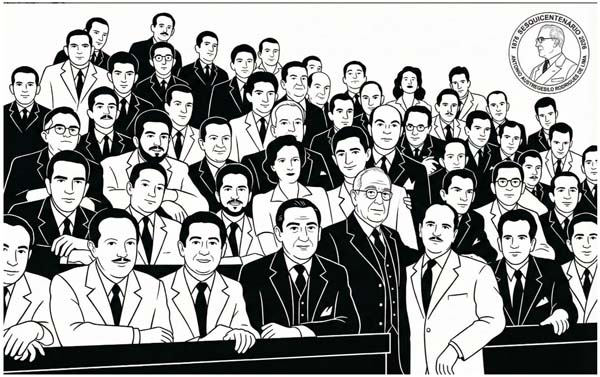
Figure 1 is a conceptual illustration inspired by a historical photograph featuring Antônio Austregésilo - standing in the center, wearing glasses - surrounded by his students and colleagues.11
Austregésilo died in Rio de Janeiro on December 23, 1960, at the age of 84. Even 150 years after his birth, his influence remains profoundly relevant - a reflection of his lasting vision, resilience, and humanism. Living through a pivotal period in Brazil's history, he played a key role in shaping the intellectual and institutional foundations of modern medicine.
His life and work remind us that true leadership demands more than brilliance - it requires compassion, integrity, and a steadfast dedication to humanity. His legacy inspires a future where medicine, ethics, and humanism advance together.
 PDF
 Print
 Send this article by email
 How to cite this article
 Submit a comment
 Mendeley
 Pocket
 Share on Facebook
 Share on Twitter