



ABSTRACT:
OBJECTIVE: The aim of this study was to understand the knowledge, beliefs, barriers, and behaviors
of mental health professionals about physical activity and exercise for people with
mental illness.
METHODS: The Portuguese version of The Exercise in Mental Illness Questionnaire was used to
assess knowledge, beliefs, barriers, and behaviors about exercise prescription for
people with mental illness in a sample of 73 mental health professionals (68.5% women,
mean age = 37.0 years) from 10 Psychosocial Care Units (Centros de Atenção Psicossocial)
in Porto Alegre and Canoas, state of Rio Grande do Sul, Brazil.
RESULTS: Most of respondents had received no formal training in exercise prescription. Exercise
ranked fifth as the most important treatment, and most of the sample never or occasionally
prescribed exercise. The most frequently reported barriers were lack of training in
physical activity and exercise prescription and social stigma related to mental illness.
Professionals who themselves met recommended physical activity levels found fewer
barriers to prescribing physical activity and did so with greater frequency.
CONCLUSION: Exercise is underrated and underused as a treatment. It is necessary to include physical
activity and exercise training in mental health curricula. Physically active professionals
are more likely to prescribe exercise and are less likely to encounter barriers to
doing so. Interventions to increase physical activity levels among mental health professionals
are necessary to decrease barriers to and increase the prescription of physical activity
and exercise for mental health patients.
Keywords: Mental health; physical exercise; health professionals; psychosocial support center; barriers.
FIGURES
| Received: May 15 2019; Accepted: October 9 2019 |
INTRODUCTION
Mental illnesses are highly prevalent worldwide: one in four people will receive a psychiatric diagnosis in their lifetime.1,2 Pharmacological treatments are considered first-line treatment strategies for most psychiatric diagnoses, including affective and psychotic disorders. Although multiple pharmacological approaches can be formulated, in some cases, such as selective serotonin reuptake inhibitor antidepressants, the short term-benefits are only modest.3 For example, compared to placebo, the odds of clinical response of different pharmacological antidepressants range from 1.37 to 2.13.3 Moreover, antipsychotics are associated with substantial weight gain.4 Together with other lifestyle factors, such as low levels of physical activity (PA),5-8 medication use can contribute to a higher prevalence of cardiometabolic diseases, such as diabetes, metabolic syndrome and cardiovascular diseases, and to lower life expectancy in people with mental illness.9
PA and exercise (a structured, systematic subset of PA designed to maintain or improve one or more physical capacities) have been proposed as complementary therapeutic approaches in mental illness treatment guidelines in many European countries.10-12 However, for the most part Brazilian guidelines do not consider the role of PA and exercise in mental health treatment. The benefits of PA and exercise on mental health symptoms, such as depression,13,14 anxiety,15,16 and psychosis are well known.17 In addition to mental health benefits, exercise can attenuate antipsychotic-induced weight gain and improve cardiometabolic profiles in people with mental illness.9,12 More importantly, exercise can improve cardiorespiratory fitness, an independent predictor of all-cause mortality.18
In Brazil, exercise prescription and supervision are roles usually associated with exercise professionals.19 However, encouraging a healthier lifestyle is the duty of all mental health professionals (MHP) involved in patient care. Thus, all MHP working with patients and their caregivers should be engaged in and possess sufficient knowledge to encourage and facilitate PA.
The recommendation or prescription of exercise by MHP varies across different conditions and cultures. For example, about 87% of mental health staff promote PA to their patients in France and Belgium,20 about 67.7% recommend exercise to children and adolescents with depression in Australia,21 and about 96% of nurses and occupational therapists recommend exercise at least occasionally to their patients in Uganda.22 In addition, the barriers to exercise prescription faced by MHP can vary across different settings and cultures. In Australia, the fragmentation of roles, prioritization of other tasks, lack of time, limited resources,23 and lack of specific training24 were the most commonly reported barriers to exercise prescription, while medication side effects and the social stigma surrounding mental illness were the most commonly reported barriers in Uganda.22 To the best of our knowledge, no study conducted in a middle-income country has evaluated the recommendation and prescription of exercise to people with mental illness or has assessed barriers to exercise prescription or participation.
Previous evidence suggests that mental health nurses without formal training in exercise prescription tend not to prescribe or recommend exercise to their patients.25 However, there is a lack of data on how MHP perceive PA and exercise as a complementary tool, as well as their own and their patients' barriers to an active lifestyle in middle-income countries. Due to these gaps, the aims of the present study were to evaluate knowledge, application, barriers, beliefs, including the importance, risks, and benefits, and correlates associated with exercise prescription and recommendation by MHP to people with mental illness in a middle-income country.
METHODS
This cross-sectional study included MHP working in Psychosocial Care Units (Centros de Atenção Psicossocial - CAPs). CAPs provide mental health treatment to community-dwelling individuals with mental illness in Brazil. CAPs can have a multidisciplinary team consisting of physicians, psychiatrists, psychologists, nurses, exercise professionals (physical therapists and physical educators), and others. The study invited all MHP working in 10 of 13 CAPs in the two largest cities (Canoas and Porto Alegre) of the metropolitan region of Porto Alegre, Rio Grande do Sul, Brazil. Three CAPs were not included because (1) they could not provide ethics committee approval in time to perform data collection (n=2), and (2) it was impossible to reach the person in charge to obtain approval for data collection (n=1).
The study was conducted between February and March of 2018. After approval was granted, one researcher (EK) visited the CAPs and applied the questionnaires to the MHP.
Potential participants were informed about the objectives, justifications, benefits and the voluntary nature of participation in this study. Participant confidentiality was assured, and all participants provided written informed consent prior to completing the survey.
Inclusion and exclusion criteria
MHP eligible for inclusion had an undergraduate degree in any health area, including physicians, nurses, exercise professionals, social workers, occupational therapists, and psychologists, or had a technical degree, such as nurse technicians. The participants had worked for a minimum of six months at CAPs for adults and provided written informed consent. MHP who worked at CAPs for children or who specialized in alcohol and drug treatment, or those who were on any type of leave or vacation during the data collection period were not included in the study.
Procedures
Participant knowledge about exercise in people with mental illness was evaluated with the Portuguese version of The Exercise in Mental Illness Questionnaire (EMIQ).26 The instrument consists of six domains: The exercise knowledge domain includes 10 items on formal training in exercise prescription and the physical and mental health benefits of exercise. The beliefs about exercise and mental illness domain includes eight questions that rank the perceived importance of exercise compared to 10 other treatments (medication, social support, electroconvulsive therapy, phototherapy, family therapy, social skills training, behavioral cognitive therapy, and vocational rehabilitation. The exercise prescription behaviors domain includes seven questions on the frequency and manner of exercise prescription. The barriers to exercise prescription domain includes 23 items, including the main barriers identified in the literature to exercise prescription for people with mental illness. This domain is further subdivided into sections on the respondents' perceived barriers to prescribing exercise for people with mental illness and the professionals' perception of barriers to exercise that their patients experience. For questions 3 to 17 and 26 to 48, a five-point Likert scale was used, in which 1 = strongly disagree and 5 = strongly agree. Higher scores indicate a higher level of agreement. The scores for each barrier subsection were summed, and an overall score for the two domains was calculated. Higher scores indicate more barriers. The personal PA habits domain includes seven items on the respondents' PA level, and each respondent's PA level was determined from their answers. Participants who got 150 minutes of moderate to vigorous PA per week were considered active. The EMIQ also examines the frequency of exercise prescription with a single item: Do you prescribe exercise for persons with a mental disorder? The four possible answers are: never, occasionally, most of the time, and always. The final domain collected demographic data.
This questionnaire also allowed participants to rank what they perceived as the most important types of therapy for mental health patients. The instrument was developed and validated in English.26 A translation to Portuguese was performed according to International Society for Pharmacoeconomics and Outcomes Research procedures27 (the translated version is available upon request).
Statistical analysis
Descriptive statistics were used to calculate the means, standard deviations (SD), and frequencies (n [%]). The barrier scores were calculated as follows: strongly disagree = 1 point; disagree = 2 points; neither agree nor disagree = 3 points; agree = 4 points; and strongly agree = 5 points. The total barrier score consisted of the sum of the barriers to exercise prescription score and the perceived patient barriers score and were categorized according to frequency of PA and exercise prescription. An independent t-test was used to compare differences in continuous measures (age, years working in the field, total barrier score), and a chi-square test was used to compare proportions in categorical measures (sex, proportion of participants achieving PA recommendations) between those who never prescribe exercise vs. those who prescribe exercise occasionally, most of the time, or always. Pearson or Spearman correlations (for normally and non-normally distributed data, respectively) were also conducted to test the association between exercise prescription frequency and the participants' total barrier score and PA level. All statistical analyses were performed in SPSS version 22. Statistical significance was considered an alpha level < 0.05.
Ethics statement
This study was approved by the research ethics committee of the Centro Universitário La Salle (CAAE 76645017.6.0000.5307) and the municipal research ethics committees of Porto Alegre and Canoas.
RESULTS
Of the potentially eligible participants, 73 (mean age = 37.0 [10.0] years, women n=50 [68.5%]) of 95 (76.8%) completed and returned the questionnaire. The participants were mostly nurses (n=25, 34.3%) or nurse technicians (n=21, 28.8%). The mean time the participants had worked in the mental health area was 9.6 years (8.0). A specialization course was the highest level of education for most of the participants (n=33, 45.2%), and most worked full time (n=33, 45.2%). Detailed information about the participants is shown in Table 1.
| Characteristic | Result |
|---|---|
| Women | 50 (68.5) |
| Age, years, mean (SD) | 37.0 (10.0) |
| Marital status | |
| Married | 25 (34.2) |
| Widow | 2 (2.7) |
| Cohabiting | 11 (15.1) |
| Divorced | 11 (15.1) |
| Single | 24 (32.9) |
| Profession | |
| Specialized physician (psychiatrist or other type) | 5 (6.8) |
| Psychologist | 10 (13.7) |
| General practitioner | 4 (5.5) |
| Occupational therapist/recreationist/ physiotherapist | 1 (1.4) |
| Nurse technician | 21 (28.8) |
| Nurse | 25 (34.3) |
| Social worker | 6 (8.2) |
| Exercise professional | 1 (1.4) |
| Time working in the field, years, mean (SD) | 9.6 (8.0) |
| Time since obtaining the highest level of education, years, mean (SD) | 7.23 (7.1) |
| Employment | |
| Full-time | 33 (45.2) |
| Part-time | 32 (43.8) |
| Casual | 2 (2.7) |
| Other | 6 (8.2) |
| Highest level of education | |
| Primary education | 1 (1.4) |
| Secondary education | 23 (31.5) |
| Higher education | 14 (19.2) |
| Specialization course | 33 (45.2) |
| Master degree | 2 (2.7) |
| Doctorate degree | 0 (0) |
Data presented as n (%), unless otherwise specified.
SD = standard deviation.
Knowledge
Most of the participants (n=67, 92%) reported receiving no formal training in exercise prescription (e.g., an undergraduate degree in physical education, physical therapy, etc. or a graduate degree or continuing education in a related field). Of the six participants who reported receiving some formal training, two (33%) rated their knowledge of exercise prescription as very low, one (16.7%) as low, one (16.7%) as average, and two (33%) as good. Three of these six (50%) professionals described themselves as having much or very much confidence in prescribing exercise to people with mental illness.
Beliefs
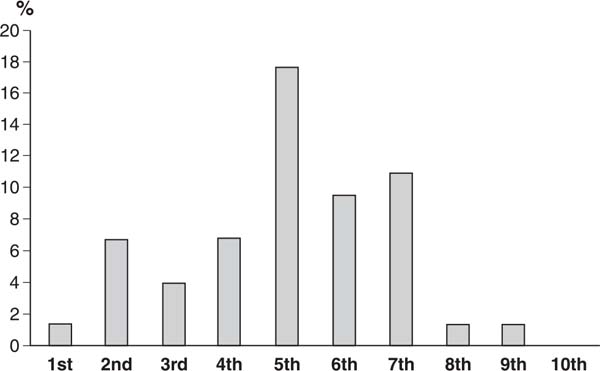
According to the respondents, the most beneficial treatments were: 1) medication (25%, n=19); 2) social support (19%, n=14); 3) family therapy and cognitive-behavioral therapy (both 7%, n=5); 4) social skills training and exercise (both 1%, n=1). PA was considered the fifth most important intervention (Figure 1).
Behavior
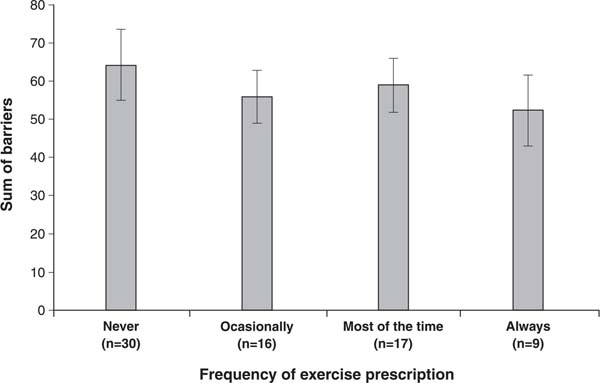
Thirty participants (41.1%) reported that they never prescribe PA, 16 participants (21.9%) stated that they occasionally prescribe it, 17 participants (23.3%) reported prescribing it most of the time, and nine participants (12.3%) always prescribe it. One participant (0.4%) did not answer the question.
Barriers
The three most frequently reported barriers to exercise prescription by MHP were: 1) "Prescribing exercise to people with a mental illness is best left to exercise professionals, such as exercise physiologists or a physical therapists," to which 53 (72.6%) of the participants responded agree or strongly agree; 2) "I don't know how to prescribe exercise to people with a mental illness," to which 28 (38.3%) participants responded agree or strongly agree; and 3) "I'm concerned they might get injured while exercising," to which 18 (24.7%) participants responded agree or strongly agree (Table 2).
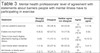
In the respondents' perception, the most prevalent barriers to exercise participation by their patients were: 1) "There is too much stigma attached to having a mental illness," to which 52 (72.2%) participants responded agree or strongly agree; 2) "There are too many side effects from the medications," to which 34 (46.5%) participants responded agree or strongly agree; and 3) "My friends or family won't exercise with me," to which 26 (35.6%) participants responded agree or strongly agree, as shown in Table 3
| Statement | Strongly disagree | Disagree | Neither agree nor disagree | Agree | Strongly agree |
|---|---|---|---|---|---|
| Their mental health makes it impossible for them to participate in exercise | 26 (35.6) | 34 (46.6) | 9 (12.3) | 4 (5.5) | 0 (0) |
| I'm concerned exercise might make their condition worse | 24 (32.9) | 35 (47.9) | 11 (15.1) | 2 (2.7) | 0 (0) |
| I am not interested in prescribing exercise to people with a mental illness | 25 (34.2) | 31 (42.5) | 14 (19.2) | 3 (4.1) | 0 (0) |
| I don't believe exercise will help people with mental illness | 38 (52.1) | 27 (37.0) | 3 (4.1) | 4 (5.5) | 1 (1.4) |
| Their physical health makes it impossible for them to participate in exercise | 12 (16.4) | 32 (43.8) | 19 (26.0) | 9 (12.3) | 0 (0) |
| I'm concerned they might get injured while exercising | 3 (4.1) | 31 (42.5) | 20 (27.4) | 17 (23.3) | 1 (1.4) |
| People with a mental illness won't adhere to an exercise program | 13 (17.8) | 38 (52.1) | 19 (26.0) | 1 (1.4) | 1 (1.4) |
| My workload is already too excessive to include prescribing exercise to people with a mental illness | 15 (20.5) | 38 (52.1) | 17 (23.3) | 2 (2.7) | 0 (0) |
| Prescribing exercise to people with mental illness is not part of my job | 12 (16.4) | 29 (39.7) | 16 (21.9) | 14 (19.2) | 1 (1.4) |
| I don't know how to prescribe exercise to people with a mental illness | 3 (4.1) | 21 (28.8) | 19 (26.0) | 25 (34.2) | 3 (4.1) |
| Prescribing exercise to people with a mental illness is best left to exercise professionals, such as exercise physiologists or a physical therapists | 1 (1.4) | 1 (1.4) | 16 (21.9) | 34 (46.6) | 19 (26.0) |
Data presented as n (%).
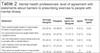
| Statement | Strongly disagree | Disagree | Neither agree nor disagree | Agree | Strongly agree |
|---|---|---|---|---|---|
| I am too unwell to exercise | 5 (6.8) | 28 (38.4) | 24 (32.9) | 15 (20.5) | 1 (1.4) |
| It takes too much time | 6 (8.2) | 42 (57.5) | 13 (17.8) | 12 (16.4) | 0 (0) |
| There is too much stigma attached to having a mental illness | 0 (0) | 11 (15.1) | 9 (12.3) | 43 (58.9) | 9 (12.3) |
| I don't know what I should do | 1 (1.4) | 20 (27.4) | 26 (35.6) | 22 (30.1) | 3 (4.1) |
| My friends or family won't exercise with me | 2 (2.7) | 18 (24.7) | 27 (37.0) | 25 (34.2) | 1 (1.4) |
| There are too many side effects from the medications | 1 (1.4) | 11 (15.1) | 26 (35.6) | 32 (43.8) | 2 (2.7) |
| I lack the confidence to perform any exercise | 0 (0) | 29 (39.7) | 27 (37.0) | 16 (21.9) | 1 (1.4) |
| I'm too fat to exercise | 8 (11.0) | 34 (46.6) | 16 (21.9) | 14 (19.2) | 1 (1.4) |
| I am afraid I will get hurt | 3 (4.1) | 28 (38.4) | 24 (32.9) | 17 (23.3) | 1 (1.4) |
| I have many physical health problems | 4 (5.5) | 26 (35.6) | 30 (41.1) | 13 (17.8) | 0 (0) |
| There is no safe place for me to exercise | 5 (6.8) | 37 (50.7) | 22 (30.1) | 9 (12.3) | 0 (0) |
| I don't have any equipment to do exercise with | 4 (5.5) | 35 (47.9) | 21 (28.8) | 12 (16.4) | 1 (1.4) |
Data presented as n (%).
PA levels and recommendations
Overall, the participants themselves spent a total of 115.04 (175.37) minutes per week in vigorous PA, 71.12 (131.15) minutes in moderate PA, and 490.30 (1,158.14) minutes walking. The average time spent sitting was 377.63 (200.60) minutes per day. A total of 39 (53.4%) participants met public health PA level recommendations.
Correlates of exercise prescription
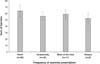
MHP who never prescribed PA and exercise did not differ from the others in age (mean = 37.79 [9.1] years vs. 36.49 [10.8] years, t = -0.516, p = 0.60) or time working in the field (mean = 9.76 [7.05] vs. 9.53 [8.5], t = -0.113, p = 0.91 years). The frequency of PA and exercise prescription did not differ by gender (30 [61.2%] women vs. 11 [57%] of men prescribe exercise, ?2 = 0.149, p = 0.928). However, those who never prescribed PA or exercise were more likely not to meet recommended PA levels themselves (MHP who met PA recommendations and prescribed PA and exercise = 27 (67.5%) vs. MHP who did not meet PA recommendations and prescribed PA and exercise = 12 (40%), ?2 = 5.25, p = 0.029). The mean number of perceived barriers according to exercise prescription frequency is shown in Figure 2.
Meeting PA level recommendations was inversely associated with the total barriers (r = -0.31, p = 0.04), the sum of barriers to exercise prescription (r = -0.26, p = 0.03), and the sum of barriers to patient exercise participation (r = -0.32, p = 0.009).
DISCUSSION
The present study is, to the best of our knowledge, the first in a middle-income country to use the EMIQ to evaluate the knowledge, beliefs, barriers, and behaviors of MHP regarding exercise for people with mental illness. Its main findings are: 1) most MHP have never received any formal training in exercise prescription; 2) among the various existing therapies used for treatment, medication is perceived as the most efficient, while PA and exercise were ranked as the fifth most important intervention; 3) about 41% of workers never prescribe exercise, and only 12% always prescribe it; 4) in the respondents' view, the most common barriers to PA that patients experience were: "There is too much stigma attached to having a mental illness," "There are too many side effects from the medications," and "My friends or family won't exercise with me," whereas the barriers the respondents reported in relation to their prescription behavior were: "Prescribing exercise to people with mental illness is best left to exercise professionals such as exercise physiologists or physical therapists," "I don't know how to prescribe exercise to people with a mental illness," and "I'm concerned they might get injured while exercising"; 5) only about half of the respondents met recommended PA levels; and 6) more active respondents prescribed PA and exercise more often and perceived fewer barriers to prescribing it.
Most participants have never received formal training in PA and exercise prescription and, of the six that did, only three felt very much confidence in prescribing it. This is expected, since the sample mostly consisted of nurses and nurse technicians, and PA is not part of their curriculum. Exercise was ranked as the fifth most important therapeutic approach by the respondents, while medication ranked first, followed by social support. This finding corroborates studies in other cultures. For example, in the United Kingdom most nurses reported knowing that exercise is important, but were more concerned with pharmaceutical treatments.28 This finding is expected, since international guidelines recommend medications as the first-line treatment for most mental illness.11
Our data show that about to 40% of mental health workers never prescribe PA and exercise, and only 12% always prescribe it. Interestingly, the most active professionals are more likely to prescribe exercise. Our findings corroborate other studies29-31 that found an association between self-reported PA and exercise prescription. These findings suggest that MHP are more likely to encourage healthy behaviors in their patients if they themselves engage in such behaviors.31 Therefore, encouraging lifestyle changes in MHP can result in greater adherence to PA recommendations and fewer barriers to encouraging PA in their patients. On the other hand, previous studies have shown that PA or self-reported physical fitness were not associated with exercise recommendation among psychiatrists in Australia and New Zealand.32,33 However, members of the Royal Australian College of General Practitioners recommend exercise more frequently than Brazilian MHP (89 vs. 36%31). This could be due to the fact that exercise has been incorporated into the stepped care approach of the Australian guidelines for depression treatment,34 while Brazilian guidelines for major depression do not mention exercise.11,35
The most prevalent barriers to prescribing exercise to people with a mental illness were the belief that it is best left to exercise professionals or physical therapists and the perceived lack of necessary skills to properly prescribe it. The first of these barriers may be related to ethics, since in Brazil only those with a degree in physical education or physical therapy are legally permitted to prescribe exercise. Although exercise prescription is indeed the role of exercise professionals, encouraging, recommending and supporting healthier lifestyles is the responsibility of all health professionals and must be performed in a multidisciplinary way. This is an important task, since patients who exercise reported that the most important factor in their decision to do so was to prior encouragement by a professional.36 Similar findings have been reported in other countries, such as Australia, where exercise physiologists, physical therapists, general practitioners, and to a lesser extent, occupational therapists can prescribe exercise,37 although psychiatrists found barriers to doing so. It should be pointed out that although 90% of psychiatrists in Australia and New Zealand have recommended exercise, over half do not utilize exercise referral processes.32 Besides the limited knowledge of how to prescribe exercise, other barriers include unclear diagnosis, lack of organizational and financial support, competing priorities and integration of the healthcare team.38
According to the present sample of Brazilian MHP, the most common barriers to patient participation in PA are social stigma, medication side effects, and lack of support from their family and friends. These results are similar to those of other studies. Glover et al.39 found that the main reasons patients did not participate in PA were: the side effects of psychiatric drugs, external physical comorbidities, and the treatment's focus on symptoms of the disease. Similarly, medication side effects and social stigma were the most common barriers to PA reported by Ugandan mental health patients.22 To overcome these barriers, MHP should provide patients with the necessary information, support, and encouragement to change.11,29-35
This study has some limitations. Although the instrument went through a translation and transcultural adaption process, the psychometric proprieties of the Portuguese language version were not tested. Moreover, the instrument only measures the frequency of prescription, not the frequency of recommendation. Semantic differences could have thus played a role, since more professionals may have recommended, but not prescribed, exercise to their patients. The sample consisted of MHP working in the two largest cities in the metropolitan area of Porto Alegre, which may not be representative of other regions in Brazil. However, we included 73 out of the 95 (76.8%) MHP in the included CAPs, which suggests that this data is quite representative. Finally, we could not explore the differences between MHP classes due to the small number of participants from each profession. Future studies should investigate these limitations and include a greater number of MHP from all areas. Social desirability can be a factor in behavioral studies, so it is possible that the MHP who volunteered to participate in the study prescribed exercise more often. However, it is unlikely that this bias significantly affected our study, since most of the participants reported not prescribing exercise to their patients. Finally, given that this was a cross-sectional study, we were unable to establish causal relationships.
In conclusion, most of the MHP in this sample do not prescribe or recommend exercise to their patients. Their lack of knowledge about how to prescribe or recommend exercise is a barrier to increasing PA levels in their patients, and they considered that the stigma associated with mental illness is a further barrier to PA. In Brazil, prescribing exercise is considered the domain of exercise professionals. However, due to the importance of exercise in mental illness treatment, all MHP should acquire sufficient knowledge to be able recommend a more active lifestyle for their patients. Physically active MHP prescribe more PA and exercise and encourage lifestyle changes, and increasing PA levels among MHP may be an efficient strategy for overcoming barriers to exercise prescription.
Disclosure
The authors report no conflicts of interest.
 PDF
 Print
 Send this article by email
 How to cite this article
 Submit a comment
 Mendeley
 Pocket
 Share on Facebook
 Share on Twitter



