



ABSTRACT:
OBJECTIVES: The bipolar spectrum concept has resulted in a paradigm shift that has affected both
the diagnosis and therapy of mood disorders, with bipolarity becoming an indicator
of treatment resistance in depression. Evening circadian preference has also been
linked to affective disorders. The aim of our study was to confirm the relationship
between the severity of depressive symptoms, bipolar features, chronotype, and sleep
quality among patients with major depressive disorder.
METHODS: A group of 55 individuals who were recruited from a mental health outpatient clinic
completed the following psychometric tools: a Chronotype Questionnaire comprising
morningness-eveningness (ME) and subjective amplitude of the rhythm (AM) scales, the
Hypomania Checklist 32 (HCL-32), the Beck Depression Inventory (BDI) and the Pittsburgh
Sleep Quality Index (PSQI).
RESULTS: Factor analysis identified two latent components, accounting cumulatively for 58%
of variables: depressive symptoms (BDI and PSQI) and bipolarity (ME, AM, and HCL-32).
After rotation, ME loading in the first factor increased the result to a significant
level. The correlation between the two components was very low.
CONCLUSIONS: Evening chronotype appears to be a bipolarity-related marker, with this relationship
being independent of its link to depressive symptoms and sleep quality. Eveningness
and high circadian rhythm amplitude may offer promise as diagnostic, prognostic, and
therapeutic predictors.
Keywords: Major depressive disorder; eveningness; circadian rhythm amplitude; bipolarity; sleep quality; latent components.
FIGURES
| Received: January 12 2021; Accepted: March 7 2021 |
INTRODUCTION
Affective disorders are a leading cause of disability worldwide and, hence, are a major clinical issue.1 It has been estimated that the prevalence of major depressive disorder (MDD) at any one point is around 3.5%, while lifetime risk ranges from 7 to 12% for men and from 20 to 25% for women. The incidence of bipolar disorder (BPD) is estimated to be 0.6%, with a 1 and 1.6% lifetime risk of type 1 and 2, respectively.2-4 The development of the bipolar spectrum concept forced a reassessment of the true proportion of BPD among all mood disorder cases, with the prevalence estimated to range from 1 to 47%, depending on the assumed criteria.5 A new definition of bipolarity was introduced, with temperamental features subthreshold to and indicative of BPD. This paradigm shift affected both diagnosis and therapy. Of note, a link between bipolarity and treatment resistance in depression has been described.6-8 Other bipolar characteristics which can be seen among MDD patients and indicative of BPD include experiencing mixed states, seasonality, many past episodes of the illness, and past suicide attempts.6
Chronotype is defined as a personal disposition towards a certain circadian pattern regarding the preferred time for activities, and the amplitude of changes in mood and energy levels throughout the day.9 In the classic approach, the term "chronotype" is synonymous with a morningness-eveningness (ME) orientation. The multidimensional structure of the construct was elaborated by later studies; for example, Oginska et al.10 reported that subjective amplitude of the rhythm (AM) appears to be an additional factor.
Evening preference has been repeatedly described as a risk factor for depressive symptoms because of predisposition to sleep debt, which is a consequence of circadian misalignment between biological and social time.11-13 In the course of MDD, eveningness has been found to be a marker of diminished response to first-line pharmacotherapy (i.e., selective serotonin reuptake inhibitors) and a predictor of increased severity of depressive symptoms, independent of perceived sleep quality.14,15 Additionally, more pronounced cognitive symptoms have been found in evening-type MDD patients than those with a morning preference.16 It has been reported that an evening preference is more prevalent among BPD patients (but probably not those in remission) than the general adult population.17,18 Interestingly, BPD patients on lithium tend to be morning types, while those on selective serotonin reuptake inhibitors tend to be evening types.19 In addition, evening-type patients tend to have higher bipolar spectrum indices, including mood fluctuation, than those with early or intermediate orientations.20 Much less is known about the role of the subjective amplitude of the circadian rhythm, although previous studies have hinted that it may be linked to emotional liability and seasonal mood change.21,22 Hence, the distinctness of the rhythm may be a factor in both MDD and BPD.
In light of the above, the objective of this study was to verify a pattern of associations among the severity of depressive symptoms, bipolar features, chronotype, and sleep quality in patients with MDD. The study was driven by the following hypotheses (all referring to the studied group of ambulatory patients with MDD): 1) bipolar features are related to chronotype: an increase in bipolarity is linked to a shift of preference towards eveningness and an increase in subjective AM; 2) eveningness is associated with an increase in depressive symptoms and poor sleep quality.
METHODS
Study sample and design
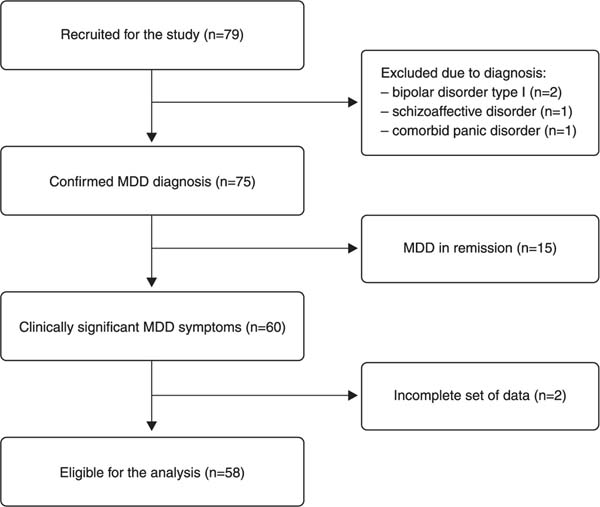
The study was conducted from October 2014 to January 2018 at the Mental Health Outpatient Clinic of Psychiatry Centre of Pabianice, Medical Centre of Pabianice, Pabianice, Poland. Three psychiatrists and one psychologist were asked to invite their MDD patients to participate and later distribute the battery of questionnaires (described below) to them. A total of 79 patients were recruited. Upon providing written informed consent, the MDD diagnosis was verified in accordance with DSM-5 criteria.23 The main inclusion criteria were: current MDD diagnosis (verified by at least two psychiatrists) and informed consent. The exclusion criteria included mood disorders other than MDD, other psychiatric diagnoses, including concomitant personality disorder and substance use disorder, a traumatic life event in the 6 months preceding the study, or severe or unstable somatic disease, e.g., end-stage renal disease, cancer, heart failure (New York Heart Association stage IV). At this point, four patients were excluded due to various diagnoses, as were and another 15 who were in remission. The data from two patients was not used in the analysis due to failure to complete the variables of interest (e.g., not answering all test items). Therefore, the final sample comprised 58 patients (Figure 1).
Questionnaires
The variables of interest were operationalized with psychometric tools. The chosen questionnaires were all well-known tests, commonly used in clinical practice, psychological diagnosis, and scientific research.
The Chronotype Questionnaire was derived and validated by Oginska.24 It comprises two dimensions: ME and the subjective amplitude, or distinctness, of the AM. Higher ME scores indicate a greater preference for evening activity. AM is defined as the ability to sense or adjust activity levels depending on the time of the day. A higher score indicates a greater amplitude. The ME scale consists of eight items, while the AM comprises six items, with possible scores ranging from 8 to 40 for the ME and 6 to 30 for the AM. It should be noted that a revised version of the Chronotype Questionnaire was recently published, with Cronbach's alpha values of 0.84 for the ME scale and 0.77 for the AM scale.10
The Hypomania Checklist 32 (HCL-32), a questionnaire to assess bipolar features, was developed by Angst et al.25 and validated in Polish by Lojko et al.26 It consists of 32 self-report items on lifetime incidence of hypomanic symptoms. Scores can range from 0 to 32. The Cronbach's a of the Polish version of the scale has been reported as 0.94.26
The Beck Depression Inventory (BDI) was used to quantify the severity of self-reported depressive symptoms in the month prior to examination. A revised and improved version of the test was published by Beck et al. and adapted to Polish by Zawadzki et al.27,28 The inventory comprises 21 items, referring to the DSM criteria of MDD. Scores can range from 0 to 63. The Cronbach's a of the Polish version of the questionnaire was of 0.93 among patients with depressive disorder.27-29
The Pittsburgh Sleep Quality Index (PSQI), developed by Buysse et al.,30 was used to assess poor sleep quality in the 4 weeks prior to the study. A Polish translation of the instrument is available via the web page of the Centre of Sleep Medicine at the Institute of Psychiatry and Neurology in Warsaw.31 No validation has been published for the Polish population so far. The questionnaire comprises 18 items grouped into seven components. Total scores can range from 0 to 21, with higher scores indicating worse sleep quality.30
Statistical analysis
The data were analyzed in SPSS version 23. The continuous variables were characterized by their minimal-maximal range and mean values with standard deviations (SD). The normality of distribution was verified with the Shapiro-Wilk W test and by analysis of histograms, skewness, and kurtosis.32,33 All continuous variables were better fitted to a normal distribution by Box-Cox transformations, assuming 250 iterations, a lambda range from -5 to 5, and a convergence parameter set at 0.00001. The initial assessment of the relationships between the continuous variables of interest was performed using Pearson correlation quotients. The Bonferroni correction was applied to avoid type-one error due to multiple testing. The group was homogeneous regarding the diagnosis. The number of the responders was sufficient for the purposes of the factor analysis since a low number of items was maintained (i.e., five: ME, AM, BDI, HCL-32, and PSQI scores).34 The Kaiser-Meyer-Olkin measure and Bartlett's test were used to assess whether the data were fit to detect a structure. Exploratory factor analysis, with principal component analysis as an extraction method, was performed in two steps: first, an unrotated factor matrix to elucidate the number of components by means of the Kaiser rule, followed by a second analysis on a rotated factor matrix. A non-orthogonal Oblimin rotation method was utilized because it was assumed that the components might be intercorrelated. The assumed maximal number of iterations for each model to reach convergence was set at 250. Indices with a common variance of at least 0.3 were considered significant association. Otherwise, the level of significance was assumed as alpha = 0.05.
Data availability statement
The database used to support this study's findings may be obtained upon request to the corresponding author.
Ethics statement
This study was conducted in accordance with the Declaration of Helsinki. The study protocol was approved by the bioethical committee of the Medical University of Lodz (RNN/130/14/KE, July 15, 2014). The ethical matters of the study concern mainly the selection and use of psychometric tools and the interpretation of their results; these are discussed in greater detail in the literature.35,36
RESULTS
A summary of the descriptive statistics of the variables of interest, both before and after Box-Cox transformation, is provided in Table 1. An intermediate, positive, and significant correlation was identified between the PSQI and BDI scores. No such statistically significant relationships were observed between the remaining correlation quotients (Table S1, available as online-only supplementary material).
| Min | Max | Mean (SD) | Skewness | Kurtosis | |
|---|---|---|---|---|---|
| Age | 22.00 | 77.00 | 48.21 (15.47) | -0.13 | -1.16 |
| ME | 7.00 | 40.00 | 26.74 (10.06) | -0.24 | -1.17 |
| AM | 10.00 | 30.00 | 23.28 (4.54) | -0.88 | 0.85 |
| BDI | 10.00 | 57.00 | 24.84 (10.24) | 0.74 | 0.48 |
| HCL-32 | 2.00 | 29.00 | 15.34 (7.22) | 0.13 | -1.04 |
| PSQI | 2.00 | 18.00 | 10.09 (4.11) | 0.11 | -0.34 |
| After Box-Cox transformation | |||||
| ME | 6.37 | 44.54 | 29.05 (11.80) | -0.21 | -1.20 |
| AM | 89.94 | 1,157.98 | 680.28 (269.23) | -0.15 | -0.50 |
| BDI | 2.76 | 5.58 | 4.01 (0.67) | 0.01 | -0.77 |
| HCL-32 | 0.88 | 12.83 | 7.68 (3.00) | -0.15 | -0.87 |
| PSQI | 0.95 | 12.72 | 7.12 (2.96) | -0.06 | -0.28 |
AM = subjective amplitude of the rhythm; BDI = Beck Depression Inventory; HCL-32 = Hypomania Checklist; Max = maximal value; MDD = major depressive disorder; ME = morningness-eveningness; Min = minimal value; PSQI = Pittsburgh Sleep Quality Index; SD = standard deviation.
The employed data appeared to be suitable for structure detection, as indicated by both the Kaiser-Meyer-Olkin measure (0.518) and Bartlett's test (?2 = 19.214, degrees of freedom =10, p = 0.04).
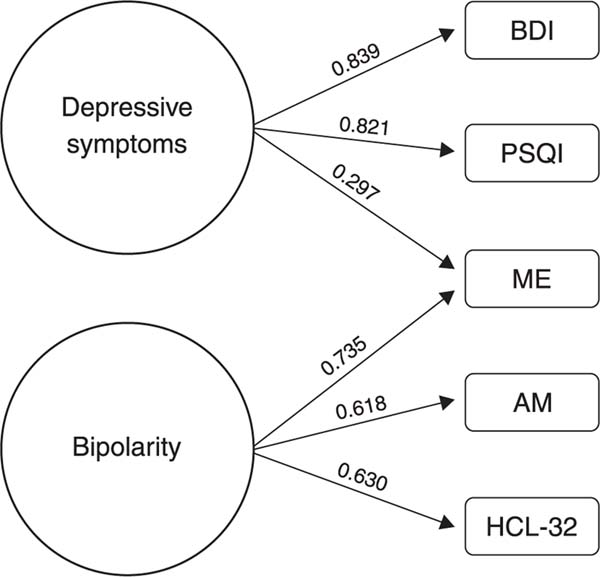
Initial factor analysis, in an unrotated matrix, indicated two latent components that cumulatively accounted for 57% of the explained variance of the variables (Table 2). Those factors comprised: 1) BDI and PSQI scores (component defined as depressive symptoms) and 2) CQ ME, CQ AM and HCL-32 scores (named: bipolar features).
| Initial eigenvalues | Extraction sums of squared loadings | ||||||
|---|---|---|---|---|---|---|---|
| Component | Total | % of variance | Cumulative (%) | Total | % of variance | Cumulative (%) | Rotation sums of squared loadings |
| 1 | 1.502 | 30.046 | 30.046 | 1.502 | 30.046 | 30.046 | 1.502 |
| 2 | 1.332 | 26.638 | 56.684 | 1.332 | 26.638 | 56.684 | 1.333 |
| 3 | 0.917 | 18.33 | 75.014 | ||||
| 4 | 0.708 | 14.153 | 89.167 | ||||
| 5 | 0.542 | 10.833 | 100 | ||||
AM = subjective amplitude of the rhythm; BDI = Beck Depression Inventory; HCL-32 = Hypomania Checklist 32; ME = morningness-eveningness; PSQI = Pittsburgh Sleep Quality Index.
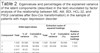
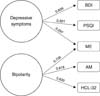
The Oblimin rotation reached convergence in four iterations, thus verifying the factor structure. A slight difference can be seen within the semi-standardized coefficients of the model when comparing the component matrix to the pattern matrix (Table S2, available as online-only supplementary material). An additional, yet rather weak link was between ME score and component 1, which was on the verge of assumed significance. The effect appeared to be independent of the relationship between ME and component 2, since the two latent factors did not appear to be correlated (r = -0.025), contrary to initial predictions.
A graphic summary of the analysis is shown in Figure 2 in the form of elucidated paths. The component plot in rotated space is depicted in Figure S1, available as online-only supplementary material.
DISCUSSION
In the current study, chronotype and bipolar features formed a latent component (called bipolarity), independent of sleep quality and depressive symptoms. ME appeared to have a small effect (i.e., on the verge of assumed significance) on the second latent component (i.e., depressive symptoms) after the model was rotated, but the elucidated factors were not correlated. Thus, both stated hypotheses were confirmed with the constructed model.
The results of our study are in line with previous research that evening type may be indicative of bipolar spectrum disorders.17,18,20 Both bipolarity and chronotype are considered to be biologically determined, which makes them temperamental traits; however, they may nevertheless be influenced by different genetic polymorphic variants.37,38
A systematic review and a meta-analysis found high harm-avoidance and low self-directedness to be typical of MDD patients, and high novelty-seeking and high self-transcendence was typical for BPD patients.39 Qiu et al.40 detected patterns of specific features among BPD type 1 patients, defined by two elucidated latent components: affective instability and general anxiety/worry. Further verification is needed before this temperamental characteristic can also be applied to bipolar spectrum disorder and MDD patients; however, it is possible that these factors, by definition, overlap with the two latent traits elucidated in the present study.
It has been recognized that biologically-determined traits play a role in the symptomatology and prognosis of mood disorders, which led Akiskal to develop the affective temperaments model.41 For example, it has been found that mania has a better functional outcome when hyperthymic features predominate over cyclothymic, depressive and anxious traits.42 It has also been found that affective temperament predicts the response to antidepressant treatment in MDD patients: similar results have been published regarding both bipolarity and eveningness.8,14,43
Thus, the search for an explanation to the link between circadian characteristics and bipolar features should focus on investigating its interrelationship with other recognized temperamental dimensions. The same approach could be applied to the relationship between eveningness and depression, since some authors report that sleep quality alone, or other indices of circadian disruption, may be not have sufficient explanatory power for different samples.15,44 The association of eveningness with three mood aspects (hedonic tone, energetic arousal, and tense arousal) was fully mediated by endurance and emotional reactivity.45 Irritable and cyclothymic traits fully mediated the relationship between chronotype and bipolarity, while depressive and anxious traits further increased the effect.46 However, both of these studies were performed on a healthy population, which raises the question of whether the results can be replicated in a clinical sample.
The subjective amplitude of the circadian rhythm may also be of value in the clinical assessment of mood disorder patients. However, it has only been found to have an indirect relationship with emotional liability or predisposition to seasonal affective disorder.10,22 This is the first study to find that the subjective amplitude of circadian rhythm is related to bipolarity among depressed patients.
Although research into the temperamental determinants of both chronotype and bipolarity may provide certain answers, other approaches should also be considered, including further analysis of the factors comprising the psychological construct of circadian orientation. For example, Putilov47,48 draws a distinction between the morning and evening components of circadian preference, and reports that morning lateness, but not eveningness, was associated with depressive symptoms. This might explain why the variance of ME observed in our study was related to two separate, uncorrelated latent traits.
Although this was only a pilot study employing exploratory factor analysis, an extended study is planned, comprising a substantially greater number of observations. We plan to include participants without depression and patients with different clinical backgrounds (e.g., both unipolar and bipolar depression) to confirm the factor structure identified in the present study.
Certain limitations should to be pointed out concerning the present study's design and the interpretation of its results. First, the sample was small, non-randomly chosen, and derived from a single center, which limits the generalizability of the findings. However, the sample's profile was naturalistic, ambulatory, and homogenous regarding the diagnosis. In addition, the number of observations was sufficient to meet the assumptions of the employed statistical methods. Another possible limitation is the study's observational character and the fact that it did not include certain clinical variables, such as pharmacological treatment. A study with a prospective design might be of particular value in studying the predictive role of chronotype, since eveningness is dominant among adolescents and young adults, with a shift towards morningness upon ageing.49,50 A relationship between current pharmacotherapy and circadian preference has also been reported.19 In addition, since no control group was used in the current study, it is not possible to propose any associations specific to MDD patients. Finally, only self-reported assessment techniques were used. However, the questionnaires chosen for the study are widely-recognized and highly-valued tools used commonly in clinical practice and scientific research.
In conclusion, the results of our pilot study suggest that evening chronotype may be a bipolarity-related marker, and this relationship was independent of its link to depressive symptoms and sleep quality. Although the mechanisms that link chronotype to bipolarity require further analysis, a preference for eveningness and a high-amplitude circadian rhythm may have potential as diagnostic, prognostic, and therapeutic predictors. Furthermore, the influence of the bipolarity-related aspect of evening preference might be distinct from that of sleep-related factors, i.e., individuals predisposed to sleep debt and biological-to-social rhythm desynchronization.
ACKNOWLEDGEMENTS
The authors would like to express their gratitude to Joanna Grzelinska (Second Department of Psychiatry, Institute of Psychiatry and Neurology, Warsaw, Poland) and Piotr Leszczynski (Department of Clinical Pharmacology, Medical University of Lodz, Poland), for their help in collection of the data, and to Edward Lowczowski, for providing language assistance. The conduct of the research was supported by the Medical University of Lodz (institutional grant no. 503/1-151/07/503-11-001-18).
Disclosure
The authors report no conflict of interest.
 PDF
 Print
 Send this article by email
 How to cite this article
 Submit a comment
 Mendeley
 Pocket
 Share on Facebook
 Share on Twitter



