



FIGURES
| Received: August 05 2022; Accepted: August 05 2022 |
The term "interventional psychiatry" has been coined to subsume interventions that are more procedural or invasive than standard pharmacological or psychotherapeutic treatments. Though originally proposed for brain stimulation techniques such as electroconvulsive therapy,1 interventional psychiatry also extends to surgical procedures (e.g., circuit-based neurosurgery for intractable obsessive-compulsive disorder2), novel pharmacological interventions (e.g., ketamine or esketamine), enhanced psychotherapy approaches (e.g., psychedelic-assisted psychotherapy), or complex digital interventions (e.g., cognitive control training combined with non-invasive brain stimulation). Whereas the field of brain stimulation with its substantial array of techniques, including recent developments such as temporal interference stimulation3 and focused ultrasound,4 has been systematically established over decades,5 the inclusion of many other novel interventions is making it a very rapidly growing field of innovation.
Some of these interventions have excellent personalization potential, e.g., by including multimodal information on individual brain connectivity.6 For instance, precision-oriented approaches that functionally target individual access points on the cortex using repetitive transcranial brain stimulation (rTMS) have been proposed as treatments for neuropsychiatric disorders. In major depressive disorder, this approach has focused on the connectivity between the left dorsolateral prefrontal cortex and the subgenual anterior cingulate cortex. Here, neuronavigated targeting can be combined with concurrent TMS/functional magnetic resonance imaging to identify the involvement of target brain areas and investigate the effects of therapeutic rTMS sessions on circuits and networks.7
A parallel approach focuses on both precision in timing and brain state control using closed-loop techniques. These methods can be applied in both non-invasive brain stimulation and deep brain stimulation. In a paradigmatic case study,8 a 36-year-old patient with highly treatment-resistant major depressive disorder first underwent stimulus-response mapping of emotional circuitry with stereoelectroencephalography electrodes for 10 days to identify targets in time and space, which were confirmed by subsequent multimodal assessment of connectivity in response to stimulation protocols. After stereoelectroencephalography biomarkers had been identified, a deep brain sensing and stimulation device was implanted and biomarker-driven closed-loop therapy was implemented. During the subsequent course of stimulation, the patient improved and finally reached remission after several months. Similarly, personalized closed-loop approaches have been proposed for non-invasive brain stimulation.9
Some interventions focus on accelerating the onset of therapeutic effects. Rapidly acting interventions like ketamine10 and potentially faster brain stimulation methods like accelerated rTMS11 create hope for quicker response and even remission, a clearly desirable goal in clinical research. Similarly, the concept of enhanced psychotherapy suggests that standard psychotherapy is insufficient due to its generally slow effect onset. However, two recent studies, one that incorporated a higher density of treatment sessions in the initial phase of cognitive behavioral therapy12 and another that added transcranial direct current stimulation to a cognitive behavioral therapy group therapy,13 failed to show better efficacy than control interventions.
A completely divergent direction from rapidly acting interventions is long-term treatment to support continuous improvement or even recovery. Implanted brain stimulation devices, e.g., the effects of vagus nerve stimulation or deep brain stimulation for major depressive disorder can be observed over a number of years. Although a randomized controlled trial found that the antidepressant effects of such devices were no better than placebo, vagus nerve stimulation has nevertheless been proposed as a treatment for major depressive disorder based on the outcomes of long-term studies, which have found beneficial effects over 5 years compared to treatment as usual.14 Thus, some researchers have argued that although the effects of this intervention are not immediate, they may be highly effective in the long run.
The multitude of therapeutic approaches in interventional psychiatry indeed comes with questions about randomized controlled trial designs and a debate about placebo controls. The strict criteria of evidence-based medicine have been evolving in the field of pharmacotherapy, with proof of a drug's superiority over placebo being mandatory for clinical implementation. However, in psychotherapy research, true placebo controls are not feasible, and active control groups have now replaced waiting list controls. In the field of interventional psychiatry, comparator conditions are becoming increasingly complex, and single therapeutic approaches must create their own "as close to active as possible" parallel control interventions (e.g., sham non-invasive brain stimulation). A critical question is which control interventions can serve as comparators for unique interventions, e.g., the immediate effects of psychedelic treatment, which completely prevent blinding. To date, no evidence-based criteria have been defined for proof of efficacy when long-term placebo treatment cannot be ethically justified or for acute interventions that cannot be placebo controlled. For some interventions, such criteria must be developed in addition to those for standard randomized controlled trial or meta-analysis. For instance, the observation that a specific intervention leads to shorter hospitalizations and outpatient visits and restores global functioning could point to novel efficacy criteria.
Finally, "interventional psychiatry" creates an urgent need for expert consensus on pathways of clinical implementation (i.e., national guidelines or treatment algorithms). Some of these methods will attract particular attention, and occasionally promotion on economic grounds may play a major role, but patients and caregivers may also ask for single interventions. This makes it necessary to change teaching and training for clinicians, develop standards for interdisciplinary collaboration (e.g., between psychiatry and neurosurgery regarding deep brain stimulation), and determine, with public and patient involvement, which ethical criteria must be established and communicated.15
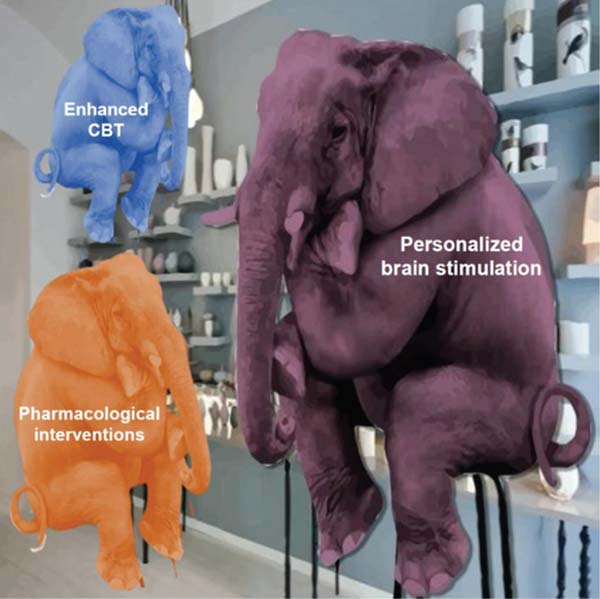
In sum, the field of interventional psychiatry has been living in a niche of mental health care for decades but is now rapidly evolving, providing new opportunities for effective and safe therapies. Each of these interventions represents a clinically challenging field that requires comprehensive translational research. Therefore, we need to understand and tame these methodological heavyweights to guarantee that they do not behave like elephants in a porcelain shop (Figure 1).
Disclosure
FP is a member of the European Scientific Advisory Board of Brainsway Inc., Jerusalem, Israel, and the International Scientific Advisory Board of Sooma, Helsinki, Finland. He has received speaking honoraria from Mag&More GmbH, the neuroCare Group, Munich, Germany, and Brainsway Inc. His laboratory has received equipment from neuro- Conn GmbH, Ilmenau, Germany, Mag&More GmbH and Brainsway Inc. ARB is chief medical advisor of Flow Neuroscience (Malmo¨ , Sweden) and has a small equity in this company (2019-onwards). The other authors report no conflicts of interest.
 PDF
 Print
 Send this article by email
 How to cite this article
 Submit a comment
 Mendeley
 Pocket
 Share on Facebook
 Share on Twitter



