



FIGURES
| Received: December 14 2022; Accepted: March 13 2023 |
Progressive multifocal leukoencephalopathy (PML) is a severe demyelinating disease of the central nervous system, caused by reactivation of the JC polyomavirus.1- 3 Although classically described in scenarios of severe immunosuppression, PML can on rare occasion affect patients with discrete, transient, or occult immunosuppression.1,3,4
An HIV-negative 57-year-old man with history of alcoholic cirrhosis (Child-Pugh A) presented with confusion and behavioral disturbances, difficulty speaking, and gait instability that developed over the last two months. His altered behavior was characterized by psychomotor retardation and aggressivity. Neurological examination revealed mixed aphasia, right hemiparesis, and ipsilateral hemianopia. The patient regularly consumed alcohol and was not taking any medication.
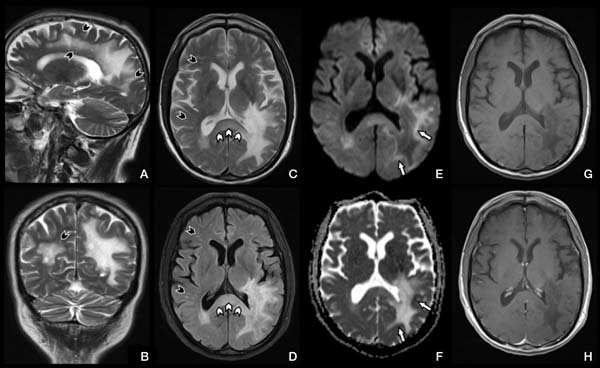
Head computed tomography revealed confluent hypodensity in the white matter of the left frontal, parietal, and temporal lobes that extended to the contralateral parietal region through the splenium of the corpus callosum. Brain magnetic resonance imaging confirmed an extensive lesion involving the periventricular and subcortical white matter (including the subcortical U-fibers) of these regions that was hyperintense on T2-weighted images, hypointense on T1-weighted images (with no enhancement), and showed a typical rim of restricted diffusion along the active margins of inflammation, which was characterized by an increased signal in diffusion-weighted imaging with corresponding low values on the apparent diffusion coefficient map. Multiple T2-weighted images showed hyperintense punctate areas surrounding the lesion, as well as in the right hemispheric white matter, consistent with a "Milky Way" pattern (Figure 1).
The patient had mild leukopenia (white blood cell count 3.3×10⁹/L) that normalized two days later (4.5×10⁹/L). HIV serology was negative and the CD4+ T cell count was 0.230×10⁹/L. Cerebrospinal fluid analysis showed slightly elevated proteins (0.64 g/L) and a normal cell count and glucose levels. Polymerase Chain Reaction analyses identified JC polyomavirus in the cerebrospinal fluid (3300 copies/mL). Based on these findings, PML was diagnosed, presumably linked to alcoholic cirrhosis, since other causes of immunosuppression were excluded.
Until recently, severe immunosuppression was considered an absolute requirement for developing PML. However, there are case reports of PML with less overt immunosuppression or with no documented immunosuppression.1- 4 In chronic diseases (i.e., alcoholic cirrhosis), transient or discrete failure in cellular immunity might be enough to promote JC polyomavirus reactivation.
A literature search yielded only 8 PML cases related to hepatic cirrhosis (3 with alcoholic etiology), including 1 woman and 7 men whose ages ranged from 41 to 64 years. Additional similarities to the present case included 3 cases with documented CD4+ lymphocytopenia or leucopenia and three descriptions of psychiatric symptomatology, which ranged from disorientation to severe mental confusion.2,4
Clinical manifestations of PML are nonspecific. Patients frequently present with gradually worsening focal neurological deficits and may develop seizures, altered mental status, or cognitive deficits.1,2 Our patient presented with confusion and behavioral disturbances, indicating that psychiatric symptomatology may be the cornerstone of this condition's clinical presentation.
Definitive diagnosis of PML requires histopathological examination or the detection of JC polyomavirus in the cerebrospinal fluid of patients with consistent clinical and imaging manifestations.5 The prognosis is poor and there is no specific treatment; thus, it is important to identify and, if possible, treat the underlying cause of immunosuppression.2- 4
In conclusion, PML has variable clinical manifestations and can affect patients with discrete or transient immunosuppression, making diagnosis particularly challenging. Although probably rare, it might be underdiagnosed in cases of cirrhosis. Therefore, early consideration of PML in cirrhotic patients with neurological and/or psychiatric manifestations is essential, along with adequate brain imaging and cerebrospinal fluid analysis.
 PDF
 Print
 Send this article by email
 How to cite this article
 Submit a comment
 Mendeley
 Pocket
 Share on Facebook
 Share on Twitter



