



ABSTRACT:
OBJECTIVE: To determine whether the stigma associated with schizophrenia has also been directed
towards people at ultra-high risk of psychosis (UHR), the present review aimed to
synthetize the literature to update and extend our understanding of this topic.
METHODS: A systematic review compliant with Preferred Reporting Items for Systematic Reviews
and Meta-Analyses guidelines was conducted in the PubMed, EMBASE, Cochrane, and Web
of Science databases for articles published until April 30, 2023, using a combination
of search terms describing at-risk mental states for psychosis, stigma, and related
terms.
RESULTS: Thirty-eight studies were included. Twenty-nine addressed individuals with UHR directly,
and nine conducted interviews with non-patients regarding UHR. A total of 2,560 individuals
with UHR were assessed, with a mean sample size of 88.3 participants. Most were quantitative
non-randomized/observational studies with young adults, 71.4% used the Structured
Interview for Psychosis-Risk Syndromes, and 25% used the Comprehensive Assessment
of At-Risk Mental States. Overall, the studies mainly involved patients of UHR clinics
from high-income Western countries. The described stigma can be grouped into five
forms, the most frequently explored of which was perceived public stigma, followed
by public stigma, self-stigma/internalized stigma, stigma stress, and associative
stigma. Quantitative nonrandomized studies predominated: only one was an interventional
study. Most of the results confirmed the presence of stigma toward individuals with
UHR.
CONCLUSION: Despite the knowledge gaps and scarcity of research on UHR-related stigma, the results
suggest that stigma toward people with UHR exists and that it is already present at
early stages of psychosis.
REGISTRATION NUMBER: PROSPERO CRD42022332037.
Keywords: Schizophrenia; at risk mental state; attenuated psychosis; stereotype; prejudice.
FIGURES
| Received: September 13 2023; Accepted: December 26 2023 |
INTRODUCTION
Stigma refers to a number of co-occurring processes that reflect discrimination, stereotyping, labeling, emotional reaction, and loss of status in a power imbalance in favor of the stigmatizer.1 Different categories of stigma can be formulated based on who (or what) is receiving or giving the stigma: it is internalized when one applies negative stereotypes about a condition to oneself, it is public when stereotypes/prejudice/discrimination are held by the general population, and it is courtesy/associative when stereotypes/prejudice/discrimination are perpetrated by people closely connected with the discredited person.2 Stigma can also be described in terms of how its influence is experienced, e.g., endorsed (agreement expressed with discrimination/stereotypes) or perceived (a personal perception that the general public holds negative attitudes/beliefs about oneself or one's condition).2 Additionally, as a stressor stigma may exceed personal coping resources, leading to what has been referred to as stigma stress.3
The findings of recent systematic reviews have revealed that self-stigma is a particular concern for people with schizophrenia spectrum disorders, affecting around 37% of patients.4,5 Negative and positive symptoms often generate socially maladaptive behaviors and, consequently, the diagnosis is typically identified with negative stereotypes.6 Indeed, schizophrenia spectrum disorders are more severely stigmatized than other non-psychotic mental illnesses, such as depression or anxiety disorders.7,8 And despite anti-stigma efforts, schizophrenia-related stigma has increased rather than decreased in recent decades.7,9,10 Self-stigma in individuals with schizophrenia has been found to significantly correlate with depressive symptoms, impaired function, decreased quality of life, and low self-esteem to a similar extent across cultures. A meta-analysis of 13 studies on individuals with schizophrenia spectrum disorders by Sarraf11 indicated that self-stigma had a significant negative correlation with quality of life. Other negative consequences of self-stigma have been described, including reduced empowerment and self-efficacy,12-14 lower subjective well-being,15 worse cognitive insight,16,17 more severe positive symptoms,12 and increased suicide risk.18 Whether internalized or experienced in other forms, stigma has also been shown to lead to exclusion from employment,19 social isolation,20 impaired intimate relationships,21 and delay or reluctance to seek help.22
Growing evidence has shown that stigma may occur at varying stages along the psychosis spectrum, including the early clinical23-25 and preclinical26 stages. This period has received different labels, such as ultra-high risk for psychosis (UHR), clinical high risk for psychosis, and at-risk mental state,27 and these nomenclatures have been used interchangeably here in this review. Indeed, it has been found that stigma is one of the main barriers to early intervention for UHR.28,29 Kotlicka-Antczak et al.30 reported that 19.2% of individuals with UHR interrupted contact with treatment services and that 52.63% of these dropouts were related to stigmatization. Also of great importance, two longitudinal studies reported that stigma could be an additional risk factor for psychosis among people with UHR.31,32 It has been proposed that stigma begins at the moment of awareness about the first subclinical psychotic symptoms and an at-risk label is applied.33 The future prospect of psychosis may be frightening and induce feelings of being "damaged."34-36 Indeed, the distinction between susceptibility and disease is unclear and may be even more subtle for the general public, who may understand UHR as a quasi-diagnosis37 and thus indistinguishable from schizophrenia itself. Stigma may also have consequences for the families of people with the disorder. It is known that the stigma faced by caregivers due to association with a mentally ill individual (i.e., associative stigma38) can delay access to mental health services or even become an impediment to treatment. Additionally, internalized stigma, identity problems, shame, and discrimination entail harmful consequences for personality development, self-confidence, and social/academic/professional aspirations.37
Since schizophrenia spectrum disorders commonly begin between the end of adolescence and the beginning of adulthood, that is, while the personality is still in development, the negative impact of stigma among patients, families, and institutions tends to be even greater.39 It also has been claimed that, if inadequately applied, the UHR framework may induce a large number of false positives, with consequent stigma and risk of unnecessary treatment.40,41 Overall, even though some empirical evidence indicates that stigma exists in the at-risk stages of psychosis, its nature, extent, and impact are still under debate, and research on this topic remains sparse.26
A 2020 systematic review attempted to synthesize the existing data on stigma and discrimination associated with UHR.28 It should be noted, however, that the review included studies that used both self-report (e.g., Anglin et al.42) and structured interviews to define their at-risk target population, thus resulting in a heterogeneous population and possible interpretation bias.43 To fill this gap, we focused on clinician-assessed UHR criteria, employing trained experienced interviewers to distinguish pathological from non-pathological psychotic phenomena, as opposed to the self-reporting of attenuated positive symptoms. Therefore, the present review aimed to synthetize the existing literature to update and extend our understanding of stigma among people with UHR. We hypothesized that stigma in all its forms would be highly present and detrimental during the UHR stage.
METHODS
This systematic review (study protocol: PROSPERO 2022 CRD42022332037) was conducted in accordance with the Preferred Reporting Items for Systematic Reviews and Meta-Analyses checklist.
Search strategy and selection criteria
On June 19, 2022, MM and FFR searched the PubMed (U.S. National Institutes of Health), Web of Science (Clarivate Analytics), EMBASE, and Cochrane electronic databases using a combination of search terms describing the at-risk mental state and stigma-related terms in compliance with each database's standards. The search terms for PubMed and Web of Science were: ("risk" OR "prodrom*" OR "ultra-high risk" OR "clinical high risk" OR "attenuat*" OR "high risk" OR "genetic high risk" OR "risk syndrome" OR "at-risk mental state" OR "ARMS" OR "risk of progression" OR "schizophrenia" OR "schizoaffective disorder" OR "schizophreniform disorder") AND ("psychosis") AND ("stigma" OR "label*" OR "stereotyp*" OR "prejudic*" OR "discriminat*" OR "shame"). The search terms for EMBASE and Cochrane are shown in Box S1 (available as supplementary material). We did not filter the results, and all languages were eligible. The records were assessed by two reviewers. To update the search, the authors repeated the procedures on April 30, 2023. The eligibility criteria were as follows: published studies on UHR with participants of any age that used a structured interview designed to diagnose UHR, i.e. the Comprehensive Assessment of At-Risk Mental States,44 the Structured Interview for Psychosis-Risk Syndromes,45 the Bonn Scale for the Assessment of Basic Symptoms,46 the Basel Screening Instrument for Psychosis,47 the Schizophrenia Proneness Instrument-Adult48 and its Child and Youth version,49 the Positive and Negative Syndrome Scale,50 the Scale for the Assessment of Negative Symptoms,51 the Brief Psychiatric Rating Scale,52 or the Early Recognition Inventory.53 We considered all stigma evaluations that focused on personal or public levels, self-stigma, perceived stigma, or experienced stigma. Thus, both descriptive and analytical studies were included with qualitative (e.g., non-structured interviews, focus groups) and quantitative data (e.g., validated scales), as well as interventional studies evaluating how different treatments or approaches interfere with stigma.
The exclusion criteria were studies addressing only individuals with an established diagnosis of psychosis according to the DSM-III, DSM-IV, or DSM-5. We also excluded studies that enrolled only participants with other subclinical psychoses that were not evaluated with an established instrument (e.g., those assessing psychotic-like experiences) and those in which stigma was not assessed in relation to UHR. Studies including mixed samples (e.g., schizophrenia spectrum disorders) were excluded if the UHR stigma results were not reported separately from the entire sample.
Descriptive measures and data extraction
Independent researchers (MM, AAL) extracted data from the included studies, with discrepancies resolved through consensus. Beyond general data such as first author, year of publication, city, and country, the included variables were: i) study type/study design, ii) UHR scale, iii) number of participants with UHR, iv) sample characteristics (age, % male), v) outcome, and vi) results. Stigma outcomes were classified based on the studies' findings according to the authors' understanding. Table S1, available as supplementary material, provides a systematic summary of all included studies.31-33,35,36,54-86
Risk of bias assessment
Since the selected studies involved different methodologies (mainly cross-sectional and qualitative), we used the Mixed Methods Appraisal Tool version 2018 for quality assessment, which allows evaluation of the methodological quality of five study categories: qualitative research, randomized controlled trials, non-randomized studies, quantitative descriptive studies, and mixed methods studies. Although calculating overall scores and mean values for the included studies is not recommended, the Mixed Methods Appraisal Tool scoring is included in Table S2 (available as supplementary Excel file for download). The mean score of the included studies was 4.21.
RESULTS
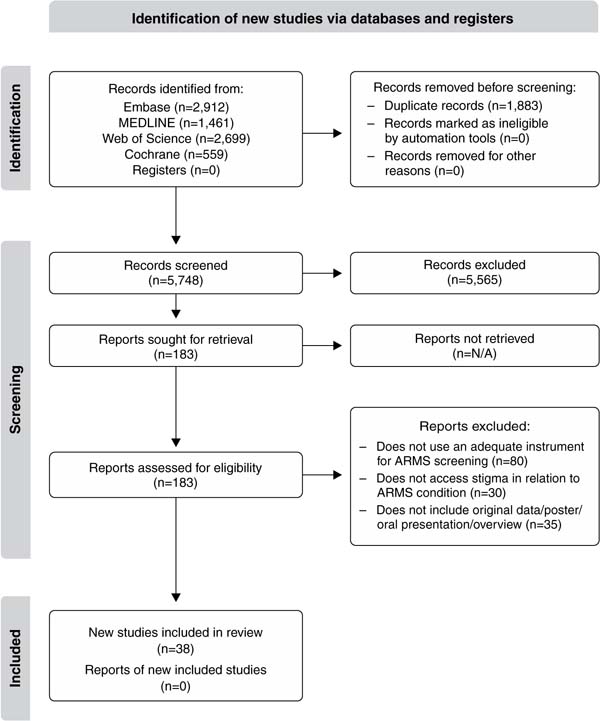
The search phase found 7,631 records. After excluding duplicates (1,883), 5,748 remained (Figure 1). After title/abstract screening, 183 articles underwent full text examination, of which 38 were included in this review.
Characteristics of the included studies
A total of 2,560 individuals with UHR were assessed in the 38 included studies, of which 29 addressed individuals with UHR directly and nine conducted interviews with non-patients regarding UHR (e.g., health professionals, students, and parents).
The mean sample size was 88.3 participants (median = 46). Ten studies were qualitative, 27 were quantitative non-randomized studies, one was a randomized control trial, and one was a case report. The weighted mean participant age was of 20.8 years, and the pooled percentage of men was 61%. To identify UHR, 71.4% used the Structured Interview for Psychosis-Risk Syndromes, 25% used the Comprehensive Assessment of At-Risk Mental States, and 3.6% used the Basel Screening Instrument for Psychosis.
Types of stigma assessment
Stigma was mainly assessed through semi-structured interviews, scales, and focus groups for qualitative research. The most frequent stigma outcomes were perceived public stigma (present in 12 studies), public stigma (evaluated in 10 studies), self-stigma/internalized stigma (10 studies), stigma stress (seven studies), and associative stigma (three studies). Sixteen of the studies assessed more than one stigma outcome.
Perceived public stigma
Byrne & Morrison55 conducted a qualitative study with eight patients from an Early Detection service in the UK. All participants described the difficulty of talking about unusual psychological experiences. Most often, they identified their central concern as the fear that their experiences meant that they were "going mad" and, therefore, that others would react negatively to them if they disclosed their mental health problems. Uttinger et al.71 conducted a qualitative study of 11 individuals, finding that fear of stigma due to negative stereotypes about psychosis caused many individuals to reveal their UHR condition to close friends and family members only. Several reported not being taken seriously or being perceived as lazy or lacking motivation by their social network and felt relieved to be finally perceived as having a mental health condition. Ben-David et al.72 explored perspectives about engagement with mental health services in UHR. Thirteen of the 30 participants agreed with the item stigma leads to secrecy, revealing that they did not want to share that they were being treated at a psychosis risk clinic. Twenty-five of the 30 participants only partially disclosed that they were being treated at a clinic to their social support networks, often because they thought others would judge them. Rüsch et al.57 found that perceived stigma was not related to help-seeking attitudes. In a 1 year follow up study (with the same sample), Xu et al.65 found that baseline levels of self-labeling, perceived stigma, stigma stress, and clinical symptoms did not predict attitudes toward psychiatric medication or psychotherapy after 1 year. These data confirm a relationship between perceived public stigma and secrecy by concealing treatment and diagnosis from family and friends.55,71,72 Nevertheless, other studies57,65 found no relationship with help-seeking attitudes. Rüsch et al.57 hypothesized that it may not be societal stigma itself that negatively affects the use of health services, but whether youth at risk for psychosis feel confident of their resources to cope with stigma as a potential stressor.
Public stigma
Public stigma was usually evaluated through vignettes exploring differences in stigma between several mental health conditions, mainly in the psychosis spectrum, including schizophrenia, UHR, depression, and psychotic-like experiences. There is an apparent gradient of stigma from schizophrenia (highest) to psychotic-like experiences (lowest), with UHR and depression in an intermediate position.64,70,79,81 However, in a sample of 153 psychology students, Yang et al.35 reported that the psychosis risk label was significantly associated with greater stigma in terms of status loss and discrimination than labels for nonpsychotic disorders. Furthermore, participants reported comparable levels of stigma for the psychosis risk and the schizophrenia labels. Interestingly, stigma towards at-risk individuals significantly decreased when respondents were provided accurate information (i.e., that only about 35% of them would actually develop psychosis).35 Anglin et al.,60 conducted a qualitative study with 49 undergraduate students in which participants had to label vignettes according to their knowledge. Those who attributed a psychosis-associated label to the person described in the vignette had a stronger fear of attribution than those who applied non-psychiatric labels. In a sample of 96 undergraduates, Parrish et al.73 added two control labels (normal stress reaction and normality) to the standard diagnosis, finding that the schizophrenia, UHR, or attenuated psychotic symptoms syndrome labels did not elicit greater stigma. In a sample of 365 participants, Baba et al.70 found that prejudice scores against UHR were lowest among psychiatry professionals (45.56 [SD, 6.02]), followed by patients with mental illness (48.31 [SD, 7.64]), but the general public attributed the highest level of stigma (49.54 [SD, 7.17]). Discrimination scores followed the same pattern: the former stigma variable reached statistical significance but the latter did not.
Internalized/self-stigma
Internalized/self-stigma was addressed in ten studies, two using data from the Early Detection and Intervention Evaluation trial. In the only randomized controlled trial included in this review, Morrison et al.58 investigated the effects of cognitive therapy on internalized stigma, finding that cognitive therapy did not significantly improve appraisals of the social acceptability of these experiences, despite a strong trend in that direction (p = 0.07). Pyle et al.59 suggested that internalized stigma may contribute to the development and maintenance of depression in young people at risk of psychosis. Yang et al.33 found relatively high stereotype awareness, and associations between stereotype awareness, stereotype agreement, and shame were significant. However, agreement with stereotypes appeared lower. Symptom-related stigma appeared more important overall at this early point in illness, and was linked with increased depression. In a qualitative study, Uttinger et al.71 found that the interviewees with UHR were aware of common stereotypes about people with psychosis but did not seem to identify themselves with these stereotypes, distancing themselves from internalized stigma. Baer et al.,77 published a case report of a young woman treated with cognitive-behavioral therapy. By the end of therapy, the strength of her belief that her brain was damaged and that she would develop psychosis declined from 80% to 30%. Herrera et al.86 found a significant association between longer facial emotion recognition response times and greater stereotype agreement and discrimination. Overall, minorities with greater internalized stigma took longer to identify facial emotions. Ruiz et al.85 evaluated 26 Non-Latinx White and 15 Latinx participants with UHR. Both the Latinx and Non-Latinx White participants frequently reported internalized stereotypes. However, instances of stereotype internalization appeared to be more important to Non-Latinx Whites than Latinx, and Latinx participants reported more anticipated rejection due to stereotypes than Non-Latinx White participants. More recently, Sportel et al.36 investigated the relationship between self-stigma and cognitive insight among individuals with UHR from the Netherlands. They found that levels of self-stigma in individuals with UHR were comparable to those in people diagnosed with a schizophrenia spectrum disorder and that alienation as a self-stigma dimension was significantly and positively correlated with self-reflection as a cognitive insight dimension in the UHR group.36
Stigma stress
Regarding stigma stress, we will describe studies by the Zurich Program for Sustainable Development of Mental Health services (Zürcher Impulsprogramm zur Nachhaltigen Entwicklung der Psychiatrie). Rüsch et al.32,61 published two articles in 2014 about the interactions between self-labeling, stigma stress, and well-being. The first study, which included 172 individuals in baseline interviews, showed that perceived public stigma, shame, and self-labeling were independently associated with increased stigma stress. Greater stigma stress predicted lower well-being, independent of age, sex, symptoms, or psychiatric comorbidity. Stigma stress partly mediated the effects of perceived public stigma, shame, and self-labeling on well-being. The latter study's results partly confirmed the cross-sectional patterns described above in the same sample, suggesting that changes in self-labeling and stigma stress over time may worsen the well-being of young people at risk of psychosis, regardless of baseline levels. Using data from the same program, in 2015 Rüsch et al.31 published another study in which the transition to schizophrenia after 1 year was associated with significantly more stigma-related harm and stigma stress at baseline, but not with more perceived coping resources. Two 2016 studies on suicidality also used Zurich Program data. The first63 reported that stigma stress was associated with more social isolation, less self-esteem, and increased depressive symptoms, being thus indirectly associated with suicidal ideation via social isolation. In the second,67 increased suicidal ideation at 1 year of follow-up was significantly associated with greater perceived stigma and higher stigma stress after 1 year. In comparison to a group of 46 participants with no change in suicidality status, the five who became suicidal reported an increase of stigma stress between baseline and follow-up (Mann-Whitney U = 203, p = 0.003), while the 22 whose suicidality had ended at follow-up reported less perceived stigma (t = 2.20, p = 0.03). In multiple logistic regressions models, an increase in stigma stress (but not perceived stigma) over time was significantly associated with suicidal ideation at 1 year of follow-up.
Associative stigma
In a study by Wong et al.,54 the families of 11 individuals with recent onset psychosis and nine families with a member at clinical risk of psychosis were evaluated using a modified and expanded version of the Opinions about Mental Illness Scale and the Family Experiences Interview Schedule. Similar results were found between the groups in generalized stigma measures: associative stigma was reported more frequently by family members of the recent psychosis onset group than by family members of prodromal individuals. Associative stigma was not associated with objective or subjective family burden. However, the overall stigma level was low. He et al.80 examined associative and public stigma in individuals from Taiwanese and Chinese families living in the United States. They used a UHR vignette condition based on a stigma framework that identifies capacities defining personhood, which thereby shapes stigma for members of a particular cultural group. Instruments were also applied regarding help-seeking attitudes, family stigma, and individual stigma. A positive association was found between family stigma scores and UHR stigma scores (r = 0.65, p < 0.01), as well as with help-seeking scores for UHR (r = 0.17, p < 0.05). A qualitative study74 using a semi-structured approach and interpretative phenomenological analysis to focus on experiences of associative stigma and the way parents make sense of these experiences found that 12 parents attempted to balance fighting against stigma with the privacy needs of their adolescents. Stigma impacted treatment-seeking and participation in family groups, which were seen as both potentially supportive and threatening.
DISCUSSION
This study was an attempt to provide an updated systematic review on stigma among individuals with UHR. Unlike a previous systematic review by Colizzi et al.,28 we decided to include only studies that used a structured interview instrument to diagnose UHR and to exclude all studies in which stigma was not related to UHR as a condition. Accordingly, five articles included by Colizzi et al. were excluded from our final selection. We also included seven new articles published since the aforementioned review.36,81-86 Overall, 38 studies that mainly involved individuals who are already being treated at UHR clinics from high-income Western countries were summarized. Five forms of stigma were explored, the most frequent of which was perceived public stigma. Quantitative nonrandomized studies were the most prevalent, with only one interventional study included. It is worth mentioning that no new intervention studies were found after 2013. Most of the results confirmed the presence of stigma toward individuals with UHR. As expected, the findings also support the hypothesis that stigma is already present in very early stages of the disease.
To what extent is stigma present in individuals with ultra-high risk of psychosis?
The studies generally documented high levels of internalized stigma in individuals with UHR. Park et al.84 found that people with UHR have higher levels of shame than healthy controls. Sportel et al.36 found no significant difference in self-stigma levels between UHR and schizophrenia patients. Similar self-stigma in both the UHR and clinical psychosis phases suggests that self-stigma is independent of previous experiences of receiving a diagnosis/label of schizophrenia.36 Concerning public stigma, the UHR label was associated with less stigma than schizophrenia or other mental health disorders. For instance, Baba et al.64 surveyed 119 psychiatry professionals, 97 patients, and 149 people from the community, finding similar patterns of stigma assessment. They observed a gradient in which discrimination and prejudice were highest against schizophrenia, followed by UHR, with the lowest toward psychotic-like experiences. This gradient was also found in a qualitative study where participants rated psychotic disorders as more stigmatized than other mental health disorders, such as depression and anxiety.78 These results were partly consistent with those of Yang et al.35 and Parrish et al.,73 who found that the schizophrenia and UHR labels evoked similar degrees of stigma. Regarding associative stigma, the findings revealed lower levels in families of individuals with UHR than in families of individuals with recent onset psychosis,54 indicating that a psychotic episode may increase a family's concern about stigma.87 This is particularly relevant, since fear of associative stigma can delay treatment seeking and participation in family groups, which are seen as both potentially supportive and threatening.74 Family was also found to both produce and be vulnerable to associative stigma, which shows that associative stigma is a dynamic experience that requires more multi-pronged anti-stigma approaches. It is also suggested that psychoeducation should consider the particularities of each family when addressing psychosis risk. Psychoeducation should also seek alternative means of connection, such as online programs, that families could access conveniently, asynchronously, and with greater anonymity.80 In a study further evaluating the relationship between associative stigma and help-seeking processes for UHR in an Asian-American sample (following the perspective of others, rather than the parents' perspective used in the above-mentioned studies), family stigma was unexpectedly associated with more positive help-seeking attitudes, which speaks against stigma as a barrier to seeking mental health help. The authors of this study reported that their results apply specifically to Chinese groups, in which the way the public views families depends on how individuals fulfill family obligations, which may be associated with stronger encouragement to seek treatment.54
Does the label ultra-high risk for psychosis, per se, encourage stigma?
Regarding the general public's view, Anglin et al.60 found that stigma was stronger among respondents who used labels closely related to psychosis (e.g., paranoid/paranoia), specifically fear attributions, similar to that of formal psychotic labels (e.g. weird, troubled). Regarding the patients' view, Kim et al.68 found that only a minority of those at risk for psychosis thought that the terms at-risk mental state, UHR, or attenuated psychotic symptoms were stigmatizing or should be changed. Professionals working in early intervention services tended to attribute greater stigma to these terms. While the at-risk label has initially been proposed as a starting point for stigma, patients reported that acknowledging their early psychotic signs and symptoms was a greater concern.33,71 Indeed, qualitative evidence showed that individuals with UHR reported being relieved that a specific term was attributed to the constellation of early symptoms and altered behaviors they experienced and generally perceived their interactions with the early intervention program as helpful.63 Similarly, participants in a previous study82 reported significantly less negative emotion after receiving feedback about their risk status. Fear of becoming psychotic seems to be much more related to the symptoms themselves rather than being treated by an UHR service.88 Despite this, secrecy and cautious disclosure were also reported as a major concern by this population in several studies.55,72,74,82,85 For instance, Lawrence et al.66 found that individuals with UHR expressed concern about disclosing their genetic test results to employers if they confirmed a higher risk of schizophrenia. This calls attention to the importance of educating at-risk people about the distinction between carrying a genetic risk and having the disorder. In addition, three studies about label-related stigma68,69,83 revealed a desire for labels that reinforce the uncertainty and potential reversibility of psychosis risk.69 The above-mentioned data have prompted some researchers (e.g., Rüsch et al.61 and Moritz et al.89) to even question the utility and relevance of early intervention in psychosis, an approach accused of catastrophizing the future of people with UHR, partly due to the harmful impact of stigma.89 In a response to these criticisms, Yung et al.88 concluded that at-risk mental state services are more beneficial than harmful and stigmatizing, although the term prodromal should be avoided, since it suggests an inevitable progression to full-blown psychosis.
Which factors correlate with stigma among individuals with ultra-high risk of psychosis?
Self-stigma in individuals with UHR was related to facial emotion recognition in two studies76,86 and to cognitive insight in one study.39 Larsen et al.76 found that greater self-stigma-related shame was associated with lower accuracy in identifying fear in faces and greater misattribution of fear to non-fearful faces. It may be that facial emotion recognition deficits lead to stigma, since youth on the psychosis spectrum show lagging development in facial emotion recognition as early as 8 years of age. It is plausible that such early facial emotion recognition deficits, especially regarding threats and fear, could lead to misattribution of others' emotions and intentions and subsequent suspiciousness, stigma stress, and stigma shame.76 Sportel et al.36 observed that participants with UHR and increased cognitive insight also had high levels of self-stigma, suggesting that interventions to target self-stigma in UHR should also consider cognitive insight.
Studies also investigated whether familiarity with, knowledge about, or working with mental health would influence stigma scores. Lee et al.64 found that volunteering or working in the mental health field reduced stigma scores in Hong Kong. Parrish et al.73 found that some knowledge of psychosis predicted stigma, whereas familiarity did not. Wang et al.81 reported that having a family member with mental illness or experience working or volunteering in mental health services had no effect on stigma. People who have visited a psychiatric hospital for a purpose other than receiving treatment showed higher discrimination toward schizophrenia, UHR, and depression. The authors suggested that personal contact without a well-designed program could be harmful rather than helpful in decreasing stigma.
To what extent is stigma a concern in individuals with ultra-high risk of psychosis?
All forms of stigma were associated with negative consequences. Perceived public stigma was related to fear of negative reactions towards people with UHR,55 being identified with stereotypes about mental disorders57 and a desire for social distance.35 It also resulted in attempts to hide UHR.55,71,78 Internalized stigma was found to contribute to the development and maintenance of depression in individuals with UHR.59 It may be compared to the development of post-psychotic depression in persons who have had a psychotic episode, which is linked to negative appraisals of psychosis, including loss of social roles, humiliation, self-blame, and shame.90 Rüsch et al.32 found that stigma stress was correlated with lower well-being in people with UHR. Thus, cognitive models of psychosis propose that early stressful events may result in cognitive vulnerability, which influences the interpretation and appraisal of daily stressors and increases the likelihood that anomalous experiences develop into a psychotic disorder and social defeat, which is more evident in people with UHR than controls. These findings are consistent with the hypothesis that social defeat is a key etiological factor in psychosis, and it is a particularly interesting risk factor since animal studies indicate its association with neurobiological changes to brain dopamine function are similar to those that occur in people with UHR.91 Moreover, stigma stress increases the risk of transition to schizophrenia over time. This is also supported by Rüsch et al.,31 in accordance with previous studies which found that poor social support and social deprivation contribute to the onset of psychosis.92,93 The included studies about suicide63,67 are consistent with a stress-diathesis model of suicidality,94 suggesting that increased stigma stress or the perception that one lacks the resources to cope with an increasing stigma-related threat may be more relevant to suicidality than greater perceived stigma per se.
Clinical implications and research perspectives
In sum, most of the existing evidence suggests that the public tends to apply similar stereotypes towards people with schizophrenia and those at-risk for psychosis. In addition, studies comparing UHR, non-psychotic mental disorders, and healthy controls report that the UHR label is associated with greater stigma. Additionally, individuals with UHR seem to be affected by perceived self-stigma to the same extent as schizophrenia patients and to a greater extent than healthy individuals. Nevertheless, we found only one intervention study about stigma reduction. The randomized controlled trial by Morrison et al.58 indicated that cognitive therapy decreases negative appraisals of unusual experiences in young people at risk of psychosis. However, the potential stigma of a psychosis risk label could be better managed at a structural or public health level, as has been done in Australia, where UHR clinical research programs were first located in community centers rather than hospitals or universities and were then embedded entirely in nationwide strategies to promote teen mental health and well-being.40 Furthermore, studies investigating feedback in early intervention clinics characterize it as an opportunity to reduce negative emotions,82 although there is evidence that self-labeling appears to partially account for the effect of labeling by others. This illustrates the importance of how individuals interpret their own symptoms,75 which should be considered in specialized feedback. Another important fact is that only seven studies have emerged since the last review on the topic31 almost 4 years ago. This lack of attention is surprising, especially since Colizzi et al.28 sounded the alarm regarding the substantial stigma affecting people with UHR. Thus, there an urgent need for additional research about the extent and effects of UHR-related stigma on patient psychological indicators, willingness to seek help, engagement in early intervention services, and clinical outcomes.31 In addition, further anti-stigma intervention studies are highly encouraged to reduce self-stigma and its detrimental effects. Certain factors (e.g., cognitive insight, previous exposure to or knowledge of the condition) appear to increase UHR-related stigma in the general public, families, and individuals with UHR. These factors should be considered when dealing with individuals with UHR and developing anti-stigma strategies.
Evidence about the effects of being labeled with UHR on stigma levels is rather mixed. Some studies reported generally positive patient experiences with the UHR label.56 Self-labeling involves awareness of one's problems and acceptance of being mentally ill, which could facilitate treatment seeking,95 lower stigma stress, and more positive attitudes toward psychiatric medications.57 In contrast, other findings revealed that the UHR label is publicly linked to stigma similar that of formal psychotic labels,60 and that patients are rather reluctant to disclose their UHR condition.43,72,74,82,85 Overall, it is still unclear whether labeling is beneficial or harmful for patients, and further research is required.
Finally, studies assessing racial differences in stigma54,80,85,86 reported findings that warrant further attention. This was pointed out by a systematic review of studies on the UHR paradigm in developing countries, which reported a proportional disparity between the number of included studies and the country's income-level.29 An online poll of corresponding authors about research limitations and findings was summarized in three topics: disparity in data and funding, follow-up issues, and cultural barriers/stigma surrounding the topic.32
Our review has several limitations. First, most of the studies consisted of help-seeking samples, which may have biased interpretation of the results and limited its generalizability. Second, several studies used convenience sampling, which can also limit generalization of the results. Third, most of the studies had small samples and focused on regional scenarios, lacking strategies to guarantee a more representative sample of ethnic minorities. Thus, further studies with larger samples that take regional factors and cross-cultural differences into consideration are needed before our findings can be generalized. Fourth, although psychiatric comorbidities were common among individuals with UHR, it was not controlled for in the included studies. Thus, it remains unclear whether and how they influence stigma experiences. Fifth, some of the included studies did not report medication usage in UHR patients, despite its possible confounding effects. Several studies interviewed patients who were undergoing treatment, which may lead to social desirability and response bias, since participants may have found it difficult to voice more negative or critical commentary while receiving clinical care from a free early intervention service.56 In addition, some studies used self-report stigma measures, which are susceptible to social desirability bias and selective recall. In addition, some studies used stigma scales not specifically designed to address pre-psychotic experiences (asking respondents about mental illness or psychosis when it is not yet their concern). Sixth, since most of the studies involved a cross-sectional design, causality cannot be analyzed. The preponderance of cross-sectional studies also limits our understanding of the dynamic evolution of stigma, which tends to decline over time, regardless of intervention. For instance, this limits our ability to determine whether the high levels of stigma reported by most studies followed a recent diagnosis of UHR or are the consequence of a more consolidated process, in accordance with the conclusions of a 2020 systematic review about stigma in individuals at risk of psychosis.28 We also join Colizzi et al.28 in questioning whether individuals at-risk for psychosis experience internalized stigma because of their fear of developing psychosis or if they consider themselves to already be affected. Finally, we point out that all of the studies included in this review were from high-income Western countries, which might limit the generalizability of our conclusions to UHR populations in low- and middle-income non-Western countries. Thus, future research should be conducted in these under-researched countries and regions, such as Arab countries (e.g., Tunisia96) where stigma is particularly common.97 Such research is strongly needed, given that both stigma98 and subthreshold psychosis99 are subject to cultural variation.
Overall, there is still a paucity of research and important knowledge gaps on all aspects of UHR-related stigma. Most of the included studies confirm that people with UHR are stigmatized, mainly through public stigma and perceived public stigma. Both stigma outcomes relate to public misconceptions about psychosis and its correlates, which underscores the need for interventional studies (e.g., public campaigns explaining the concept of UHR in schools and health clinics) to effectively tackle stigma beginning with the early stages of the disease. This review also reveals the need for studies in low- and middle-income non-Western countries, where the complex interrelationships between poverty, social inequality, and mental disorders can be clarified. Similarly, studies in different ethnic and cultural contexts are essential for understanding the cause-and-effect relationships between discrimination, persecution, and psychosis.
DISCLOSURE
The authors report no conflicts of interest.
 PDF
 Print
 Send this article by email
 How to cite this article
 Submit a comment
 Mendeley
 Pocket
 Share on Facebook
 Share on Twitter



