



FIGURES
| Received: January 02 2024; Accepted: February 11 2024 |
Choroid plexus papillomas (CPPs) are rare benign tumors that arise from the choroid plexus, a structure in the brain responsible for producing cerebrospinal fluid. They are generally observed in children, and the most common location is the lateral ventricle.1 While these tumors are primarily associated with neurological symptoms, data on psychiatric manifestations (including psychosis) are limited. An association between CPPs and psychiatric symptoms, particularly psychosis, has been reported in previous case studies. Carson et al. described a 9-year-old boy who developed psychosis, including auditory hallucinations and violent behavior changes, in association with a CPP. Magnetic resonance imaging (MRI) revealed a mass in the third ventricle, which was subsequently removed. Following surgery, the patient's psychotic and behavioral symptoms improved.2 Similarly, Arasappa et al. described a 38-year-old man who developed psychosis (including delusions of reference and persecution and auditory hallucinations) in association with a CPP in the fourth ventricle. After the tumor was surgically resected, his psychotic symptoms improved.3
This case report focuses on a forensic psychiatric inpatient with psychosis who was incidentally diagnosed with CPP. A 27-year-old man arrived at our hospital's forensic psychiatry unit accompanied by law enforcement officers for assessment of his criminal responsibility. A comprehensive physical and psychiatric examination was conducted. Communication was established through sign language due to his congenital hearing impairment. It was found that for the past 3 years, he believed that people he encountered were talking about him, plotting to take his bank card by force, and intending to harm him. These reference and persecutory delusions led to social withdrawal. He also occasionally became verbally aggressive due to his delusions. His first psychiatric admission occurred 3 years ago when psychotic symptoms emerged; he received inpatient treatment and a discharge diagnosis of unspecified schizophrenia spectrum and other psychotic disorder according to the DSM-5. One year ago, due to intensified psychotic symptoms, especially persecutory delusions regarding family members, he was readmitted to the hospital and received inpatient treatment, receiving the same discharge diagnosis. He had been unable to maintain regular medication use since his last discharge.
The patient also had a history of criminal incidents during psychotic episodes. According to the history of events that led to his forensic admission, the first incident occurred when his psychotic symptoms emerged 3 years ago. He believed that someone on the street wanted to take his money, so injured that person with a knife. The second incident occurred 3 months before admission when, following persecutory delusions, he threatened a security guard with a knife. He had no history of substance abuse, and his family had no history of psychiatric disease.
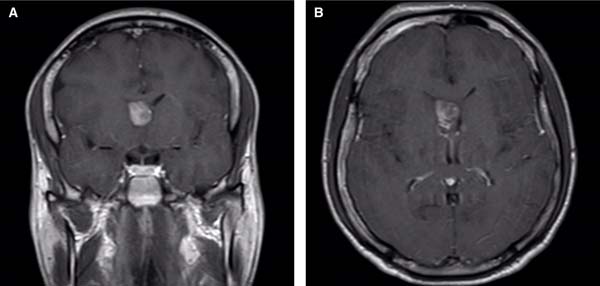
There were no relevant findings in the patient's physical and neurological examinations. MRI was performed as part of his evaluation, which showed an incidental mass in the lateral ventricle (Figure 1). Contrast-enhanced MRI was recommended by the consulting neurosurgeon, and the consulting radiologist who performed it reported that the mass was compatible with CPP. Since the patient had no neurological symptoms and his psychiatric condition was unstable, he was considered unsuitable for surgery, and follow-up for any neurological symptoms or growth in the mass was recommended by the consulting neurosurgeon.
After comprehensive psychiatric examinations, the patient is diagnosed with unspecified schizophrenia spectrum and other psychotic disorder according to the DSM-5. His psychotic symptoms responded significantly to antipsychotic treatment. It was determined that he lacked criminal responsibility for the incidents during his psychotic episodes. He was discharged, prescribed pharmacological treatment (amisulpride 800 mg/day, quetiapine 300 mg/day and biperiden 4 mg/day), and neurosurgical and psychiatric follow-up was recommended.
The exact mechanism underlying the relationship between CPPs and psychiatric symptoms remains unclear, but hypotheses include the tumor's direct effects on brain function and disruptions in cerebrospinal fluid circulation.2-4 The choroid plexus's involvement in a potential pathophysiological mechanism involving the neuroimmune axis is also suggested as a mechanism for psychosis.5 In addition, choroid plexus calcification, which has been suggested as a neuroradiological marker of hallucinations, could support a relationship between choroid plexus pathologies and psychosis.6
Treatment for CPPs typically involves surgical removal of the tumor, and the diagnosis depends on histological confirmation. Radiography and antigen-specific markers have been inconclusive.1 Asserting that this patient's psychosis is definitively associated with CPP could be problematic, given that CPP was diagnosed with contrast-enhanced MRI, histological confirmation was impossible, and progress after tumor resection cannot be monitored.
In conclusion, while the relationship between CPPs and psychiatric symptoms remains an area of active research, there is evidence to suggest that these tumors may be associated with an increased risk of psychosis and aggressive behavior. Health care professionals should be aware of potential psychiatric manifestations in patients with CPP. Early detection and appropriate treatment may improve patient outcomes. Future studies should aim to clarify the underlying mechanisms of this relationship and identify potential treatment strategies for patients with CPPs and psychiatric symptoms.
 PDF
 Print
 Send this article by email
 How to cite this article
 Submit a comment
 Mendeley
 Pocket
 Share on Facebook
 Share on Twitter



