



ABSTRACT:
OBJECTIVE: To investigate Brazilian psychiatrists' knowledge of and perceived confidence in diagnosis
and evidence-based treatment recommendations for eating disorders.
METHODS: In this cross-sectional study, 259 psychiatrists filled out an online form including
sociodemographic data and questions about the diagnosis and treatment of eating disorders
based on standard guidelines. The sample's knowledge level and perceived confidence
regarding eating disorders were characterized using descriptive statistics.
RESULTS: The sample, which was predominantly women (65.64%), had a mean age of 42.86 years,
was from southeastern Brazil (56.37%), worked predominantly in private practice (59.85%),
and had less than 10 years of experience in psychiatry (51.74%). We found that 33.21%
of the participants correctly identified the diagnostic criteria for anorexia nervosa,
29.73% for bulimia nervosa, and 38.22% for binge eating disorders. Correct answers
for therapeutic options were similar for bulimia nervosa and binge eating disorder
(20.8%) but were considerably lower for anorexia nervosa (2.7%). The participants'
training about eating disorders occurred during medical school (15.1%), medical residency/graduate
study (59.8%), or as continuing education (58.7%). Only 8.89% felt satisfied with
their training about eating disorders, 50.97% felt confident diagnosing eating disorders,
and 37.07% felt confident about treating patients with eating disorders.
CONCLUSION: These results show an important knowledge gap about eating disorders among Brazilian
psychiatrists, which affects their confidence and competence in treating patients
with eating disorders.
Keywords: Eating disorder; training; psychiatry.
FIGURES
| Received: December 17 2023; Accepted: February 28 2024 |
INTRODUCTION
Eating disorders (ED) are a group of psychiatric disorders with very specific physical, psychological, and social characteristics.1,2 The DSM-5 incorporated several changes in its chapter on "Feeding and Eating Disorders."3 Disturbed eating behaviors generally arise due to a dysfunctional relationship with food and body image, leading to significant physical and mental impairment.4 ED are also an important cause of morbidity and mortality, comparable to severe psychiatric disorders such as drug use disorders.5
Health care providers often consider patients with ED complex and challenging. One explanation for this is that EDs are perceived to be "on purpose." The ego-syntonic nature of the typical symptom presentation6 and a common lack of motivation and adherence among patients are considered important barriers to successful treatment. Consequently, feelings of frustration, irritability, and aversion can be identified in the care team, which hinders a good therapeutic alliance and further affects treatment prognosis.7
Other factors related to the professionals themselves can compromise treatment response, such as a lack of confidence and poor training in screening, diagnosing, and treating people with EDs, the limited number of specialized services, and a lack of financial resources and ED specialists to plan effective and widely accessible interventions.8-10
Regarding the lack of specific instructions medical students receive about ED, recent studies have shown that a basic educational program on ED can reduce prejudice towards people with these disorders11 and improve their detection and treatment in primary care.6,12 However, in most countries, ED education and training is limited in both undergraduate education and graduate education/medical residency.13,14 A study found that only about one-third of doctors in the United Kingdom received 4 or more hours of classes specifically on ED.14
ED data are even scarcer in Brazil. As far as we know, only a few specialized ED services exist and most are in state capitals in the southeast region, usually in university hospitals. Thus, public demand is not being met.15
Considering the importance of the current situation and the main obstacles to ED care in Brazil, this study investigated Brazilian psychiatrists' knowledge of and perceived confidence in diagnosing and treating patients with ED.
METHODS
Study design and participants
This cross-sectional study was developed by the Eating Disorders Commission (Comissão de Transtornos Alimentares) of the Brazilian Psychiatric Association, the official nationwide organization of Brazilian psychiatrists. All affiliated Brazilian psychiatrists were invited to participate in this study through an e-mail with a link to an online questionnaire. Between June and August 2021, 259 psychiatrists filled out the questionnaire after providing written informed consent (the study was previously approved by Universidade Federal do Rio de Janeiro research ethics committee). We estimate that around 6,000 psychiatrists received the invitation, and response rate was approximately 4.32%.
Procedures
After receiving authorization from Dr. William Rhys Jones, we developed a questionnaire to assess Brazilian psychiatrists' knowledge of ED based on his work.4 The adapted form was uploaded to Google Forms. A pre-test was then performed in which six psychiatrists (non-specialists in ED) responded to the initial instrument and made comments/suggestions. After reviewing and updating the questionnaire, the instrument was finalized and data collection proceeded. Through advertising, members of the Brazilian Psychiatric Association had access to the research questionnaire link and could respond to the online form.
Instrument and variables
The final questionnaire used was divided into three sections. The first was on sociodemographic information: sex, age, location, public or private practice, length of experience, and academic degrees (Brazilian Psychiatric Association specialist title, graduate degree/residency in psychiatry, current academic activity).
The second section assessed ED knowledge through six theoretical multiple-choice questions: three on diagnostic criteria (one each on anorexia nervosa [AN], bulimia nervosa [BN], and binge ED [BED]) and three on treatment recommendations (one for each condition). The level of ED knowledge was assessed according to the number of correct answers through categorical analysis.
The third section was on the participants' training during undergraduate and graduate education, residency, and continuing education, as well as satisfaction with their knowledge of ED and their confidence in diagnosing and treating ED in clinical practice.
Statistical analysis
The data were analyzed anonymously in Stata 16.0. Descriptive statistics were used to assess the sample's characteristics, ED knowledge level, and opinions. The sample's characteristics and ED knowledge level are shown in frequency tables that include the number and percentage of correct responses for each item. The respondents' opinions are summarized in three bar graphs (one for each question) based on a 5-point Likert scale.
RESULTS
Sample
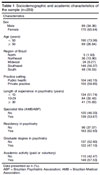
A total of 259 psychiatrists responded to the questionnaire. The sample's sociodemographic and academic characteristics are summarized in Table 1. The sample, which was 65.64% women, had a mean age of 42.86 years (range: 25-75). Most participants were from southeastern Brazil (56.37%), worked predominantly in private practice (59.85%), had less than 10 years' experience in psychiatric practice (51.74%), completed a residency in psychiatry (62.93%), and were involved in academic activity (57.53%).
| Characteristics | |
|---|---|
| Sex | |
| Male | 89 (34.36) |
| Female | 170 (65.64) |
| Age (years) | |
| < 50 | 190 (73.36) |
| = 50 | 69 (26.64) |
| Region of Brazil | |
| North | 5 (1.93) |
| Northeast | 36 (13.90) |
| Midwest | 24 (9.27) |
| Southeast | 146 (56.37) |
| South | 48 (18.53) |
| Practice setting | |
| Public health | 104 (40.15) |
| Private practice | 155 (59.85) |
| Length of experience in psychiatry (years) | |
| < 10 | 134 (51.74) |
| 10-29 | 84 (32.43) |
| = 30 | 41 (15.83) |
| Specialist title (AMB/ABP) | |
| No | 120 (46.33) |
| Yes | 139 (53.67) |
| Residency in psychiatry | |
| No | 96 (37.07) |
| Yes | 163 (62.93) |
| Graduate degree in psychiatry | |
| No | 137 (52.90) |
| Yes | 122 (47.10) |
| Academic activity (paid or voluntary) | |
| No | 110 (42.47) |
| Yes | 149 (57.53) |
Data presented as n (%).
ABP = Brazilian Psychiatric Association; AMB = Brazilian Medical Association.
Eating disorder knowledge level among Brazilian psychiatrists
Based on the number and percentage of correct answers, the respondents' knowledge level of diagnostic criteria and treatment recommendations for ED are presented in Table 2. Each questionnaire item had six response options, and participants were instructed to mark all that were correct. Responses were considered correct only if all correct options were marked and all incorrect ones were unmarked.
| Correct responses | |
|---|---|
| Questions about diagnostic criteria | 33 (12.74) |
| Anorexia nervosa | 86 (33.21) |
| Bulimia nervosa | 77 (29.73) |
| Binge eating disorder | 99 (38.22) |
| Questions about treatment recommendations | 0 (0.00) |
| Anorexia nervosa | 7 (2.70) |
| Bulimia nervosa | 52 (20.08) |
| Binge eating disorder | 52 (20.08) |
Data presented as n (%).
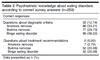
Although almost one-third of the sample correctly answered each question about ED diagnostic criteria (33.21% for AN; 29.73% for BN; 38.22% for BED), only 12.74% correctly answered all three. Regarding ED treatment, 2.7% answered correctly for AN, 20.08% answered correctly for BN, and 20.08% answered correctly for BED, with none correctly answering all three items.
Knowledge about diagnostic criteria for eating disorders
The instrument included three questions about ED diagnostic criteria according to the DSM-5: one each on AN, BN, and BED. "Intense fear of getting fat" was the top-rated item for AN (89.2%), followed by "Excessive preoccupation with weight and body shape" (69.5%), and "Significantly low body weight" (68.3%). "Amenorrhea" was mistakenly marked by 28.2% of the sample as a diagnostic criterion for AN.
For BN, "Inappropriate compensatory behaviors for weight control" was correctly identified by 94.6% of participants, while "Binge eating episodes once a week for 3 months" was only marked by 52.5%. A total of 61% correctly identified "Excessive preoccupation with weight and body shape" for BN diagnosis, while 29.34% incorrectly identified "Binge eating episodes twice a week for 3 months."
Regarding BED, the items with the highest number of correct answers were "Intense suffering with binge eating episodes" (89.6%) and "Binge eating episodes once a week for 3 months" (56.4%). Nevertheless, "Binge eating episodes twice a week for 3 months" and "Inappropriate compensatory behaviors for weight control" were erroneously marked as correct by 35.4 and 16.6% respectively.
Knowledge about treatment recommendations for eating disorders
There were three questions on ED treatment recommendations according to international guidelines. Regarding AN, 91.5% correctly identified "Cognitive behavioral therapy," 47.1% correctly identified "Family therapy," and 32.4% correctly identified "Atypical antipsychotics," while 60.6% incorrectly identified "Selective serotonin reuptake inhibitors."
Regarding BN, 93.8% correctly identified "Cognitive behavioral therapy" and 83.8% correctly identified "Fluoxetine," but only 47.5% correctly identified "Topiramate" as an accepted therapy. Regarding BED, 92.3% correctly identified "Cognitive behavioral therapy," 56.8% "Lisdexamfetamine," 65.3% "Fluoxetine," and 69.1% "Topiramate."
Training about eating disorders
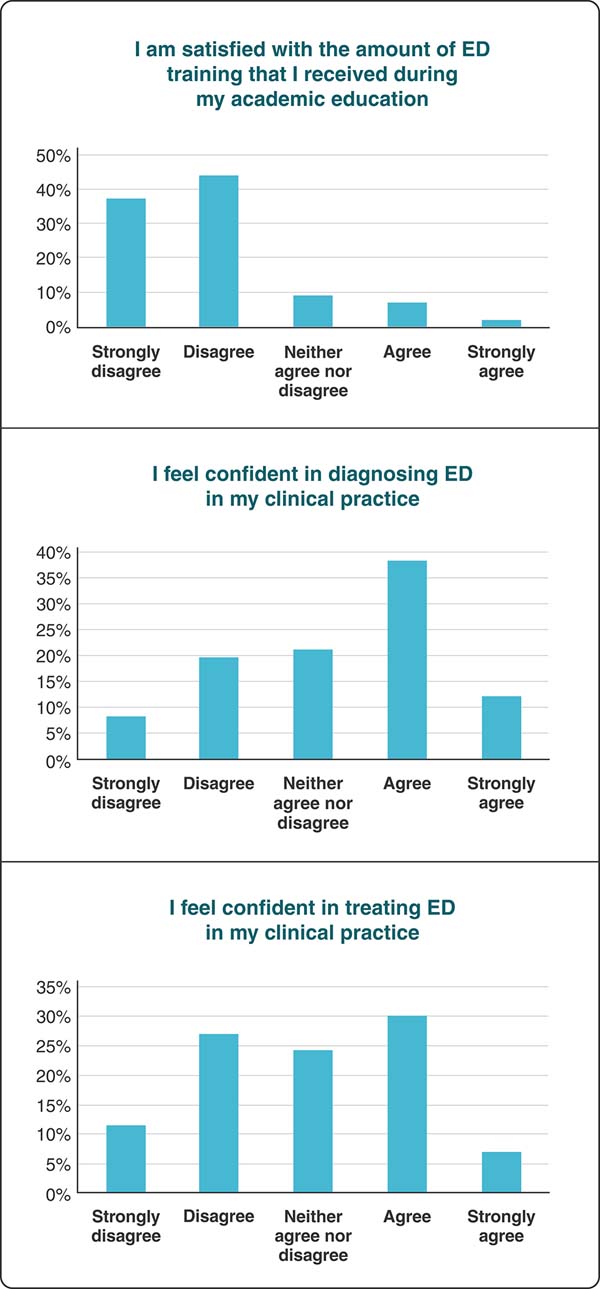
Only 15.1% of the participants received specialized training in ED during medical school, and 59.8% underwent a residency training program or graduate studies in psychiatry. A total of 58.7% mentioned complementary ED training (courses, conferences, specific events). A total of 8.89% of the respondents felt satisfied with their ED training, 50.97% felt confident in diagnosing ED, and 37.07% felt confident in treating ED patients (Figure 1).
DISCUSSION
This is the first study to assess ED knowledge, including diagnosis and treatment, among Brazilian psychiatrists. Regarding ED knowledge, 33.21% of the respondents correctly identified the diagnostic criteria for AN, 29.73% for BN, and 38.22% for BED. Regarding ED treatment, the therapeutic options for BN and BED were correctly identified by 20.8% of the respondents, but the proportion was considerably lower for AN - only 2.7%.
Specialized ED training was reported by 15.1% during medical school, 59.8% during residency or graduate study, and 58.7% in complementary training. Only 8.89% felt satisfied with their ED training; 50.97% felt confident in diagnosing ED, and 37.07% felt confident in treating patients with ED.
In line with previous studies on ED knowledge among health professionals in other countries,4,13,16 we found an important gap in ED training among Brazilian psychiatrists. Considering that general psychiatrists are usually the first available resource for the majority of patients with ED in our large developing country, their lack of accurate information and limited clinical expertise can intensify ED stigma and stereotypes, compromising treatment adherence among these patients and creating an additional barrier to effective treatment.17,18
More than 28% of the psychiatrists identified amenorrhea, a former diagnostic criterion for AN in the DSM-IV, as a current criterion in the DSM-5, and 29.34% incorrectly responded to an item about the frequency of compensatory episodes in BN, which was also used in the DSM-IV. This might be due to the respondents' lack of scientific updating. Identifying selective serotonin reuptake inhibitors as a treatment for AN was another frequent mistake (60.6% of the sample), probably due to its good results in patients with comorbidities. However, strictly speaking, the main international ED treatment guidelines do not consider them an option for patients with AN only. These results were lower than expected, despite the fact that psychiatrists are considered to have the highest level of ED knowledge among health professionals.19
Even in the United Kingdom, which is considered quite advanced in ED, medical education is considered insufficient to provide the necessary skills and knowledge to safely treat ED patients - less than 2 hours in medical schools and a little more time in graduate training.14,20 Our data indicate a similar situation in Brazil. We believe that including more theoretical and practical training about ED during medical school, graduate study, and psychiatric residency programs would improve young psychiatrists' knowledge of ED, and a consistent schedule of continuing medical education might improve the performance of older professionals.
The main challenges are raising awareness of ED, its negative impact on the community, and attracting the interest of stakeholders and financial support to develop and widely disseminate strategies to increase ED knowledge among psychiatrists. Some recently proposed solutions to address ED treatment gaps can also be considered, such as: train-the-trainer, in which training is provided to one professional who then trains others in the region; web-centered training and supervision, which is more scalable and less expensive; and higher-level support and policy to provide a more significant chance of success than waiting for clinicians to voluntarily seek training and modify their behavior.21
Two online ED training programs for health professionals, both developed in Australia, have shown promising results,10,22 improving health professionals' knowledge, skills, and confidence for treating people with ED and reducing their prejudice towards ED. These programs represent a novel and probably effective way of meeting the educational needs of general psychiatrists who work with ED patients. Investment in the adaptation and testing of online training programs for ED may help address some of the issues raised in this study.
Our results demonstrate that Brazilian psychiatrists' knowledge of ED is inadequate, although most participants acknowledged this in their responses about confidence and competence. Therefore, academic training about ED must improve among Brazilian psychiatrists, which could lead to improved ED care in Brazil.
Although ours is the first study to investigate ED knowledge among Brazilian psychiatrists, it has some limitations, such as no sample size calculation, using a convenience sample, using an instrument that was not previously validated, and collecting self-reported data. These factors could limit the national representativeness of our findings and should be addressed in future studies.
We attribute the low response rate (4.32%) to the fact that this was an online survey. Evidence suggests that response rates to online surveys are very low, unlikely to reach the expected rates of in-person or mailed surveys.23 However, since we conducted this study during the COVID-19 pandemic, a period of great worldwide operational difficulty, the online methodology was necessary for data collection. The response rate may also reflect a low level of interest in ED treatment by general psychiatrists.
As a consequence of the results of this study, we suggest that Brazilian psychiatrists receive greater training in ED content. Furthermore, additional training should be regularly offered, especially to older psychiatrists, who may have had no previous training or whose training has become outdated. Finally, our findings indicate that our country needs greater investment in and resources for ED.
 PDF
 Print
 Send this article by email
 How to cite this article
 Submit a comment
 Mendeley
 Pocket
 Share on Facebook
 Share on Twitter



