


ABSTRACT:
OBJECTIVE: The practice of using drugs to modulate experiences is a well-documented phenomenon
worldwide, particularly among men who have sex with men (MSM). This study aims to
describe patterns of drug combinations used by Brazilian MSM, embracing a detailed
examination of the Brazilian context, which may inspire research elsewhere while enriching
the global panorama on MSM drug use. By focusing on Brazilian MSM, the study sheds
light on specific drug use combinations, which may help in the development of effective,
culturally sensitive public health strategies.
METHODS: This investigation was conducted within the Latin American MSM Internet Survey, a
pioneer online study addressing psychosocial and sexual health of MSM in the region.
Conducted from January to May 2018, the survey garnered responses from over 18,139
Brazilian MSM. Using exploratory factor analysis through maximum likelihood estimation,
the study identified distinct sub-groups of drug users among 15,499 participants after
exclusion due to discrepant responses (Kaiser-Meyer-Olkin measure = 0.94 and Bartlett's
test = 0.01), indicating adequate sampling and suitability for factor analysis across
all substances.
RESULTS: The factor analysis revealed four primary drug combination groups among participants:
Group One (Heavy Drug Users), Group Two (Party Drug Users), Group Three (Conservative
Users), and Group Four (Classic Chemsex Users). Each group represents unique drug
use patterns and preferences, from the use of potent stimulants to more socially accepted
substances like tobacco and cannabis. Notably, Group One, identified as "heavy" drugs
users, used particularly risky substances, including mephedrone, crack, crystal meth,
heroin, and other synthetic stimulants.
CONCLUSION: The findings reveal diverse and complex drug use patterns among MSM in Brazil. Understanding
these patterns is essential for developing targeted interventions and support mechanisms
for various sub-groups among MSM. Future research should focus on the health outcomes
associated with these patterns and the social and psychological contexts of drug use.
Keywords: Drug combinations; men who have sex with men; sexualized substance use; chemsex, anthropology of drug use; Brazil; psychosocial health; exploratory factor analysis.
FIGURES
| Note: How to cite this article: Nikobin R, Mella-Cobas J, Veras MA, Bastos FI, Barbarà JC, Ávila VS, et al. Patterns of drug combinations used by men who have sex with men in Brazil. Braz J Psychiatry. 2025;47:e20243874. http://doi.org/10.47626/1516-4446-2024-3874 |
| Received: August 20 2024; Accepted: December 10 2024 |
INTRODUCTION
The relationship between patterns of drug use and men who have sex with men (MSM) is multifaceted and relevant in the realm of epidemiological studies. The literature consistently indicates that MSM engage in higher rates of substance use than their heterosexual counterparts.1-3 Substance use among MSM is linked to a range of drugs, including cannabis, poppers, cocaine, and erectile dysfunction medication.1,2 A Systematic review of the literature suggested that the overall prevalence for chemsex related behavior among MSM ranges from 3% to 29%.4
The prevalence and patterns of drug use among MSM in Brazil - despite significant improvement in terms of stigmatization in comparison to the 1980s - still indicate a pressing concern, as evidenced by multiple studies. Torres et al.5 elaborate on the prevalence of sexualized drug use (chemsex), which is associated with higher risks for substance use disorders. Magno et al.6 report a high prevalence of self-reported discrimination among MSM in Brazil, which could potentially contribute to substance use as a coping mechanism. De Sousa et al.7 identify illicit drug use as more common among MSM with lower socioeconomic status.
Interestingly, while substance use is prevalent among MSM, the patterns and implications of use are complex. For instance, the use of amyl nitrite, commonly known as poppers, has been associated with specific expectations around sexual desire and pleasure, which may influence sexual risk-taking.8
Brazil's MSM population faces unique sociocultural and structural factors that influence drug use patterns, particularly in the context of chemsex. Socioeconomic disparities and pervasive discrimination against MSM, coupled with evolving norms around sexuality and drug use, have shaped these behaviors in distinctive ways. For instance, the practice of chemsex often intersects not only pleasure-seeking and coping mechanisms, but stigma and social isolation.9 Unlike in Europe or North America, where certain drugs are more prevalent, the substance choices of Brazilian MSM are influenced by local availability and socioeconomic conditions, as well as the influence of a highly socialized (i.e., closely connected through social activities) and mobile culture (i.e., dating apps for MSM). The role of substance use in the context of sexual behavior is also influenced by psychological factors such as sensation seeking, self-worth, and masculinity.3 The complexity of these relationships underscores the need for targeted interventions that addresses substance use among MSM to effectively produce better health outcomes in this group.1,3,10
The objective of this study was to better understand patterns of drug usage among Brazilian MSM, with the intent of finding a way to assess health risks and the development of appropriate public health interventions. This study aimed to extend the foundational work of the European MSM Internet Survey (EMIS) by adapting its methodology to the Latin American context through the Latin American MSM Internet Survey (LAMIS), a cross-sectional, Internet-based survey targeting MSM living in 18 Latin American countries (Argentina, Bolivia, Brazil, Chile, Colombia, Costa Rica, Ecuador, El Salvador, Guatemala, Honduras, Mexico, Nicaragua, Panama, Paraguay, Peru, Suriname, Uruguay, and Venezuela) that gathered data about sexual behaviors, human immunodeficiency virus (HIV)/sexually transmitted infections and viral hepatitis knowledge, prophylactic use of antiretrovirals, psychosocial health, and access to sexual health services. The survey went online for 4 months and was available in three languages (Spanish, Portuguese, and Dutch). Promotion was carried out using dating apps, websites, social networks, and by community-based and academic organizations of each participating country directly in gay venues and in their own premises. Overall, 64,655 MSM participated in LAMIS-2018. Dating apps and websites were the most important recruitment source in most countries, except for Honduras, Nicaragua, and Suriname, where community-based organizations recruited most of the participants.11
The effectiveness of public health policies is closely linked to a deep understanding of the target population's sociodemographic factors and cultural dynamics,12 particularly in treatment for substance use disorders, where culturally adapted interventions play a crucial role if properly designed to target different cultural and ethnic groups.13,14
As the first large-scale Brazilian dataset examining patterns of drug use among MSM, this study aimed to identify the combinations of psychoactive substances most commonly used within this specific population. This investigation aligns with ongoing inquiries into which drugs fall under the broadly defined category of "chemsex drugs." Future research may focus on assessing specific risk behaviors associated with each cluster of drugs used by MSM.
METHODS
Study design
This study was embedded in LAMIS-2018, which aimed to assess the psychosocial and sexual health of MSM across the region. The study utilized a cross-sectional design, collecting data through an online questionnaire disseminated via major social networking sites, gay meet-up websites, and mobile apps. The survey targeted gay men and other MSM, focusing on their sexual behaviors, drug use patterns, and exposure to HIV and other sexually transmitted diseases. A notable methodological consideration of this study is the potential limitation associated with reverse causality. This challenge, particularly pertinent to cross-sectional designs, pertains to the difficulty of establishing the directionality of observed associations- whether the drug use patterns lead to specific health outcomes or vice versa. Acknowledging this limitation emphasizes the complexity of interpreting data on psychosocial and sexual health behaviors, underscoring the need for cautious extrapolation of causative relationships based on the observed patterns.
Data collection
The online survey was available from January to May 2018 and was elicited through various digital platforms to reach a diverse MSM population in Brazil. Participation was voluntary and anonymous, with eligibility restricted to MSM aged 18 years or older and residing in Brazil. The survey included questions on demographics, sexual behavior, drug use in sexual settings, knowledge of HIV/sexually transmitted infections prevention methods, and the use of post-exposure prophylaxis.
Data analysis
The data were analyzed using exploratory factor analysis and maximum likelihood estimation to identify underlying patterns of drug use among the participants. A trichotomization (i.e., ever consumed; never consumed; N/A) of the original variables was utilized as a form of simplifying the structure for the original question addressing substance use in the LAMIS design: "How long has it been since you last consumed the following substances in any context? Please say when you last did something, even if this was not typical for you."
The exploratory factor analysis sought to uncover distinct sub-groups of drug combinations reported by respondents, while maximum likelihood estimation provided a probabilistic framework for estimating the parameters of the observed data distributions. Factors were extracted based on eigenvalues > 1 and an Oblimin rotation with Kaiser normalization was employed to unveil the assumed correlation structure within our sample.
Oblimin rotation, in conjunction with Kaiser normalization, is regarded as effective for exposing underlying correlation structures in factor analysis.15 When combined with Kaiser normalization, Oblimin rotation adjusts factor loadings by considering variable communalities, which can lead to more accurate estimates of the standard errors for loadings and inter-factor correlations.16,17 This approach tends to decrease the standard errors for variables with low communalities and increase those for the correlations among oblique factors, enhancing the interpretability of the factor structure.16
Selecting an oblique rotation method, such as Oblimin, allowed for anticipated intercorrelations among factors related to MSM drug use patterns, reflecting the conceptual and behavioral overlap in these constructs. Unlike orthogonal rotations like Varimax, which assume uncorrelated factors, Oblimin rotation accommodates these interrelations, providing a nuanced understanding of the complex and interconnected substance use behaviors within the MSM population.
The decision to simplify substance use data through trichotomization of the substance use data into categories of "ever consumed," "never consumed," and "N/A" was guided by the design and goals of the LAMIS-2018 survey, as detailed by the survey's methodology. The LAMIS-2018 questionnaire, adapted from the EMIS-2017 and piloted across 18 Latin American countries, aimed to capture a broad yet comprehensive picture of substance use among MSM. Collapsing various temporal categories into three primary groups reduces data complexity, aligning with our study's exploratory goals to reveal patterns of drug use, without the variability introduced by detailed recency categories.18 As a result, the decision to prioritize the presence or absence of use facilitates clearer factor structures. By addressing sparsity, issues that might compromise factor stability, this simplification provides a robust foundation for identifying prevalent drug combinations among MSM, reflecting overarching behavioral trends rather than specific temporal usage nuances. As supported by the Kaiser-Meyer-Olkin test and Bartlett's test of sphericity, data with reduced sparsity and clearer response patterns are more likely to meet the assumptions for exploratory factor analysis.19
RESULTS
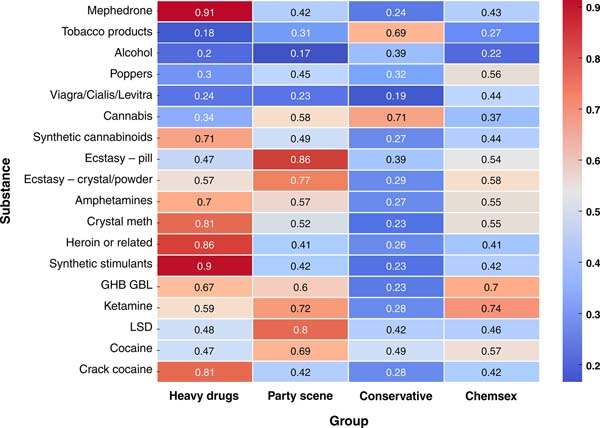
Factor analysis conducted on the survey data from 15,499 Brazilian MSM yielded four discrete sub-groups characterized by distinct drug combinations (Figure 1). To ensure the reliability and consistency of the responses, we applied a filtering process to the original dataset, from the original sample (n=18,139), 2,640 cases were excluded before the analysis due to the presence of discrepant responses. The participants' ages spanned from 18 to 77 years, with a mean age of 29.91 years. The Kaiser-Meyer-Olkin coefficient was 0.940, which is considered marvelous. The results from Bartlett's t-test (< 0.001) indicated that the sample was suited for factor analysis.
Group One: Heavy Drug Users
This group was characterized by the frequent combined use of mephedrone, crack cocaine, other synthetic stimulants (e.g., cathinones - commonly known as "bath salts"), synthetic cannabinoids, heroin, and crystal meth. These participants had the highest loadings for what could be considered "heavy" substances, a notable group of particularly harmful psychoactive substances. The lesser degree of association with other amphetamines, ketamine, and gamma-hydroxybutyrate (GHB) was also observed in this group.
Group Two: Party Scene Users
Participants in this group used ecstasy - 3,4-methylenedioxymethamphetamine, lysergic acid diethylamide, and ketamine, with lesser degree of association present for cocaine, GHB, cannabis, and amphetamines. This pattern suggests a preference for substances often related to self-exploration and enjoyment, as well as transcendental experiences. This group's drug use is driven by the pursuit of heightened sensory perceptions, compatible with party drug use scenarios.
Group Three: Conservative Users
This group consisted of users of socially accepted substances: tobacco, cannabis, and alcohol. However, a subset of this group also occasionally used snorted cocaine, indicating a bridge between "acceptable" substance use and more risky drug experiences.
Group Four: Classic Chemsex Users
The fourth group included users primarily engaging in what could be somehow considered "classic" chemsex drug combinations, with high factor loadings for GHB and ketamine, alongside other classic substances for this category, such as poppers, MDMA, amphetamines, methamphetamine, and cocaine. The use of poppers and Viagra was more prevalent among this subgroup, suggesting a particular concern with sexual performance. It is also relevant that some of the investigated drugs were present in more than one of the groups (factor loadings > 0.5), such as ketamine, which was included in both the Party Scene and Chemsex User groups, as well as GHB, which was included in every group except Conservative Users.
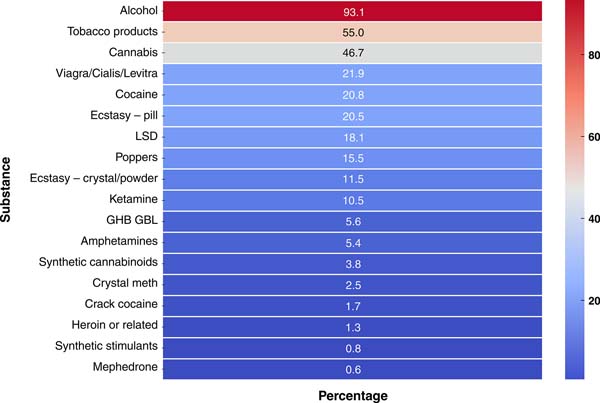
Based on the responses of 15,499 participants, Figure 2 shows a detailed breakdown of the number and percentage of users for each substance, as well as the number of participants who reported never having used the substance and those who did not answer (N/A). Regarding substance consumption patterns, while substances like alcohol (93.1%), tobacco products (55%), and cannabis (47.7%) are widely used among Brazilian MSM, the prevalence of other substances, such as synthetic cannabinoids (3.8%), heroin or related substances (1.3%), and synthetic stimulants other than mephedrone (0.8%), was lower.
DISCUSSION
By examining distinct drug-use clusters among MSM, our study provided a comprehensive and nuanced understanding of substance use dynamics within a community frequently facing adverse health and social consequences.
A study conducted by Halkitis et al.20 in New York City identified a strong correlation among five "club" drugs, with longitudinal data revealing significant associations between specific substances, notably methamphetamine, ecstasy, and GHB. This association suggests a sustained link between these drugs in club or party contexts. Similarly, in our study, the "Party Drug" group included ecstasy (in both pill and powder forms), GHB, and methamphetamines, highlighting comparable substance combinations that characterize the party scene among MSM. These findings underscore the potential significance of these particular drug combinations within the MSM party context, warranting further exploratory analyses to better understand these relationships and their implications for targeted interventions.
Wong et al.,21 identified four distinct substance use categories among MSM in Hong Kong through latent class analysis, which underscores the complex structure of MSM networks, which vary in risk behavior and social linkage characteristics. Unlike Wong's findings, where categories may be less distinct due to the focus within the "chemsex realm," our results reveal four clearly delineated sub-groups - Heavy Drug Users, Party Scene Users, Conservative Users, and Classic Chemsex Users. This distinction suggests that, by examining substance use beyond solely chemsex contexts, our study captures a broader spectrum of drug use behaviors within the Brazilian MSM population, highlighting unique sociocultural patterns that may contribute to these discrete subgroups.
A latent class analysis among MSM by Scholz-Hehn et al.22 identified similar subgroups, including chemsex and party scene users, as observed in our study. Additionally, Scholz-Hehn et al.22 reported a group characterized by minimal substance use, limited mostly to poppers and cannabis. In parallel, our study's "conservative" group reflects this low-consumption profile, with cannabis emerging as the primary substance. This pattern suggests that cannabis may play a moderating role, potentially curbing the use of other substances within this subgroup.
The examination of drug use patterns among MSM consistently reveals high substance use prevalence, as documented across various studies. Thiede et al.,23 for example, reported that 66% of young MSM in the United States engage in illicit drug use, with distinct sociodemographic factors highlighting drug use as a significant health concern in this population. Similarly, Mccarty-Caplan et al.24 identified subcategories of MSM, including groups characterized by "sex-drug" use and polydrug use. In alignment with these findings, our "heavy drugs" cluster comprises substances with a high potential for misuse, indicating a subgroup at elevated risk for substance use disorder. This further underscores the importance of targeted interventions for high-risk MSM groups to address substance-related health risks effectively.
A Chilean study by Lisboa et al.,25 which used LAMIS data to identify cannabis, poppers, and Viagra as the most frequently used substances in sexual contexts, supports the argument that chemsex research should extend beyond the traditional focus on "usual chemsex drugs." In line with our findings, which reveal diverse substance combinations among MSM, this reinforces the need for a broader approach to chemsex research that encompasses a wider range of drugs. This expanded scope will better capture the full spectrum of sexualized drug use behaviors across different cultural contexts, as observed in our study among Brazilian MSM.
The findings of Wei et al.,26 which highlight the prevalence of ecstasy and Viagra use among MSM in Asia, suggest that sexual performance enhancement may play a significant role in substance use patterns within these populations. In our study, Viagra similarly appeared in the Classic Chemsex Users group, though it was positioned near the cutoff point, indicating its peripheral yet relevant role in this subgroup. This nuanced placement suggests that, while sexual performance may be an influencing factor, the broader array of substances used by Brazilian MSM reflects a more complex interplay of motivations, likely shaped by distinct cultural and social contexts beyond performance enhancement alone.
A study by Mullens et al.8 on amyl nitrite expectancy among gay and bisexual men highlights the significance of substance expectancies in understanding usage patterns within MSM communities. In our study, poppers, or amyl nitrite, prominently appeared within the Classic Chemsex group, while nearly reaching the cutoff for inclusion in the Party Scene Drug Users group. This distribution underscores the role of expectancy in shaping drug use behaviors across different social contexts, suggesting that while poppers are strongly associated with the chemsex context, their prevalence within the Party Scene group may reflect additional social or recreational motivations among MSM in Brazil.
These studies collectively indicate that there is a body of research examining drug use patterns among MSM. However, it is important to note that there may still be specific aspects of drug use within MSM populations that are less studied or understood, such as the nuances of drug use in different cultural contexts or among non-gay-identifying MSM.27
The interpretation of substance abuse within the Brazilian context highlights critical disparities when applying contemporary methodologies predominantly rooted in European cultural frameworks. The transfer of a predominantly international paradigm fails to recognize the intricate sociocultural dynamics and historical substance use patterns unique to Brazil and other non-European contexts, which are essential in shaping local substance use behaviors and responses.28 This might result in public health initiatives that fail to resonate with the lived experiences and specific needs of Brazilian MSM, thereby limiting their effectiveness. In this context, our study emphasizes the necessity of distinguishing the Brazilian MSM population by specific drug use patterns. This approach allows us to move beyond assuming that Brazilian chemsex practices mirror those in Europe or North America. Future research should investigate whether these groups differ in terms of sexual risk behaviors commonly associated with chemsex.
The identification of distinct groups in this study, such as Heavy Drug Users, Party Scene Users, Conservative Users, and Classic Chemsex Users may point to varied motivations, risks, and needs within the substance use scene for MSM. It is clear that one-size-fits-all approaches are insufficient29; instead, strategies must be as diverse and tailored as the drug use patterns they seek to mitigate.
Recommendations for future research
This study, while contributing valuable insights into the patterns of drug combinations used by Brazilian MSM, is subject to several limitations that should be taken into consideration when interpreting our findings. First, the cross-sectional design restricts the ability to establish causal relationships between drug consumption behaviors and health outcomes, including temporal ambiguity and confounding variables. Additionally, the reliance on self-reported data in an online survey may lead to response biases, such as social desirability or recall bias, potentially skewing the prevalence rates of drug use and sexual behaviors.30 This is because LAMIS-2018, a convenience survey in which respondents self-select to participate, it may not be considered representative of chemsex users in Brazil. However, online surveys not only encourage the sharing of sensitive information, including higher levels of drug use, than face-to-face surveys at the respondent's physical residence, but exclude potential participants without Internet access.31 Further, the LAMIS-2018 questionnaire included 62 questions and 20 additional questions that were shown when a condition question was answered.11 While this provided a rich dataset, the regional focus may not fully capture the nuanced sociocultural dynamics specific to the Brazilian context. Moreover, the dissemination of the survey through social networking sites, gay meet-up websites, and mobile apps may not reach MSM who are less active online or who do not identify with these platforms, leading to possible selection bias. Given these limitations, future research should consider employing longitudinal study designs to understand the temporal dynamics and the causality of substance use behaviors among Brazilian MSM.
This study has illuminated the complex and varied patterns of drug combinations used by Brazilian MSM, revealing four distinct sub-groups: Heavy Drug Users, Party Scene Users, Conservative Users, and Classic Chemsex Users. Each group's unique preferences underscore the multifaceted nature of drug consumption behaviors in Brazil. These findings underscore the critical need for culturally nuanced public health strategies that address the specific needs and risks of each subgroup within the MSM community in Brazil. By acknowledging the diverse sociocultural dynamics at play, policymakers and health care providers can develop more targeted, effective interventions. Future research should continue to explore the health outcomes and social contexts associated with these drug usage patterns, facilitating a more comprehensive understanding and response to this global health phenomenon within local frameworks.
ACKNOWLEDGEMENTS
Latin American MSM Internet Survey (LAMIS) was undertaken by researchers from the Red Iberoamericana de Estudios en Hombres Gay, otros Hombres que tienen Sexo con Hombres y Personas Trans (RIGHT Plus): Centro de Estudios Epidemiológicos sobre las Infecciones de Transmisión Sexual y Sida de Cataluña (CEEISCAT), Spain; Faculdade de Ciências Médicas da Santa Casa de São Paulo, Brazil; Universidad Peruana Cayetano Heredia, Peru; Escuela de Salud Pública Facultad de Medicina Universidad de Chile, Chile; and Instituto de Saúde Pública, Universidade do Porto, Portugal. LAMIS used resources from the European MSM Internet Survey (EMIS)-2017, which was funded by the European Commission Union Health Program 2014-2020, and, in particular, from Sigma Research, London School of Hygiene and Tropical Medicine (United Kingdom), Department for Infectious Disease Epidemiology Robert Koch Institute, Germany, and Faculty of Psychology and Neuroscience, Maastricht University (the Netherlands). LAMIS was also possible thanks to the support of the collaborating partners in each of the 18 participating countries: Associação Brasileira de Lésbicas, Gays, Bissexuais, Travestis, Transexuais e Intersexos (ABGLT)-Brazil, Fundacion Savia y Fundacion Asociación Chilena de Protección de la Familia (APROFA), Chile; Corporación Universitaria Minuto de Dios (UNIMINUTO), seccional Bello, Colombia; Parea Surinam, Surinam; RedGayLatino, Mexico; Federación Argentina LGBT, Argentina; Asociacion Entre Amigos, El Salvador; Venezuela Igualitaria, Venezuela; SOMOSGAY, Paraguay; Colectivo Ovejas Negras, Uruguay; Centro de investigación y Promoción para America Central (CIPAC), Costa Rica; Fundacion Sida I Societat, Guatemala; MANODIVERSA, Bolivia; Grupo Genesis Panama, Panama; Fundaci n Ecuatoriana Equidad, Ecuador; Centro para la Educación y Prevención del SIDA, Nicaragua; and Asociación Kukulcan, Honduras.
LAMIS contributions: CEEISCAT, Spain (Jordi Casabona Barbara, Percy Fernández Dávila): LAMIS network and local recruitment coordination, economic and legal aspects of hosting the database. Centro de Investigación Interdisciplinaria en Sexualidad, Sida y Sociedad (CIISSS) (Carlos F. Cáceres, E. Michael Reyes): LAMIS Regional Report for Latin America. Núcleo de Pesquisa em Direitos Humanos e Saúde da População LGBT+ (NUDHES), Brazil (Maria Amelia de Sousa Mascena Veras, Daniel Barros): study website and its graphic design. London School of Hygiene and Tropical Medicine, UK (Sigma Research: Axel Jeremias Schmidt, Ford Hickson, David Reid, Peter Weatherburn): questionnaire design, support with survey software and monitoring of recruitment, graphic arts of banners for promotion, data cleaning and labelling, error handling, variable manual, templates for national and community reports, collaboration with Joint United Nations Programme on HIV/AIDS (UNAIDS). Robert Koch Institute, Germany (Ulrich Marcus, Susanne B. Schink): negotiations with web pages/apps for free promotion of LAMIS, coordination of central recruitment.
LAMIS funding: questionnaire design, core survey execution, and the variable manual were provided by EMIS-2017 (funded by the EU Health Programme 2014-2020 for Europe) and adapted for use in LAMIS. Additional financial support was provided by CEEISCAT, CIISSS, Instituto de Saúde Pública da Universidade do Porto, Maastricht University, NUDHES, and Robert Koch Institute.
LAMIS acknowledgements: We thank all men who took part in LAMIS, as well as our app partners Grindr and Planet Romeo, who helped to recruit participants through free-of- charge instant messages, and our local partners who recruited participants via Facebook and other social media and placed promotional banners on their websites.
This study did received no specific grants from funding agencies in the public, commercial, or not-for-profit sectors.
Disclosure
The authors report no conflicts of interest.
Author contributions
RN: Conceptualization, Investigation, Methodology, Project administration, Visualization, Writing - original draft, Writing - review & editing.
JM-C: Writing - review & editing, Investigation, Data curation, Formal analysis, Methodology.
MAV: Writing - review & editing, Validation.
FIB: Conceptualization, Methodology, Writing - review & editing, Validation.
JCB: Writing - review & editing, Validation.
VSA: Writing - review & editing, Validation.
DXS: Conceptualization, Data curation, Formal analysis, Methodology Writing - review & editing, Supervision, Validation.
All authors have read and approved of the final version to be published.
Handling Editor: João Castaldelli-Maia
 PDF
 Print
 Send this article by email
 How to cite this article
 Submit a comment
 Mendeley
 Pocket
 Share on Facebook
 Share on Twitter