


ABSTRACT:
OBJECTIVE: There has been a call for neuroscientific studies of spiritual experiences due to
their global prevalence, significant impact, and importance for understanding the
mind-brain problem. Mediumship is a spiritual experience where individuals claim to
communicate with or be influenced by deceased persons or non-material entities. We
assessed whether mediums carry specific genetic alterations.
METHODS: We selected highly gifted mediums (n=54) with over 10 years of experience who engaged
in mediumistic work for no material gain, performed whole-exome sequencing of these
individuals, and compared its findings to those of first-degree relatives who claimed
no mediumship (n=53).
RESULTS: We identified 15,669 variants exclusively found in mediums, likely to impact the function
of 7,269 genes. Thirty-three of these genes were altered in at least one-third of
all mediums but in none of their relatives. The inflammatory pathway was the most
frequently affected (43.9%), with the translocation of zeta-chain associated protein
kinase 70 kDa (ZAP-70) to the immunological synapse being particularly prominent.
CONCLUSION: This is the first exome-wide investigation of genes possibly related to mediumistic
experiences. We identified gene variants that were present in mediums but not in their
non-medium first-degree relatives. These genes emerge as possible candidates for further
investigations of the biological underpinnings that allow spiritual experiences such
as mediumship.
Keywords: Exome; gene; mediumship; anomalous experiences; spiritual experiences.
FIGURES
| Note: How to cite this article: Gattaz WF, Costa MA, Salatino-Oliveira A, Gonçalves DG, Talib LL, Moreira-Almeida A. Candidate genes related to spiritual mediumship: a whole-exome sequencing analysis of highly gifted mediums. Braz J Psychiatry. 2025;47:e20243958. http://doi.org/10.47626/1516-4446-2024-3958 |
| Received: October 4 2024; Accepted: December 24 2024 |
INTRODUCTION
Spiritual experiences are highly prevalent worldwide, have a strong impact on those experiencing them, and have received increased attention from the scientific community. A recent paper published in Nature made an emphatic call for neuroscientific studies of spiritual experiences as "crucial to understanding the human brain - and human life" (p. 27).1 A spiritual experience often reported by the general population and in sacred texts is the claim of being in communication with, or influenced by, deceased persons or non-material entities.
An increasing body of research highlights the prevalence of these occurrences within the general population. Recent nationwide surveys in the United States and Brazil found that more than half of the general population reported having felt "the presence of the dead" or "that a family member who is dead has visited them."2,3 A British study revealed that over 20% of individuals reported having seen deceased individuals, whereas more than 15% claimed to have heard voices that others could not.4 It is worth mentioning that these experiences cut across religious affiliations, extending even to individuals who identify as atheists or agnostics. So, what is the significance of these widespread experiences?
Individuals who claim the ability to perceive, communicate with, or be influenced by deceased individuals are often called mediums.5 Mediumship has a long-documented history and has been the subject of thorough investigation, with rigorous scientific studies dating back to the latter half of the 19th century.6 Remarkably, the examination of such phenomena has played a substantial role in shaping concepts such as dissociation and the subconscious mind, providing foundational support for the development of psychology and psychiatry.7-9
Mediumship very often manifests as unshared sensory experiences (hallucinations, e.g., seeing and hearing) that may be symptoms of a psychotic or dissociative disorder.10 Nevertheless, a robust body of research indicates that most individuals experiencing such phenomena do not exhibit signs of mental disorders.11 Remarkably, certain individuals with high levels of these experiences, such as spirit mediums, demonstrate levels of health on par with or even exceeding those not affected by such experiences.12 Therefore, studies do not support the hypothesis that most of these phenomena are manifestations of mental disorders.
Because most mediums are mentally healthy and their so-called hallucinations are not symptoms of mental disorders, some authors have proposed alternative denominations for these non-pathological unshared experiences.13 For more than a century, there have been scientific investigations on whether these mediumistic experiences are perceptual errors or if they can provide accurate and veridical information that cannot be obtained by regular means (e.g., senses and reasoning).14,15
Some studies have investigated the neurophysiology of mediumship, including through functional neuroimaging16,17 and electroencephalography (EEG).18 However, we are not aware of any studies on the genetics of mediumship. A broad genomic assessment, focused on DNA variants that result in high-impact alterations in the encoded genes, may support the hypothesis that specific individuals possess enabling biological foundations that allow a different perception of reality. Within this context, exome sequencing emerges as a highly useful tool for identifying genetic variants associated with complex traits (such as mediumship), providing insights into their genetic basis. In alignment with this proposition, the primary objective of the present study is to identify nucleotide variants associated with non-pathological spiritual experiences in mediums through whole-exome sequencing, while concurrently comparing any such variants to those found in their first-degree relatives who claim no experiences of mediumship, followed by validation in an independent cohort. Our hypothesis posits that specific gene variants in pathways responsible for information processing will exhibit a higher prevalence among mediums when compared to their non-medium first-degree relatives.
METHODS
Study design and participants
This case-control study was conducted from April 2020 to April 2021 and included individuals from all regions of Brazil who were identified by their spiritual communities as highly gifted mediums. For this study, mediums were defined as individuals who assert the ability to perceive (either by seeing or hearing) or to act under the direct and evident influence of a purported deceased personality.5
To identify highly skilled mediums, our initial approach involved collaborating with religious groups where mediumistic activities are regularly practiced, mainly Spiritism, Umbanda (an Afro-Brazilian religion), and Spiritualism. Subsequently, mediums were considered eligible for inclusion in the study if they met all the following criteria: i) a minimum of 10 years of experience in mediumship; ii) engaged in mediumistic practices at least once a week; iii) recognized by their peers as having a notably high level of mediumistic ability; iv) engaged in their mediumistic work voluntarily, without receiving any financial compensation or material benefits; and v) regarded by their peers as having a consistent track record of obtaining verifiable and accurate anomalous information, defined as information allegedly not acquired through normal means or the conventional five senses.19
To compose a non-medium control group with high genetic and sociocultural similarity, we selected mediums' first-degree relatives during the same time frame. Inclusion criteria for this group were as follows: i) adults; ii) first-degree relatives of the mediums; and iii) not exhibiting mediumship themselves. When enrolling relatives, we followed a preference order for recruitment, prioritizing: i) siblings of the same sex as the medium; ii) siblings of different sex; iii) parents; iv) children; and v) half-siblings, either paternal or maternal.
To implement a validation cohort sample, mediums without a paired relative were included in the study. Additionally, two of the participating mediums were monozygotic twins, strategically integrated into the research design to bolster the qualitative assessment and strengthen the reliability of our findings. Both mediums' twins were compared with a third, non-medium control sibling. Both the pair of monozygotic twins and the sample of mediums without paired relatives were utilized to validate our findings as well.
Procedures
Initially, we conducted training sessions for collaborators (usually health professionals) in the cities where the spiritualist establishments were located to ensure they were proficient in applying the criteria mentioned above to recruit mediums and their relatives. Once this initial selection process was completed, we contacted the chosen participants and their respective controls. Our purpose was to secure their informed consent, facilitate their completion of self-rated questionnaires via an online platform, and facilitate the collection of saliva samples.
Non-stimulated saliva was used as the source of DNA for this study. Each participant provided ~ 2.5 mL of saliva, which was combined with an equal volume of stabilization buffer (100 mM NaCl, 10 mM Tris, 10 mM ethylenediaminetetraacetic acid [EDTA], proteinase K [0.1 mg/mL], and sodium dodecyl sulfate [SDS] 0.5%) in 15 mL tubes. Samples were stored at room temperature (RT) for a maximum of 7 days or refrigerated at 4 °C for up to 3 months. Subsequently, the tubes containing samples and stabilization buffer were sent to Laboratório de Neurociências (LIM-27), Instituto de Psiquiatria, Hospital das Clínicas, Faculdade de Medicina, Universidade de São Paulo (HCFMUSP) for subsequent DNA extraction. Downstream analyses are described below.
Assessments
Sociodemographic data
Ethnicity (self-declared), educational background, and age were collected.
Mediumship Activity Questionnaire
Mediumistic abilities were assessed using an instrument developed by our research team.20 The instrument assesses a spectrum of phenomena, including psychophony (speaking under the influence of spirits), projection (out-of-body experiences), psychography (writing under the influence of spirits), clairvoyance (seeing spirits), clairaudience (hearing spirits), incorporation (full trance or "embodiment"), physical effects, healing, and mediumistic painting.
World Health Organization Quality of Life Brief Version (WHOQOL-Bref)
The WHOQOL-Bref is a 26-item self-rated scale developed to measure the quality of life and its four domains: physical, psychological, social relations, and the environment.21 The total score ranges from 0 to 100. We used a version validated for the Brazilian population.21
DNA extraction
The DNA extraction protocol was based on Goode.22 Briefly, 250 µL of saliva specimens was added to 500 µL of Cell Lysis Solution (cat. no. 158908) (Qiagen, Hilden, Germany). The mixture was incubated at RT for 30 min. RNA was removed by adding 4 µL of RNase A (100 mg/mL), incubated at 37 °C for 15 min, followed by proteinase K digestion and protein precipitation (cat. no. 158912) (Qiagen, Hilden, Germany). After centrifugation, supernatants were transferred into new tubes for DNA precipitation using isopropanol and glycogen. The recovered DNA was washed in 70% ethanol, dried, and resuspended in 60 µL of tris-EDTA. Gel and spectrophotometry analysis indicated sufficient integrity, purity, and concentration for exome sequencing.
Whole-exome sequencing (WES) analysis
The whole exome was captured (SureSelect V6, Illumina, San Diego, USA) and sequenced using the Illumina NovaSeq platform (Macrogen, Seoul, Korea). Germline variants were determined according to the best practices of the Genome Analysis Toolkit (GATK).23,24 A series of steps were taken to streamline alignment, preprocessing, and variant calling (Supplementary Figure S1). Briefly, sequencing reads (FastQ files) were mapped to the reference human genome sequence (GRCh37/hg19) using BWA-MEM (v0.7.17-r1188) with default parameters,25 except for the number of threads, which was set to 8. The aligned files (BAMs generated by the mapping) were pre-processed by GATK version 4.2, using the MarkDuplicates, BaseRecalibrator, and PrintReads tools with default parameters, again with the number of threads set to 8.
Variant calling was done in HaplotypeCaller with the -ERC GVCF parameters for each sample, followed by the CombineGVCs and GenotypeGVCFs steps, characterizing the identification of variants in the "joint analysis" format. The identified variants were annotated with SnpEff and SnpSift software using several DNA polymorphism databases, described below. These variants were then filtered as follows: i) filter applying GATK's variant recalibration (VQSR) method with parameters HapMap, dbSNP, and tranches 100.0, 99.90, 99.0, and 90.0; ii) hard filter with parameters recommended by GATK Best Practices.26 Common variants (> 1% variant allele frequency [VAF]) that were also found in public databases (such as dbSNP,27 1,000 genomes,28 gnomAD,29 and ABRaOM, a database of variants found in Brazilian subjects30), which are less likely to correlate with the phenotypes observed here, were identified and removed. The remaining variants were annotated by Funcotator, and a Mutation Annotation Format (MAF) file was generated. Silent variants - which lead to no amino acid alterations - were not considered for further analysis. Next, we selected variants that had enough vertical coverage (a sequencing depth of at least eight sequencing reads covering a variant base) and a VAF of at least 30% (more likely compatible with heterozygous or homozygous alleles).
The resulting variants were retained for further analyses if they met our criteria for: 1) potential functional impact - i) non-synonymous variants, ii) variants leading to premature stop-codons, or iii) indels that disrupt the reading frame or were located in splicing sites; and 2) specificity to the medium group - i) absent in paired controls (close biological relatives of medium subjects) and ii) with very low frequencies (< 1%) in the other control databases. Finally, to identify the genes that were more likely to be associated with mediumship, we selected a subset of genes that were altered in at least one-third of mediums, as well as those that also had high-impact variants in mediums from the validation cohort (unpaired mediums).
We used the Human Allen Brain Atlas Project (HABAP) in our investigation. This extensive multimodal atlas integrates gene expression data with anatomical insights to formulate a gene set relevant to pineal gland function.31 To delineate this gene set, we compiled genes exhibiting significant upregulation (with a fold change of 10 ×) within the pineal gland compared to their expression levels across the entire brain, as indicated by at least one gene prob.32 A total of 89 protein-coding genes were encompassed within this gene-set framework (Supplementary Table S1, available as a spreadsheet file for download).
For genes with valid alterations, as reported here, an analysis of pathways more frequently altered was performed using the WebGestalt tool and the following parameters: Homo sapiens as the organism of interest, Network Topology-based Analysis (NTA) as the method of interest, and network/PPI BIOGRID as the functional database. For the network view, we used the Search Tool for the Retrieval of Interacting Genes/Proteins (STRING) program,33 which summarizes the network of predicted associations for the remaining genes. Using the same tool, we performed KEGG analysis, where the p-values are corrected within each category using the Benjamini-Hochberg procedure.
Statistical analyses
To analyze metabolic pathways, we conducted a proportion test (prop.test) using Pearson's chi-square test statistic to evaluate the significance of the proportion of genes exhibiting variants within a given pathway. Specifically, we assigned the count of genes with identified variants to parameter x, and the total number of genes within that metabolic pathway to parameter n. In instances where the requirements for prop.test (n > 30 and expected counts = 5 for valid chi-squared approximations) were not satisfied, we opted for the exact binomial test (binom.test).
Four mediumistic abilities were analyzed separately: i) psychophony and/or incorporation; ii) clairvoyance; iii) clairaudience; and iv) the presence of five or more mediumistic abilities. The Fisher test was used to assess whether the variants present in specific genes were associated with these phenotypes, considering the presence of each mutated gene (yes or no) and the presence of mediumistic ability (yes or no) as variables.
Ethics statement
This study is part of a larger project conducted by the Instituto Nacional de Biomarcadores em Neuropsiquiatria (INBION) and received approval from the ethics committee of HCFMUSP (approval 465412/2014-9, CAAE 41849020.5.0000.0068). Before participating in the study, all individuals signed an informed consent form.
RESULTS
Description of the sample
The study enrolled 147 participants. Among these, 10 individuals (five mediums and five controls) did not provide saliva specimens. Among the remaining 137 participants, the extraction of DNA material was unsuccessful in 14 cases due to inadequate sample quantity/quality (eight mediums and six controls). Consequently, DNA content was successfully assessed in 123 individuals, of whom 107 were matched with a medium-relative control (54 mediums and 53 controls). Notably, one relative (a sister) was a control for two mediums, resulting in an uneven distribution of mediums and controls. Of the 123 individuals, 12 were mediums without a matched control, and four were relatives without a matched medium. These 12 mediums were used in the subsequent analysis to validate the main findings.
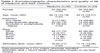
From the whole sample of 123 volunteers, most were female (n=68; 55.3%), White (n=89; 72.4%), and had a higher education (n=92; 74.8%). The mean age was 53.4 years (SD = 17.2), and the average global WHOQOL-Bref score was 74.4 (SD = 17.6). Table 1 provides demographic information for those mediums an`d their controls included in the main analysis.
| Mediums (n=54) | Controls (n=53) | |
|---|---|---|
| Female | 33 (62.26) | 26 (52.00) |
| n=53 | n=50 | |
| Age, mean (SD) | 59.15 (12.79) | 44.14 (18.57) |
| n=53 | n=50 | |
| Education | ||
| Any higher | 6 (11.32) | 14 (28.00) |
| Undergraduate degree | 20 (37.73) | 15 (30.00) |
| Graduate or postgraduate degree | 27 (50.94) | 21 (42.00) |
| n=53 | n=50 | |
| Race | ||
| White | 38 (71.70) | 40 (80.00) |
| Black | 2 (3.77) | 3 (6.00) |
| Brown | 10 (18.87) | 6 (12.00) |
| Asian | 1 (1.89) | 1 (2.00) |
| Other | 2 (3.77) | 0 (0.00) |
| n=53 | n=50 | |
| WHOQOL-Bref, mean (SD) | 76.65 (17) | 71.74 (19.08) |
| n=53 | n=46 |
Data presented as n (%), unless otherwise specified.
WHOQOL-Bref = World Health Organization Quality of Life Brief Version.
The mediums' group without paired controls (n=12) showed similar demographics. Most were female (56.3%, n=7), white (83.3%, n=10), and had a higher education (58.3%, n=7). The mean age within this subset was 65.92 years (SD = 8.64), and the average global WHOQOL-Bref score was 76.13 (SD = 15.26).
In response to the Mediumship Activity Questionnaire, 53 mediums provided insights into their experiences. Of these, 51 (92.7%) acknowledged speaking under the influence of spirits, 39 (70.9%) expressed themselves in writing under such influence (psychography), 29 (52.7%) reported seeing spirits, 28 (50.9%) experienced full trances, 26 (47.3%) reported out-of-body experiences, 23 (41.8%) auditory perceptions of spirits, 19 (34.5%) claimed healing abilities, seven (12.7%) reported physical effects, and four (7.3%) revealed painting activities.
Exome sequencing
Successful WES was achieved for 123 subjects, including 66 individuals designated as mediums and 57 controls. Four of these controls were later removed due to the low quality of the exome data obtained from their corresponding medium relatives. This left us with 119 subjects (66 mediums and 53 controls), divided into two groups: i) 54 mediums with their 53 first-degree relative controls; and ii) 12 mediums with no controls, who composed the validation sample described below.
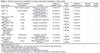
Coverage metrics showed that 60% of the exome had a minimum coverage of 10 × for the mediums and 58% for controls. From the paired samples, the median number of observed variants per subject was 487, with the majority being missense mutations (85.4%) resulting in amino acid alterations, followed by insertions/deletions (11.2%) that can disrupt reading frames, nonsense mutations (2.1%) causing premature stop codons, or variants located within splicing sites (1.2%). The predominant variants were transitions, specifically C>T or T>C mutations (Supplementary Figure S2). Close biological controls were paired to most mediums (54/66 mediums, 81.8%). Following the stringent criteria adopted here, including sequencing coverage depth, high allelic variant frequency in the subjects, low frequency in public databases, absence in biological relatives, and presence in multiple mediums, a total of 15,669 variants with the potential to impact the function of 7,269 genes were found in mediums but not in their control relatives (Supplementary Table S2, available as a spreadsheet file for download). Among these, 33 were altered in at least 33% of mediums (18 out of 54). These genes with more frequent mutations in mediums were often genes related to mucous protection of epithelial tissue and exhibited immune-related functionalities (see Table 2 for a list of genes presenting mutations in at least half of the mediums and Supplementary Table S3 for the comprehensive list of genes showing mutations in at least 33% of the mediums).
| Gene name | Tissue with highest expression┼ | Function | Mediums sample (n=54) | Twins╬ (n=2) | Validation sample§ (n=12) | Sensory system | Pineal gland|| |
|---|---|---|---|---|---|---|---|
| Mucin 19 | Minor salivary gland | Mucous protection of epithelial tissues | 47 (87.04) | 2 (100.00) | 11 (91.67) | - | X |
| Mucin 3a | Small intestine | Mucous protection of epithelial tissues | 36 (66.67) | 2 (100.00) | 11 (91.67) | - | - |
| Mucin 4 | Colon | Mucous protection of epithelial tissues | 35 (64.81) | 2 (100.00) | 8 (66.67) | - | - |
| MHC class II DR Beta 5 | Lung | Antigen presentation | 34 (62.96) | 2 (100.00) | 9 (75.00) | - | - |
| Zinc finger protein 717 | Thyroid | Transcriptional regulation | 31 (57.41) | 1 (50.00) | 8 (66.67) | - | - |
| MHC class II DQ Beta 1 | Lung | Antigen presentation | 31 (57.41) | 2 (100.00) | 8 (66.67) | - | - |
| MHC class II DR Beta 1 | Lung | Antigen presentation | 30 (55.56) | 2 (100.00) | 9 (75.00) | - | - |
| Transmembrane phosphatase with tensin homology | Testis | Signal transduction | 28 (51.85) | 2 (100.00) | 11 (91.67) | - | - |
| Notch receptor 4 | Adipocytes | Regulates cell fate determination | 27 (50.00) | 2 (100.00) | 5 (41.67) | - | - |
| Ephrin type-B receptor 6 | Brain cortex | Modulates cell adhesion and migration | 27 (50.00) | 2 (100.00) | 10 (83.33) | - | - |
| Fc gamma binding protein | Colon | Maintenance of mucosal structure | 27 (50.00) | 2 (100.00) | 11 (91.67) | - | - |
Data presented as n (%).
Gene name, tissue expression, and function are given as provided by genecards.org.
┼ According to RNA-Seq data from genecards.org.
╬ A pair of monozygotic twins presenting mediumship.
§ Twelve mediums without controls used for independent validation.
|| X indicates that the corresponding gene is on the gene set related to pineal gland function.
Validation cohort
This cohort comprised 12 unrelated mediums and was used to verify if the initially identified variants would be again identified in an independent group of mediums. Remarkably, the genes most frequently exhibiting mutations in paired mediums were also highly frequent in this validation cohort (Table 2 and Supplementary Table S3). A total of 1,574 variants (834 genes) found in the paired medium group could be confirmed in most mediums (11/12) of the validation cohort. This validation cohort also included one pair of mediums who are identical twins. Four hundred thirty-four mutations (354 in both mediums) were identified in 230 genes (167 in both mediums) within the twin pair and were absent in their non-medium relative (Supplementary Table S4, available as a spreadsheet file for download). Among the 33 genes exhibiting the highest frequency of mutations among paired mediums, 15 genes (45%) also carried variants in both twins and were absent in their non-medium sibling (Table 2 and Supplementary Table S3).
Mediumistic abilities and sensory system
The Fisher test revealed no association between any of the 7,269 mutated genes in mediums and specific mediumistic abilities (Supplementary Table S2, available as a spreadsheet file for download).
Gene pathways analysis indicated a total of 611 genes included in one or more of the functional categories related to the "Sensory System," as classified by KEGG34 (release 104.1, November 1, 2022). Among these, we observed 226 genes (37%) carrying 420 variants identified in 48 different subjects of the medium group. This functional cluster pathway includes four sub-categories, related to inflammatory processes, taste, olfaction, and phototransduction sensing. As seen in Table 3, the inflammatory pathway was the category with the highest percentage of altered genes (43.9%). At the same time, the largest sub-category (olfactory) was also the one with the higher number of mediums showing alterations. No significant associations were found when proportion tests assessed whether metabolic pathways were significantly represented among genes with variants (Supplementary Table S5, available as a spreadsheet file for download).
| Sub-category (KEGG pathway) | Genes in the sub-category, n | Altered genes, n (%) | Total variants found, n | Sample, n | p-value | Adjusted p-value |
|---|---|---|---|---|---|---|
| Inflammatory (HSA-04750) | 98 | 43 (43.9) | 66 | 39 | 0.91 | 1.00 |
| Taste (HSA-04742) | 86 | 33 (38.4) | 54 | 32 | 0.99 | 1.00 |
| Olfactory (HSA-04740) | 439 | 156 (35.5) | 304 | 47 | 1.00 | 1.00 |
| Phototransduction (HSA-04744) | 29 | 7 (24.1) | 13 | 9 | 1.00 | 1.00 |
Pathways, network, and gene ontology (GO)
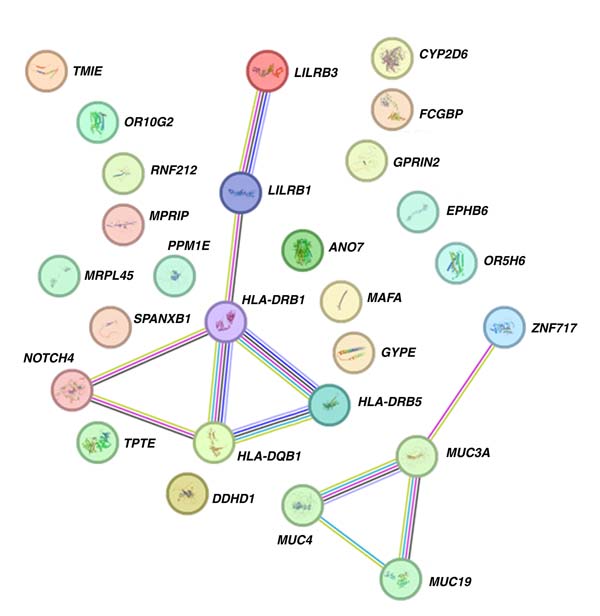
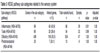
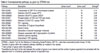
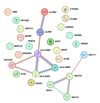
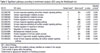
The STRING tool identified 12 overrepresented pathways within genes presenting mutations in at least one-third of mediums from our sample (Table 4). The pathway with the most significant strength is the translocation of zeta-chain associated protein kinase 70 kDa (ZAP-70) to immunological synapse (HSA-202430). Moreover, we also performed a network analysis (Figure 1), which revealed the presence of two distinct clusters. The first cluster comprises the genes leukocyte immunoglobulin like receptor B1 (LILRB1), leukocyte immunoglobulin like receptor B3 (LILRB3), human leukocyte antigen (HLA), class II, DR beta 1 (HLA-DRB1), HLA, class II, DR beta 5 (HLA-DRB5), HLA, class II, DQ beta 1 (HLA-DQB1), and Notch receptor 4 (NOTCH4). The second cluster is composed of the zinc finger protein 717 (ZNF717), mucin 4 (MUC4), mucin 3A (MUC3A), and mucin 19 (MUC19) genes. Enrichment analysis (GO) identified 12 distinct significant pathways, as outlined in Table 5.
| Pathway | Description | Genes found┼ | Gene count╬ | Strength§ |
|---|---|---|---|---|
| HSA-202430 | Translocation of ZAP-70 to immunological synapse | 3 | 16 | 2.14 |
| HSA-5083625 | Defective GALNT3 causes HFTC | 3 | 18 | 2.08 |
| HSA-5083636 | Defective GALNT12 causes CRCS1 | 3 | 18 | 2.08 |
| HSA-202427 | Phosphorylation of CD3 and TCR zeta chains | 3 | 19 | 2.06 |
| HSA-5083632 | Defective C1GALT1C1 causes TNPS | 3 | 19 | 2.06 |
| HSA-389948 | PD-1 signaling | 3 | 20 | 2.04 |
| HSA-977068 | Termination of O-glycan biosynthesis | 3 | 25 | 1.94 |
| HSA-5621480 | Dectin-2 family | 3 | 28 | 1.89 |
| HSA-202433 | Generation of second messenger molecules | 3 | 31 | 1.85 |
| HSA-3906995 | Diseases associated with O-glycosylation of proteins | 4 | 69 | 1.63 |
| HSA-877300 | Interferon gamma signaling | 3 | 90 | 1.39 |
| HSA-202424 | Downstream TCR signaling | 3 | 92 | 1.38 |
STRING = Search Tool for the Retrieval of Interacting Genes/Proteins; ZAP-70 = zeta-chain associated protein kinase 70 kDa.
┼ Number of genes within the metabolic pathway identified as mutated in the sample.
╬ Total number of genes within the pathway.
§ Quantified by the log10 of the ratio between the number of genes in our network and the number of genes expected to be annotated with the respective term in a randomly generated network of equivalent size.
| GO ID | GO name | Genes found┼ | Gene count╬ | p-value | Adjusted p-value§ |
|---|---|---|---|---|---|
| GO:0002768 | Immune response-regulating cell surface receptor signaling pathway | 6 | 304 | <0.001 | 0.006 |
| GO:0090345 | Cellular organohalogen metabolic process | 2 | 2 | <0.001 | 0.006 |
| GO:0090346 | Cellular organofluorine metabolic process | 2 | 2 | <0.001 | 0.006 |
| GO:0050778 | Positive regulation of immune response | 7 | 648 | <0.001 | 0.012 |
| GO:0002764 | Immune response-regulating signaling pathway | 6 | 446 | <0.001 | 0.018 |
| GO:0002429 | Immune response-activating cell surface receptor signaling pathway | 5 | 277 | <0.001 | 0.026 |
| GO:0048584 | Positive regulation of response to stimulus | 10 | 2.027 | 0.000 | 0.027 |
| GO:0050776 | Regulation of immune response | 7 | 837 | 0.000 | 0.031 |
| GO:0016098 | Monoterpenoid metabolic process | 2 | 6 | 0.000 | 0.031 |
| GO:0002684 | Positive regulation of immune system process | 7 | 894 | 0.000 | 0.041 |
| GO:0002223 | Stimulatory C-type lectin receptor signaling pathway | 3 | 56 | 0.000 | 0.045 |
| GO:0002220 | Innate immune response activating cell surface receptor signaling pathway | 3 | 58 | 0.000 | 0.046 |
DISCUSSION
This study marks the inaugural endeavor to assess the genome of individuals with mediumistic spiritual experiences. Notably, we meticulously chose mediums from across the Brazil who were recognized by their peers as manifesting outstanding levels of mediumistic phenomena. The control group was composed of first-degree relatives of these mediums who did not claim mediumship themselves but had a shared context, ancestry, and religious background with the mediums, enabling us to control our findings for sociocultural and biological confounders. In a previous paper, we failed to find any relationship between this sample of mediums and psychoses or any other mental disorder, as mediums exhibited levels of social adjustment and quality of life similar to those of their control subjects.12 In the present study, we investigated whether mediumship could be related to inherent genetic alterations, suggesting mediums might process information differently from controls.
After incorporating stringent criteria to consider valid genomic variants, our analyses led to identification of 7,269 genes found to be altered in mediums but not in their controls. These gene variations potentially exert a moderate or high impact on the functionality of their respective encoded proteins. Within this set, 33 genes were mutated in at least one-third of the mediums, while their control relatives did not show such alterations. Notably, genes associated with the mucous protection of epithelial cells and antigen presentation topped this list.
The mucin 19 gene (MUC19) particularly stood out, being the most prevalent in both the sample of mediums (87.04%) and the validation sample (91.67%). Furthermore, MUC19 was identified in both twins and ranks among the genes with highest expression in the pineal gland, which is intriguing, considering the longstanding hypothesis that this gland serves as the epicenter for spiritual experiences.35,36
Our analysis of overrepresented pathways revealed that the translocation of ZAP-70 to the immunological synapse exhibited the highest strength. ZAP-70 plays a crucial role in T-cell antigen receptor stimulation. Moreover, enrichment analysis further delineated 12 significantly distinct pathways, most of which are associated with immune-system functions. In the first cluster identified in network analysis, both LILRB1 and LILRB3 are representatives of genes within the leukocyte immunoglobulin-like receptor (LIR) family. Predominantly expressed in immune cells, these receptors interact with major histocompatibility complex (MHC) class I molecules on antigen-presenting cells, thereby negatively regulating immune cell activation. Their putative role involves modulating inflammatory responses and cytotoxicity, contributing to the precise regulation of the immune response and the limitation of autoreactivity.37
HLA-DRB1, HLA-DRB5, and HLA-DQB1 belong to the MHC, HLA, class II beta chain paralogs. MHC class II molecules play a crucial role in the immune system by presenting peptides derived from extracellular proteins.38 Notably, MHC genes exhibit high polymorphism due to their functionality, which determines peptide binding specificities. The NOTCH4 gene encodes a member of the type I transmembrane protein family. Notch signaling represents an evolutionarily conserved intercellular pathway that regulates interactions between physically adjacent cells by binding Notch family receptors to their respective ligands.
Alterations in immune cells might play a crucial role in mediating information transfer from the external to the internal environment. It is tempting to speculate that such signals might be transmitted through inflammatory responses and cytotoxicity, like the immune response. In essence, immune cells may act as intermediaries, influencing how the body perceives and responds to stimuli from its surroundings and internal state. This complex interplay highlights the intricate relationship between the immune system and sensory perception, shedding light on the potential mechanisms underlying our perception of the world around us and our internal physiological conditions. Also, we may be on the brink of discovering novel functions for these genes, spurred by the recognition of our incomplete comprehension regarding the actions of each known gene.
In the second identified cluster, the ZNF717 gene encodes a Krüppel-associated box (KRAB) zinc-finger protein, which belongs to an extensive group of transcriptional regulators in mammals. The MUC4, MUC3A, and MUC19 genes encode mucins, which serve as the primary components of mucus. Mucins are pivotal in protecting epithelial cells and have been implicated in epithelial renewal and differentiation processes. Concerning these mutations, we are even more likely on the verge of uncovering new functions for these genes. Interestingly, it is worth noting that the epithelium and the central nervous system share a common origin from the embryonic ectoderm.
The fundamental role of some of the genes found here is controversial. This is especially true for the FLAGS genes, including HLA, olfactory receptor genes, and mucins.39HLA and MUC genes are frequently identified in studies that investigate mutations related to diseases as diverse as autism,40 congenital heart disease,41 and pulmonary arterial hypertension.42 These genes were excluded in all the studies mentioned above due to their hypervariability. However, the claim that genes like MUC and HLA are always found mutated in genomic analyses is not entirely accurate. Whereas these genes do appear relatively frequently in mutation lists, the reasons for their apparent prevalence depend on several factors, such as sequencing depth, filtering thresholds, and mutation hotspots. Finding them mutated is not a universal truth, and their significance depends on the specific context of each study and the technical considerations involved. Other authors argue that, despite their frequent identification in many diseases, these genes, including HLA and mucins, may be involved in diseases as passenger mutations that are relevant for some patient groups.43 Finally, as the mutated genes in mediums were not associated with specific mediumistic abilities, it is conceivable that those genes could be related to mediumistic experience in general, but not with any particular modality of mediumship.
An important issue to highlight is that the genes with more frequent mutations in mediums are not specifically associated with mental or physical disorders. This non-specificity aligns with the understanding that spiritual well-being is strongly interconnected with overall health, encompassing physical, mental, and social dimensions.44,45 Higher levels of self-transcendent spirituality appear to be robust indicators of an individual's enhanced ability to regulate health holistically, facilitated by well-integrated brain connectivity and dynamic gene expression that adapts to changing conditions. Consequently, gifted mediums, who exhibit better average health and unique genetic variants related to inflammation, immune response, and adaptation, contrast with the pervasive markers of low self-awareness prevalent in poorly regulated populations under current global conditions.
In sum, it is noteworthy that the mutated genes identified herein are intricately associated with metabolic pathways relevant to interactions with the external environment, specifically involving the epithelial and immune systems. This observation prompts the intriguing hypothesis that individuals carrying these mutations may possess an inherent biological predisposition that influences their processing of information from the outside world in a manner distinct from those lacking such genetic variations. Analogous to certain animals that exhibit extraordinary senses beyond human capabilities,46 it is conceivable that these individuals may have evolved to perceive the environment uniquely.
This might be attributed to the hypothesis that their sensory system is a "filter" with more prominent "pores" or a less restrictive "valve," enabling them to perceive aspects of reality that most individuals do not. Seminal authors such as James,47 Schiller,48 and Huxley49 have proposed that the brain would act as a filter or a "reducing valve" of the larger reality to select perceptions needed for survival.50,51 Supporting this hypothesis, a recent experiment found that repetitive transcranial magnetic stimulation (rTMS) inhibiting the activity of the left medial middle frontal lobe induced higher psi ("paranormal") skills.52 An alternative hypothesis is that the mutated genes may harbor functions beyond the scope recognized in previous studies.
To our knowledge, this was the first study to perform a large exome-wide investigation of genes potentially related to mediumistic experiences. We identified 33 genes significantly expressed in at least one-third of unrelated mediums from our sample but not in their first-degree relatives. These genes emerge as possible candidates for further investigation of the biological underpinnings that allow spiritual experiences such as mediumship to occur. Replication studies are warranted and necessary before any conclusion can be drawn.
SUPPLEMENTARY MATERIALS
Supplementary Material
Supplementary Table S1
Supplementary Table S2
Supplementary Table S4
Supplementary Table S5
ACKNOWLEDGEMENTS
We thank Fundação de Amparo à Pesquisa do Estado de São Paulo (FAPESP) (grant 2014/50873-3) and Conselho Nacional de Desenvolvimento Científico e Tecnológico (CNPq) (grant 46542/2014-9) for supporting this study.
We thank all the mediums and their relatives who consented to participate in the study and our collaborators who assisted in recruiting participants across Brazil: Ana Catarina Tavares Loureiro, Arismar Leon, Bruno Paz Mosqueiro, Darcy Neves Moreira Ferreira, Fábio Araújo, Jader dos Reis Sampaio, Jorge Daher Jr., Leonardo Machado Tavares, Marco Aurélio Vinhosa Bastos Jr., Marcos de Noronha, Marcus Welby Borges Oliveira, and Sergio Thiesen. We thank Emmanuel Dias-Neto for assistance with exome analysis and interpretation.
 PDF
 Print
 Send this article by email
 How to cite this article
 Submit a comment
 Mendeley
 Pocket
 Share on Facebook
 Share on Twitter