



ABSTRACT:
OBJECTIVE: Major depressive disorder is heterogeneous. While transcranial direct current stimulation
(tDCS) is an effective treatment, its impact on symptoms remains underexplored. This
ancillary study investigated the effects of home-use tDCS on depression symptom clusters.
METHODS: Data were used from the Portable Transcranial Electrical Stimulation and Internet-Based
Behavioral Therapy for Major Depression Study (PSYLECT) study, in which 210 depressed
patients were randomized to active (n=137) or sham tDCS (n=73) for 6 weeks. Items
from the Hamilton Depression Rating Scale were grouped into symptom clusters using
hierarchical clustering. Treatment effects were analyzed with mixed regressions. An
alternative clustering solution was also evaluated using a larger sample.
RESULTS: Four clusters were identified: emotional, sleep, psychomotor, and psychosomatic symptoms.
None showed significant group differences (sleep: p = 0.058, Cohen's d = 0.36, emotional:
p = 0.976, d = -0.01, psychosomatic: p = 0.157, d = 0.27, psychomotor: p = 0.944,
d = 0.01). The alternative clustering solution produced a similar sleep cluster, where
tDCS led to significant reductions (p = 0.033, d = 0.41), but no differences were
observed in other clusters (emotional: p = 0.707, d = 0.07, atypical: p = 0.537, d
= 0.12).
CONCLUSION: The association between tDCS and sleep improvement warrants further study. tDCS may
be more effective for specific symptom clusters.
Keywords: depression; non-invasive brain stimulation; hierarchical clustering; machine learning; personalized treatments.
FIGURES
| Note: How to cite this article: Luethi MS, Borrione L, Cavendish BA, Aparicio LVM, Goerigk S, Ramos MRF, et al. Effects of home-use transcranial direct current stimulation on clusters of depressive symptoms: an ancillary analysis of the PSYLECT study. Braz J Psychiatry. 2025;47:e20243972. http://doi.org/10.47626/1516-4446-2024-3972 |
| Received: October 15 2024; Accepted: January 8 2025 |
INTRODUCTION
Major depressive disorder is a highly prevalent and debilitating condition.1,2 First-line treatment includes antidepressant medication, which is associated with modest efficacy and adverse effects,3,4 and psychotherapy,5 which is costly and time-consuming. Transcranial direct current stimulation (tDCS), a non-invasive brain stimulation technique, is a treatment option with few side effects and has been shown to be effective in treating depression when administered by trained personnel.6,7
Technological advances have made portable tDCS devices available for unsupervised home use, overcoming the logistical burdens associated with application in clinical facilities. The Portable Transcranial Electrical Stimulation and Internet-Based Behavioral Therapy for Major Depression Study (PSYLECT) was an adequately powered, randomized clinical trial that examined the efficacy of unsupervised, home-use tDCS for the treatment of a major depressive episode for 6 weeks in adults.8 This study found no treatment effects on overall scale scores when comparing active and sham tDCS.
However, relying on overall symptom severity scores could obscure the considerable heterogeneity of depression symptoms.9,10 An analysis of symptom groups would provide a more nuanced understanding of patients' clinical presentations and would align with the objectives of precision medicine to tailor treatment to individual patients based on their unique clinical profile.11,12 A previous study found that, for depression, tDCS was specifically effective in reducing insomnia, while escitalopram was most effective in reducing anxiety symptoms, highlighting the variability of treatment efficacy based on specific features of the disorder.13
In this exploratory study, we used hierarchical clustering, an unsupervised machine learning technique, to identify depressive symptom clusters and determine whether tDCS efficacy was associated with specific clusters.
METHODS
Overview
The PSYLECT study was a placebo-controlled, double-blinded, randomized clinical trial that investigated the efficacy of unsupervised, home-use tDCS, combined or not with a self-guided, psychological digital intervention (DI), for the treatment of a major depressive episode.8 A total of 210 adult depressed patients were allocated to three groups: active tDCS and active DI, active tDCS and sham DI, and sham tDCS and sham DI. The primary outcome was Hamilton Depression Rating Scale, 17-item version (HDRS-17) scores.14 Participants in all three groups showed improvements in depressive symptoms, but no differences were found between groups; thus there was no evidence of a treatment effect for tDCS.
For the present ancillary analysis, we examined the effects of tDCS on a more granular level of depressive symptom clusters. To this end, we combined the active tDCS groups with or without DI into a single active tDCS group (n=137) and compared it to sham tDCS (n=73).
Patients
The patients were 18 to 59 years old and had been diagnosed with major depressive disorder according to DSM-5 criteria.15 All patients had an HDRS-17 score of = 17 at baseline, indicating a moderate to severe depressive episode. Antidepressant medications were allowed, but participants had to have been on a stable dose for at least 6 weeks prior to study enrollment and had to have remained stable throughout the study. Benzodiazepines were tolerated up to a maximum of 10 mg diazepam per day (or equivalent).
Interventions
Portable tDCS devices (Flow Neuroscience, Malmo, Sweden) were used to deliver electric stimulation through a left anode and a right cathode, placed approximately over the F3 and F4 locations according to the 10-20 electroencephalography system. The patients received 21 home-use tDCS sessions over 6 weeks, five times per week in the first 3 weeks, then twice a week for the remaining 3 weeks.
A smartphone app instructed participants about the correct placement of the tDCS device and initiated and ended the stimulation sessions. During the sessions, the smartphone app directed the patients either to interact with text and video content based on behavioral therapy principles (active DI) or to freely browse the Internet (sham DI).
Assessments
At baseline, sociodemographic, clinical, treatment-related information were collected and depression and anxiety rating scales were applied. Depressive symptoms were evaluated using HDRS-17 and the Montgomery-Åsberg Depression Rating Scale16 at baseline and after 2, 3, 4, and 6 weeks of treatment onset.
Statistical analyses
The analyses were conducted in R 4.4.0.17 In the first step, agglomerative hierarchical clustering was used to find data-driven depressive symptom subgroups based on individual HDRS-17 items. This is a bottom-up method that merges scale items successively based on the similarity of their values, providing a deterministic clustering solution without a priori assumptions about the number of clusters. Missing item values were imputed with a random forest algorithm from the R package missForest.18 As in previous symptom clustering studies,13,19 the items "insight" (item 17), "loss of appetite" (item 12), and "loss of weight" (item 16) were rated absent for most patients and were excluded from the analysis. For the remaining 14 items, all time points were used to perform hierarchical clustering with the R package stats. Item similarity was computed using Euclidean distance, and items were clustered according to the Ward.D2 algorithm, which minimizes the sum of the squared distances within clusters during merging. Cluster number and formation were determined with an automated hybrid approach based on the dendrogram and the item dissimilarity matrix in the R package Dynamic Tree Cut.20 A sensitivity analysis was performed with k-means clustering. Item selection, configurations of hierarchical clustering, and cluster formation were analogous to studies by Chekroud et al.19 and Goerigk et al.13 Further exploratory analyses were conducted using the symptom clustering solution obtained by Chekroud et al.,19 which was based on data from the Sequenced Treatment Alternatives to Relieve Depression (STAR*D) trial, which had a sample size of 4,017.
In the second step, we determined whether there were treatment effects on the symptom cluster level, comparing active tDCS (with and without DI) to sham tDCS (with sham DI). The sum of the cluster items was calculated for every cluster at every time point. Each cluster sum score served as the outcome in a separate linear mixed model. Group, time, and their interaction were included as fixed effects, and participants as random effects. The group and time interactions were tested for treatment effects. Degrees of freedom were estimated with Satterthwaite approximation, and p-values < 0.05 were considered significant. Effect sizes were calculated for the differences in time slopes using Cohen's d and were scaled by a factor of 6 to approximate the study duration.
Ethics statement
This study was approved by national ethics committees and was registered in ClinicalTrials.gov (NCT04889976). It was conducted between April 2021 and October 2022, with all participants providing written informed consent.
RESULTS
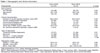
Patient information is summarized in Table 1.
| Active tDCS | Sham tDCS | ||
|---|---|---|---|
| Characteristic | (n=137) | (n=73) | p-value |
| Demographics | |||
| Sex (female) | 122 (89) | 58 (79) | 0.09 |
| Age (years) | 38.7±9.6 | 39.2±8.8 | 0.93 |
| White | 102 (74) | 50 (68) | 0.45 |
| Clinical characteristics | |||
| Duration of current episode (months), mean (SD) | 29.6±50.8 | 25.0±22.9 | 0.28 |
| Current antidepressant medication | 87 (64) | 51 (70) | 0.44 |
| Current benzodiazepine use | 29 (21) | 14 (19) | 0.87 |
| Concurrent psychotherapy | 50 (36) | 37 (51) | 0.07 |
| Onset age of MDD (years), mean (SD) | 24.4±9.5 | 25.6±8.3 | 0.66 |
| No. previous depressive episodes, median (IQR) | 3 (2-5) | 3 (2-5) | 0.56 |
| Type of depression | |||
| Treatment-resistant depression | 37 (27) | 21 (29) | 0.91 |
| Recurrent | 113 (82) | 66 (90) | 0.18 |
| Chronic (> 2 years episode) | 49 (36) | 32 (44) | 0.32 |
| Comorbid anxiety disorders | 99 (72) | 53 (73) | > 0.99 |
| Depression scales | |||
| HDRS-17, mean (SD) | 20.9±3.4 | 20.8±3.3 | 0.89 |
| MADRS, mean (SD) | 30.1±5.9 | 29.9±5.7 | 0.92 |
| BDI-II, mean (SD) | 36.3±8.1 | 36.1±8.8 (n=72) | 0.95 |
Data presented as n (%), unless otherwise specified.
BDI-II = Beck Depression Inventory II; HDRS-17 = Hamilton Depression Rating Scale, 17-item version; IQR = interquartile range; MADRS = Montgomery-Åsberg Depression Rating Scale; MDD = major depressive disorder; tDCS = transcranial direct current stimulation.
Symptom clustering
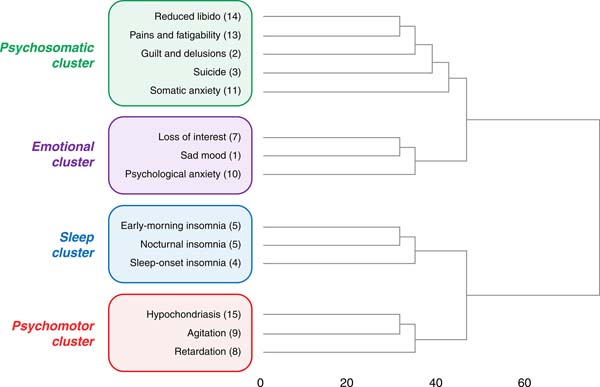
Hierarchical symptom clustering based on HDRS-17 items resulted in four distinct clusters, which were interpreted as: 1) emotional, 2) psychosomatic, 3) sleep, and 4) psychomotor symptom groups (Figure 1). Clustering with k-means confirmed this solution (Supplementary Table S1).
Treatment effects
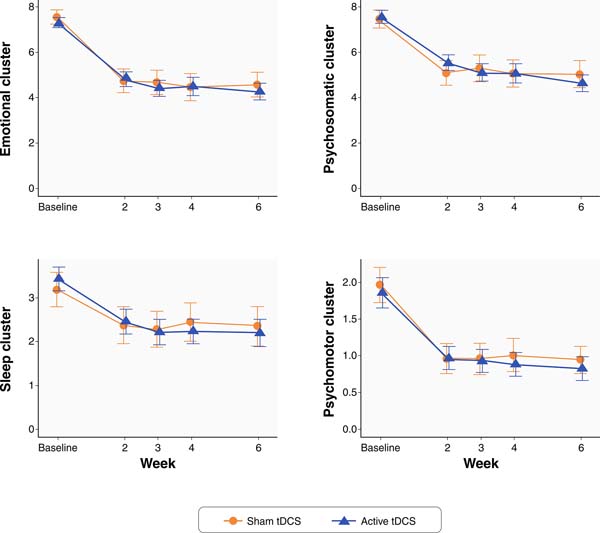
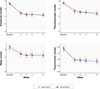
No significant differences were found in the 1) emotional, 2) psychosomatic, 3) sleep, and 4) psychomotor cluster scores between active and sham tDCS (Table 2, Figure 2, Supplementary Table S2).
| Active vs. sham tDCS | Estimate | SE | t | DF | p-value | Cohen's d |
|---|---|---|---|---|---|---|
| Cluster solution based on study dataset | ||||||
| Emotional cluster (1) | 0.00 | 0.16 | 0.03 | 838 | 0.976 | -0.01 (-0.37 to 0.38) |
| Psychosomatic cluster (2) | -0.23 | 0.16 | -1.42 | 838 | 0.157 | 0.27 (-0.1 to 0.64) |
| Sleep cluster (3) | -0.23 | 0.12 | -1.90 | 838 | 0.058 | 0.36 (-0.01 to 0.73) |
| Psychomotor cluster (4) | -0.01 | 0.08 | -0.07 | 838 | 0.944 | 0.01 (-0.36 to 0.39) |
| Cluster solution based on STAR*D dataset | ||||||
| Core emotional | -0.09 | 0.23 | -0.38 | 838 | 0.707 | 0.07 (-0.3 to 0.44) |
| Atypical | -0.07 | 0.11 | -0.62 | 838 | 0.537 | 0.12 (-0.26 to 0.49) |
| Sleep (insomnia) | -0.31 | 0.14 | -2.13 | 838 | 0.033* | 0.41 (0.03 to 0.78) |
Described statistics are based on the interaction of time and group.
Cohen's d = effect size with 95%CI; DF = degrees of freedom; STAR*D = Sequenced Treatment Alternatives to Relieve Depression; SE = standard error; tDCS = transcranial direct current stimulation.
* Significant value.
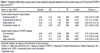
When applying the three-cluster solution reported for the STAR*D sample,19 a significant treatment effect was found for the sleep cluster, with larger improvements observed in the active tDCS group than the sham tDCS group. The sleep cluster differed slightly from our solution, with the addition of the item "pains and fatigability" to the three "insomnia" items. No significant group differences were found for the other two clusters - core emotional and atypical (Table 2, Supplementary Table S3, Supplementary Figure S1).
DISCUSSION
This ancillary study explored the treatment effects of unsupervised, home-use tDCS for a major depressive episode in adults on a symptom cluster level. No group differences were observed for the emotional, psychosomatic and psychomotor clusters. Moreover, when hierarchical clustering was based on the present dataset, there were no group differences in the sleep cluster. However, significantly larger improvements were found in the sleep cluster for active tDCS than sham tDCS when the cluster solution from the larger STAR*D sample was used. There were no significant differences between groups in the other STAR*D clusters.
Four symptom clusters were identified through hierarchical clustering. The emotional cluster captures core symptoms of depression, related to sadness/loss of interest and psychological anxiety, which includes excessive worry. The psychosomatic cluster encompasses somatic symptoms related to pain, fatigability, reduced libido and somatic anxiety, as well as feelings of guilt and suicide-related symptoms. Mental pain, such as guilt,21 has been shown to predict suicidal ideation,22 highlighting the associations between symptoms in the psychosomatic cluster. The sleep cluster combines the three insomnia-related items of HDRS-17. The psychomotor cluster includes psychomotor slowing, agitation, and hypochondriasis.
Other studies that used hierarchical clustering on HDRS-17 items reported 3-4 clusters.13,19,23 All of these studies identified a cluster of depressive core symptoms and another cluster related to sleep and insomnia. Goerigk et al.13 documented two further clusters, called atypical and guilt/anxiety. The atypical cluster was similar to the psychomotor cluster of the current study, but also included the suicide item. The guilt/anxiety cluster was somewhat similar to our psychosomatic cluster, but included psychological anxiety, while it also contained the suicide item from the present study. The two other studies found only three clusters; thus, all items that were not part of the depressive core and sleep clusters were grouped in a third cluster called atypical19 or somatic/anxious.23
When analyzing data from 4,017 patients of the STAR*D trial, the largest sample used for a hierarchical clustering analysis of HDRS-17 items, the item "pains and fatigability" was included in the sleep cluster.19 When applied to the current study, a significant treatment effect was found for tDCS on the sleep cluster. However, in our cluster solution, tDCS had no significant effect on sleep, with the p-values differing by only 2.5%. In both analyses, the effect size of active tDCS relative to sham tDCS was small for sleep symptom reduction. It is plausible that this effect size would be larger in studies that found a significant overall antidepressant effect for tDCS. Only one study13 has examined the effects of tDCS on depressive symptom clusters. Based on a trial24 in which tDCS significantly reduced overall depressive symptoms compared to placebo, that study reported the strongest tDCS effect on sleep symptoms, with a large effect size. The finding that tDCS is most effective at reducing insomnia was partly corroborated by the present study.
A study that used dedicated sleep questionnaires concluded that sleep duration and quality were improved after tDCS treatment in depressed patients with insomnia.25 Similarly, another study reported that tDCS positively affected sleep quality in bipolar patients.26 However, a study that specifically targeted insomnia patients found no evidence that tDCS changed sleep continuity or sleep architecture.27 Additionally, tDCS was found to provide pain relief but no changes in sleep quality for diabetes patients.28 While the effects of non-invasive brain stimulation on sleep disturbances in mood disorders have been encouraging, findings in other patient groups have been inconsistent.29 A mechanistic study suggests that tDCS activates specific sleep-promoting brain pathways inhibited by stress, leading the authors to conclude that it is effective against stress-induced sleep disruption.30
The fact that this study was an exploratory analysis with no correction for multiple comparisons was a limitation. Participants were depressed for more than 2 years on average and were allowed to continue with antidepressant treatments. These factors, together with the aforementioned obstacles of home tDCS use, could have hampered treatment efficacy. However, the non-significant findings in this exploratory study are in line with the original study, where no treatment effects were found on the primary outcome (HDRS-17 scores) or any secondary outcome.8
In conclusion, this ancillary study suggests that tDCS may improve sleep-related symptoms in individuals experiencing a major depressive episode. The sleep cluster showed a partial effect, favoring active tDCS over sham treatment. This aligns with previous research suggesting that tDCS may be particularly effective in targeting insomnia and other sleep disturbances associated with depression. Given the exploratory nature of this analysis and the aforementioned limitations, further research is needed to more definitively assess the impact of tDCS on sleep. Dedicated sleep assessments and controlled environments for tDCS application could enhance our understanding of its potential benefits on sleep in depression.
SUPPLEMENTARY MATERIALS
ACKNOWLEDGEMENTS
The original study was supported by Fundação de Amparo à Pesquisa do Estado de São Paulo (FAPESP; grant 2019/06009-6). Flow Neuroscience donated a small sum that was used solely for paying clinical and research staff directly involved in the trial. MSL is supported by FAPESP (grant 2021/10574-0). FF is funded by the National Institutes of Health (RO1 grant 1R01HD082302-01A1).
 PDF
 Print
 Send this article by email
 How to cite this article
 Submit a comment
 Mendeley
 Pocket
 Share on Facebook
 Share on Twitter



