The use of structured and semi-structured diagnostic instruments allows objective assessment of DSM categories by professionals involved in child and adolescent mental health evaluation, which has been essential to the advancement of clinical and epidemiological research in the field. Over the years, several semi-structured diagnostic instruments have been developed and tested for reliability and validity, such as the Diagnostic Interview for Children and Adolescents (DICA)
1; the Development and Well-Being Assessment (DAWBA)
2; and the Schedule for Affective Disorders and Schizophrenia for Schoolage Children (K-SADS).
3The K-SADS is among the most widely used instruments in child and adolescent psychiatry. The first version was the K-SADS present state (K-SADS-P), developed by J. Puig-Antich and W. Chambers in 1978. Updates and adaptations were published in the following decades: the K-SADS-P IIIR in accordance to DSM-IIIR criteria, as well as the K-SADS epidemiologic (K-SADS-E), which collects lifetime diagnoses for epidemiologic purposes. After publication of the DSM-IV in 1994, Kaufman, Birmaher, Brent, Rao, and Ryan introduced the K-SADS present and lifetime version (K-SADS-PL), which was the most comprehensive version developed to date.
3 The K-SADS-E and K-SADS-PL have been translated into Brazilian Portuguese, and have been used extensively by researchers and clinicians ever since.
4,5In 2013, the American Psychiatry Association launched the fifth edition of the DSM, with relevant changes to the psychiatric classification of disorders affecting children and adolescents.
6,7 Soon after, a revised version of the instrument (K-SADS-PL-DSM-5) was developed to keep the instrument up to date with the new classification system. However, this instrument has not yet been translated into Brazilian Portuguese, hindering the advancement of child and adolescent psychiatry research in the country. On that account, we endeavored to translate the revised K-SADS-PL-DSM-5 from English into Brazilian Portuguese.
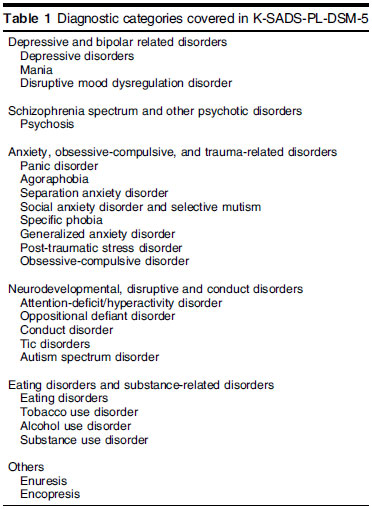
In this letter, we describe the careful process of translation of the latest version of the K-SADS-PL, now updated according to current DSM-5 criteria (K-SADS-PL-DSM-5), for use in Brazil. We invited specialists in each diagnostic area covered by the instrument (Table 1) to translate the respective section. The entire text was then revised by two child and adolescent psychiatrists (TBR and CK) and standardized by an independent professional (RK, a pediatrician and child neurologist with a background in linguistics). Subsequently, the translators of each area approved the final version of the document.
We regard this as a much-needed and relevant accomplishment, which should be followed by validation of this translated version. Scientific research is asymmetrically scarce in low- and middle-income countries,
8 where the health demands of children and adolescents are mostly unmet.
9 While many factors operate in this equation, we believe that the availability of up-to-date translated and validated versions of psychometric instruments used worldwide is an important step towards equality of means.
DISCLOSURECK has received support from Brazilian governmental research funding agencies Conselho Nacional de Desenvolvimento Científico e Tecnológico (CNPq), Coordenaçao de Aperfeiçoamento de Pessoal de Nível Superior (CAPES), and Fundaçao de Amparo à Pesquisa do Estado do Rio Grande do Sul (FAPERGS); and has received authorship royalties from Brazilian publishers Artmed and Manole. LAR has served on the speakers' bureaus and/or acted as a consultant for Eli Lilly, Janssen-Cilag, Medice, Novartis, and Shire; has received authorship royalties from Oxford University Press and ArtMed; and has received travel grants from Shire to attend the 2015 World Federation of ADHD Annual Meeting and from Novartis to attend the 2016 American Academy of Child and Adolescent Psychiatry Annual Meeting; the ADHD and Pediatric Bipolar Disorder Outpatient Programs chaired by him has received unrestricted educational and research support from Eli Lilly, Janssen-Cilag, Novartis, and Shire. The other authors report no conflicts of interest.
REFERENCES1 Reich W. Diagnostic interview for children and adolescents (DICA). J Am Acad Child Adolesc Psychiatry. 2000;39:59-66.
2 Goodman R, Ford T, Richards H, Gatward R, Meltzer H. The development and well-being assessment: description and initial validation of an integrated assessment of child and adolescent psychopathology. J Child Psychol Psychiatry. 2000;41:645-55.
3 Ambrosini PJ. Historical development and present status of the schedule for affective disorders and schizophrenia for school-age children (K-SADS). J Am Acad Child Adolesc Psychiatry. 2000;39:49-58.
4 Mercadante MT, Asbarh F, Rosário MC, Ayres AM, Ferrari MC, Assumpçao FB, et al. K-SADS, entrevista semi-estruturada para diagnóstico em psiquiatria da infância, versao epidemiológica. Sao Paulo: PROTOC - Hospital das Clínicas da FMUSP; 1995.
5 Brasil HHA. Development of the Brazilian version of K-SADS-PL (Schedule for Affective Disorders and Schizophrenia for School Aged Children Present and Lifetime Version) and study of psychometric properties [dissertation]. Sao Paulo: Universidade Federal de Sao Paulo; 2013.
6 American Psychiatric Association. Diagnostic and Statistical Manual of Mental Disorders, Fifth Edition (DSM-5). Arlington: American Psychiatric Publishing; 2013.
7 Machado JD, Caye A, Frick PJ, Rohde LA. DSM-5. Major changes for child and adolescent disorders [Internet]. In: Rey JM, editor. IACAPAP e-textbook of child and adolescent mental health. Geneva: International Association for Child and Adolescent Psychiatry and Allied Professions; 2013. [cited 2016 Dec 21].
http://iacapap.org/wp-content/uploads/A.9-DSM-5-2013.pdf8 Nature. Country outputs [Internet]. Nature Index. 2016 Jun 1 [cited 2016 Dec 21].
www.natureindex.com/country-outputs9 Kieling C, Baker-Henningham H, Belfer M, Conti G, Ertem I, Omigbodun O, et al. Child and adolescent mental health worldwide: evidence for action. Lancet. 2011;378:1515-25.





 © 2026 All rights reserved


 PDF
 Print
 Send this article by email
 How to cite this article
 Submit a comment
 Mendeley
 Pocket
 Share on Facebook
 Share on Twitter